
Research basics · 3 min read
In vitro, in vivo and clinical research: what each can show
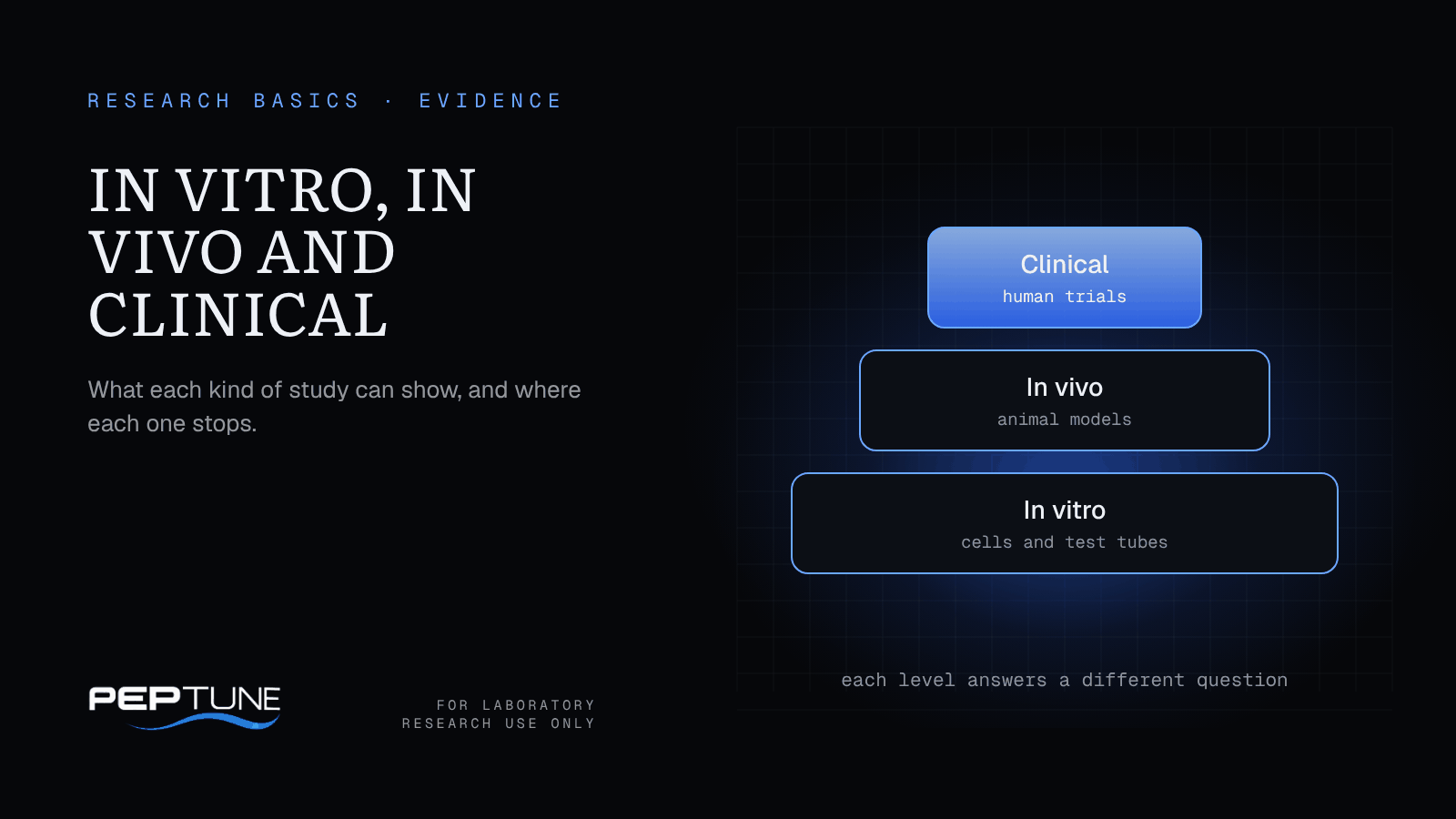
Peptide research is published at very different levels, from a reaction in a test tube to a trial in hundreds of people. The terms in vitro, in vivo and clinical describe those levels. Knowing which one a result comes from is the single most useful thing when reading a claim, because each kind of study answers a different question.
In vitro: outside a living organism
In vitro means "in glass". The work happens outside a living organism: in a tube, a well plate or a dish of cultured cells. Typical in vitro experiments measure whether a peptide binds a receptor, how it affects an enzyme, or how cultured cells respond to it.
The strength of in vitro work is control. Researchers can change one variable at a time, run many conditions side by side and repeat experiments quickly. The limitation is the same simplicity. A dish of cells has no blood supply, no liver, no immune system and none of the interactions between organs. A result in vitro shows what can happen in that model, not what will happen in a whole organism.
In vivo: inside a living organism
In vivo means "within the living". In early research, that usually means an animal model. In vivo studies show how a molecule behaves when absorption, distribution, breakdown and clearance all come into play, and they can reveal effects that no isolated assay would show.
They have limits too. Species differ in their receptors, their metabolism and their physiology, so a result in a mouse or a rat does not automatically carry over to other species, people included. Study design matters as much as in any other research: group size, controls, blinding and how outcomes were measured.
Clinical research: studies in people
Clinical research studies human participants. Trials are usually described in phases, from small early studies to large ones comparing groups over time. Only well-designed human studies can say anything about outcomes in people.
Even so, a human study is not automatically conclusive. Its size, its comparison group, how long it ran, which outcomes it measured, its risk of bias and whether it has been repeated all affect how far the result can be trusted. A trial may also apply only to the population and conditions it studied.
A chain of questions, not a ladder
It is tempting to see these levels as a ladder, where a good result at one rung leads to the next. In practice, many promising in vitro results do not show the same effect in animals, and many animal results do not carry over to people. Each level answers its own question:
- In vitro: is this interaction or response possible in a controlled model?
- In vivo: does something similar happen in a whole organism of that species?
- Clinical: what happens in people, under these conditions?
A positive result at one level is a reason for further work, not a conclusion about the next.
Describing results honestly
Wording matters. "Bound the receptor in a cell assay", "showed a signal in a rodent model" and "improved an outcome in a controlled human trial" are three very different statements. A careful description names the model, the outcome measured and the main limitation, so a reader can see both what was learned and what is still unknown.
Peptune's compound articles follow that rule: they describe what has been examined and in which model, and they do not turn laboratory or animal findings into claims about people. For a fuller checklist, see how to evaluate peptide studies.
Common questions
Is in vitro research less valuable?
No. It is the best tool for studying mechanisms and screening ideas under control. Its conclusions are simply limited to the model that was tested.
Are all human studies equally strong?
No. Design, size, comparison group, outcomes, bias and replication all affect how much confidence a result deserves.
Sources
- ClinicalTrials.gov, a public registry of clinical studies
- Fosgerau K., Hoffmann T. Peptide therapeutics: current status and future directions. Drug Discovery Today, 2015
Materials for in vitro work
Peptune supplies research peptides for laboratory and in vitro work, with certificates of analysis published on each product page as they arrive. Browse single vials, blends or the full catalogue.
For laboratory research use only. Nothing in this article is medical advice or a suggestion to use any compound on people or animals.
For laboratory research use only. Not for human or veterinary use. Nothing here is medical advice.