
Research basics · 4 min read
From GLP-1 to triple agonists: how incretin peptide research evolved
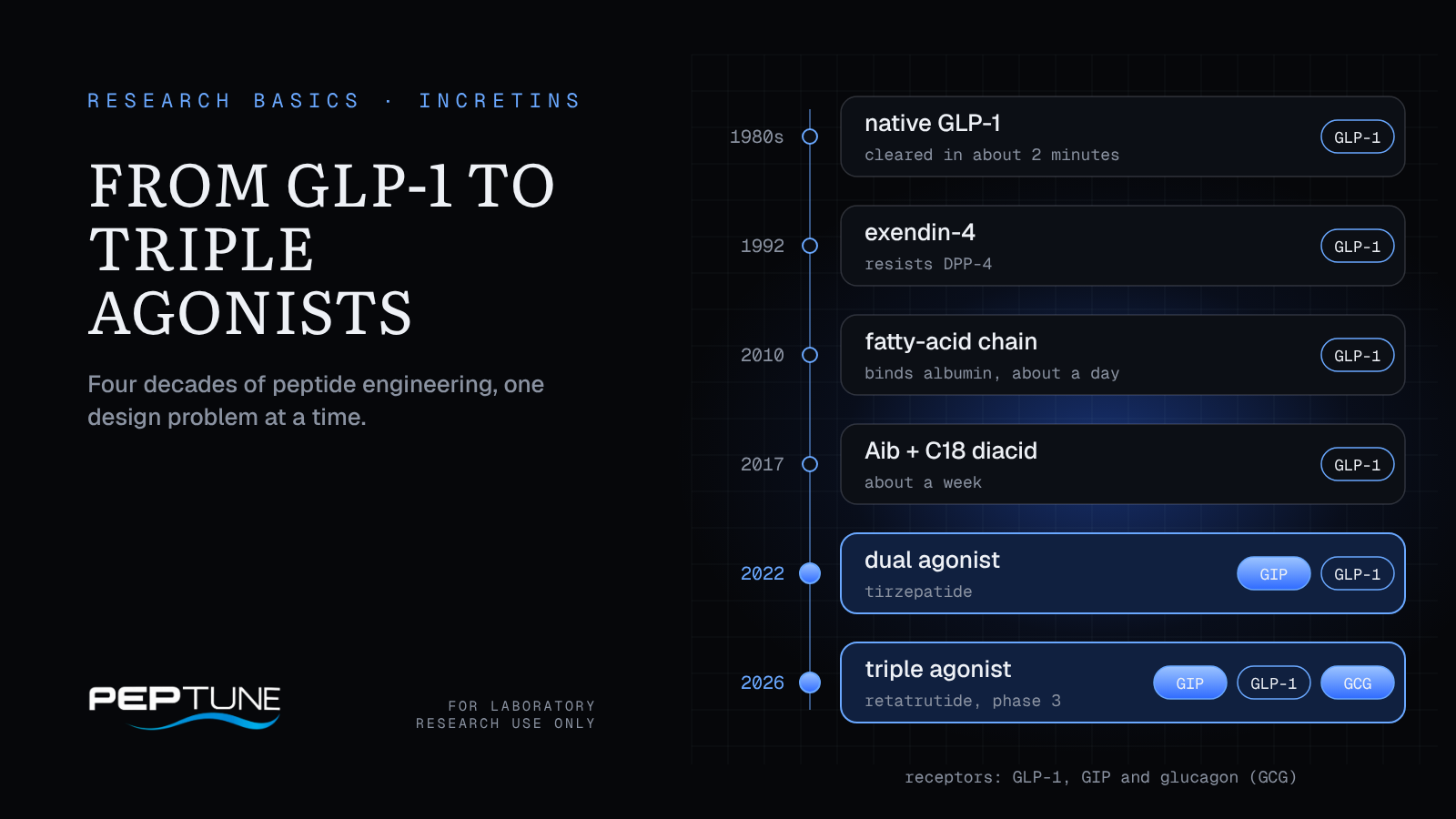
Few areas of peptide science have moved as fast as incretin research. A gut hormone discovered in the 1980s, which the body clears in about two minutes, has become the template for some of the most studied molecules in the world, and the field is now testing peptides that act on three receptors at once. The story is worth knowing because almost every step was a peptide-engineering problem with a clever solution.
This article is a history of the research. It is not medical advice and not a suggestion to use any compound on people or animals.
The hormone that started it
Incretins are hormones the gut releases after a meal. The two that matter here are glucagon-like peptide-1 (GLP-1) and glucose-dependent insulinotropic polypeptide (GIP). In the early 1980s, researchers studying the proglucagon gene found that it encoded GLP-1 alongside glucagon itself, and over the following years groups including Joel Habener, Svetlana Mojsov and Daniel Drucker showed what the active form of GLP-1 does. Habener and Mojsov, with Lotte Bjerre Knudsen of Novo Nordisk, received the Lasker Award in 2024 for that work and what followed.
The problem was obvious from the start. Native GLP-1 is cut by an enzyme, dipeptidyl peptidase-4 (DPP-4), and cleared so fast that it lasts only a couple of minutes in circulation. As a research tool, and as a starting point for anything longer acting, it needed protecting.
Solution one: resist the enzyme
The first long-acting answer came from an unexpected place. In 1992, John Eng isolated exendin-4 from the venom of the Gila monster. It activates the GLP-1 receptor but differs from human GLP-1 at the cut site, so DPP-4 cannot break it down quickly. Its synthetic version became the first licensed GLP-1 receptor agonist in the United States in 2005.
Researchers also learned to protect human GLP-1 itself by swapping the second amino acid for one the enzyme cannot recognise, such as aminoisobutyric acid (Aib). The same trick appears in many later designs, including tesamorelin, where a different modification guards the same kind of cut site on GHRH.
Solution two: hitch a ride on albumin
Enzyme resistance alone still left a peptide that the kidneys clear within hours. The next step was to attach a fatty-acid chain. A fatty acid lets the peptide bind reversibly to albumin, the most abundant protein in blood, which protects it and releases it slowly.
- Liraglutide, introduced around 2010, added a 16-carbon fatty acid and lasted about a day.
- Semaglutide, introduced in 2017, combined an Aib substitution with a longer 18-carbon diacid chain and a linker, which stretched the action to about a week.
That combination, an enzyme-resistant backbone plus an albumin-binding side chain, became the standard design for the next generation.
Solution three: more than one receptor
Once a weekly GLP-1 design was possible, researchers asked whether one peptide could do more. GIP had long been considered the weaker incretin, but a molecule acting on both receptors behaved differently from one acting on GLP-1 alone.
- Tirzepatide is a 39-amino-acid peptide built on the GIP sequence, engineered to also activate the GLP-1 receptor, with a 20-carbon diacid chain for weekly action. It became the first licensed dual GIP and GLP-1 receptor agonist in the United States in 2022.
- Retatrutide adds a third receptor, the glucagon receptor, which is studied for its role in energy expenditure and liver fat. Its developer reported results from four phase 3 trials between December 2025 and July 2026, which makes it the most advanced triple agonist in development.
Our guides to what tirzepatide is, what retatrutide is and retatrutide vs tirzepatide cover their structures and receptor profiles in detail.
What the history teaches researchers
Each generation solved one problem and exposed the next: speed of breakdown, then speed of clearance, then the limits of a single receptor. For laboratory work, the practical lessons are the same ones.
- Small sequence changes have large effects. An analogue with one substituted residue is a different molecule, so identity testing matters. See how mass spectrometry confirms identity.
- Fatty-acid chains change how a peptide behaves in solution and how it binds proteins, which affects assay design.
- Multi-receptor agonists need single-receptor controls. Comparing a dual and a triple agonist side by side is a direct way to isolate what the extra receptor contributes.
Incretin compounds at Peptune
Peptune stocks the two most studied multi-receptor incretin agonists. Certificates of analysis appear on each product page once they are on file, and in the certificate library.
- Tirzepatide: the dual GIP and GLP-1 receptor agonist, available in 10 mg and 20 mg vials.
- Retatrutide: the triple GIP, GLP-1 and glucagon receptor agonist, available in 10 mg and 20 mg vials.
Researchers comparing the two often order both together, so the only variable is the third receptor. Every order ships within Canada in discreet packaging, free on orders of $150 or more.
Sources
- Drucker D.J., Habener J.F., Holst J.J. Discovery, characterization, and clinical development of the glucagon-like peptides. Journal of Clinical Investigation, 2017
- Eng J. et al. Isolation and characterization of exendin-4, an exendin-3 analogue, from Heloderma suspectum venom. Journal of Biological Chemistry, 1992
- Lau J. et al. Discovery of the once-weekly glucagon-like peptide-1 (GLP-1) analogue semaglutide. Journal of Medicinal Chemistry, 2015
- Lasker Foundation: 2024 Lasker~DeBakey Clinical Medical Research Award
For laboratory research use only. Nothing in this article is medical advice or a suggestion to use any compound on people or animals.
For laboratory research use only. Not for human or veterinary use. Nothing here is medical advice.