
Compounds · 4 min read
Tesamorelin's clinical record: what the trials measured
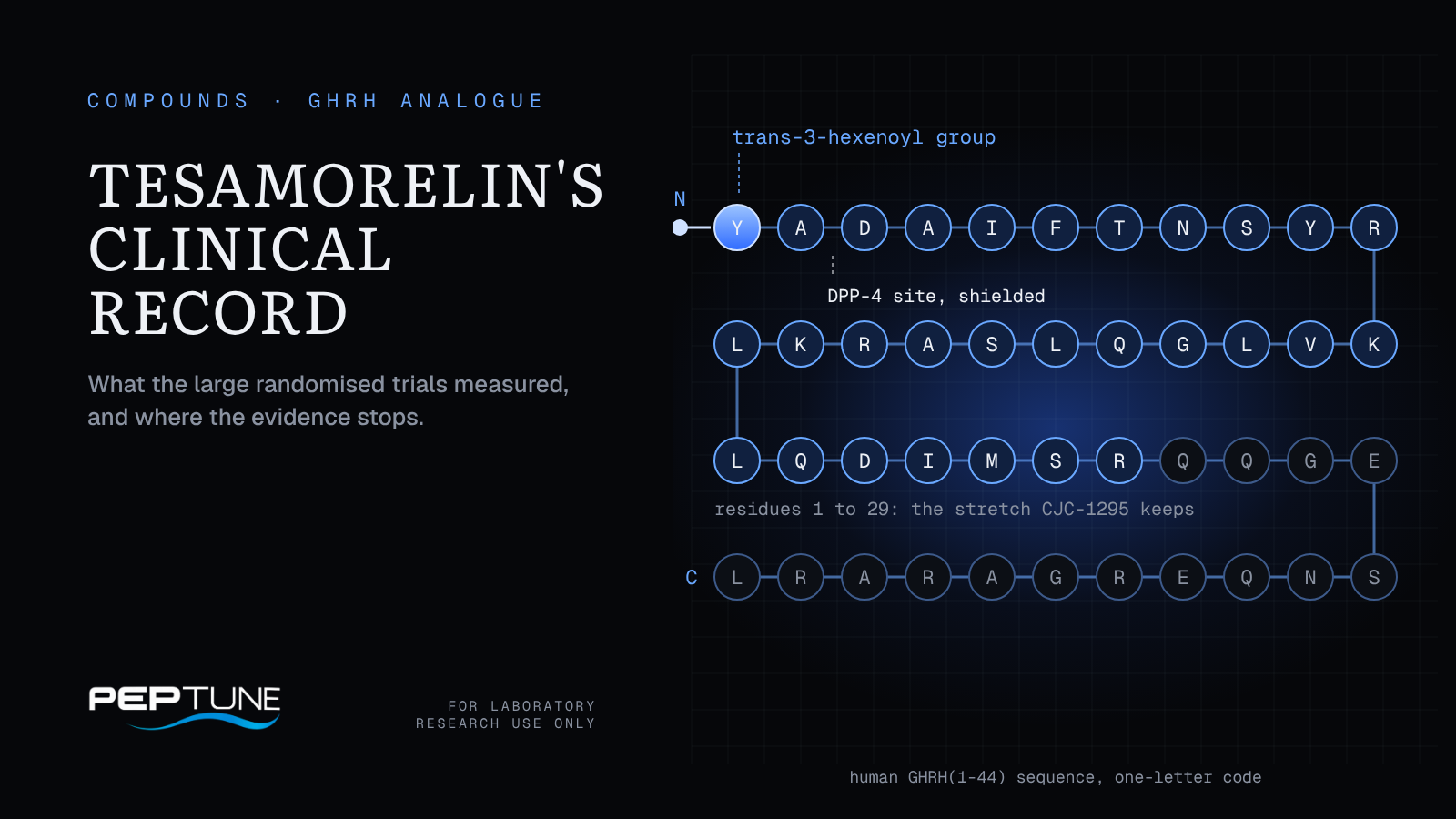
Most peptides discussed in research circles have a thin clinical record: cell studies, animal work and perhaps a small human trial. Tesamorelin is an exception. It has been tested in large randomised, placebo-controlled trials, and it became a licensed medicine in the United States in 2010. That makes it a useful reference point for anyone studying the growth hormone-releasing hormone (GHRH) receptor, and a good case study in what a strong evidence base looks like.
This article summarises the published research. It is not medical advice and not a suggestion to use any compound on people or animals.
What tesamorelin is
Tesamorelin is a synthetic analogue of human GHRH, the 44-amino-acid hormone the hypothalamus releases to signal the pituitary gland. It keeps the full 44-residue sequence and adds a trans-3-hexenoyl group to the first amino acid. That small change protects the peptide from dipeptidyl peptidase-4, the enzyme that quickly cuts natural GHRH, while keeping its affinity for the GHRH receptor.
- Code name in early research: TH9507
- Molecular formula: C221H366N72O67S
- Molecular weight: about 5,136 g/mol
- Developer: Theratechnologies
For how it sits beside CJC-1295 and ipamorelin, see two receptors, one axis.
Why the mechanism interests researchers
Tesamorelin does not supply growth hormone. It binds GHRH receptors on the pituitary's somatotroph cells and prompts them to release their own growth hormone, which in turn raises insulin-like growth factor 1 (IGF-1). Because the signal passes through the pituitary, the body's normal brakes stay in place: somatostatin and IGF-1 feedback still limit how much is released, and release stays pulsatile rather than constant. That difference from giving growth hormone directly is one reason GHRH analogues are studied as a separate class.
Our guide to IGF-1 LR3 covers the downstream end of the same axis.
What the large trials measured
The main trials enrolled adults living with HIV who had accumulated excess abdominal fat, a population in which visceral fat was a recognised clinical problem.
- In 2007, Julian Falutz and colleagues reported a phase 3 trial of 412 participants in the New England Journal of Medicine. After 26 weeks, visceral fat measured by CT scan fell by about 15 per cent in the tesamorelin group and rose by about 5 per cent in the placebo group. IGF-1 levels rose, as the mechanism predicts.
- A second phase 3 trial followed, and a pooled analysis of both trials, covering more than 800 participants, reported a similar reduction.
- Extension phases reported that the reduction in visceral fat largely returned after treatment stopped, which tells researchers the effect depended on continued receptor stimulation.
- In 2014, Takara Stanley and colleagues published a smaller randomised trial of 50 participants in JAMA that also measured liver fat. Over six months, both visceral fat and liver fat fell compared with placebo. The authors called the liver fat change modest and its clinical importance uncertain.
The trials also tracked glucose and IGF-1 closely, since raising growth hormone can affect both, and reported injection-site reactions and joint discomfort among the side effects. These measurements are part of what makes the record useful: the trials looked for unwanted effects as carefully as for the intended one.
What the trials do not show
A strong record in one setting is not a record in every setting.
- The participants were a specific clinical population. The results do not describe what happens in other groups.
- The licensed use is narrow. Claims you may see online about other outcomes go beyond what these trials tested.
- Results came from pharmaceutical-grade material with verified identity and purity. Research on material of unknown quality cannot borrow that confidence.
Our checklist for evaluating a peptide study is a good companion when you read further.
Tesamorelin compared with shorter analogues
CJC-1295 without DAC, also called modified GRF 1-29, keeps only the first 29 amino acids of GHRH, the shortest fragment that keeps full activity, with four substitutions for stability. Tesamorelin keeps the full sequence and relies on a single N-terminal modification instead. In receptor research, the two are often compared directly to study how chain length and modification affect stability and signalling. Ipamorelin works on a different receptor altogether, the ghrelin receptor GHS-R1a, which makes it a common partner in experiments that separate the two pathways.
GHRH-axis compounds at Peptune
Peptune stocks tesamorelin and the related compounds researchers most often study beside it. Certificates of analysis appear on each product page once they are on file, and in the certificate library.
- Tesamorelin, 10 mg: the full-length GHRH analogue discussed here.
- CJC-1295 + Ipamorelin, 5 mg + 5 mg: a shorter GHRH analogue and a ghrelin-receptor agonist in one vial, for pathway comparisons.
- Ipamorelin, 10 mg: the ghrelin-receptor agonist on its own, for single-pathway controls.
- IGF-1 LR3, 1 mg: a long-acting IGF-1 analogue for work further down the axis.
Every order ships within Canada in discreet packaging, free on orders of $150 or more.
Sources
- Falutz J. et al. Metabolic effects of a growth hormone-releasing factor in patients with HIV. New England Journal of Medicine, 2007
- Stanley T.L. et al. Effect of tesamorelin on visceral fat and liver fat in HIV-infected patients with abdominal fat accumulation: a randomized clinical trial. JAMA, 2014
- PubMed, the US National Library of Medicine's index of biomedical literature
For laboratory research use only. Nothing in this article is medical advice or a suggestion to use any compound on people or animals.
For laboratory research use only. Not for human or veterinary use. Nothing here is medical advice.