
Compounds · 3 min read
CJC-1295, tesamorelin and ipamorelin: two receptors, one axis
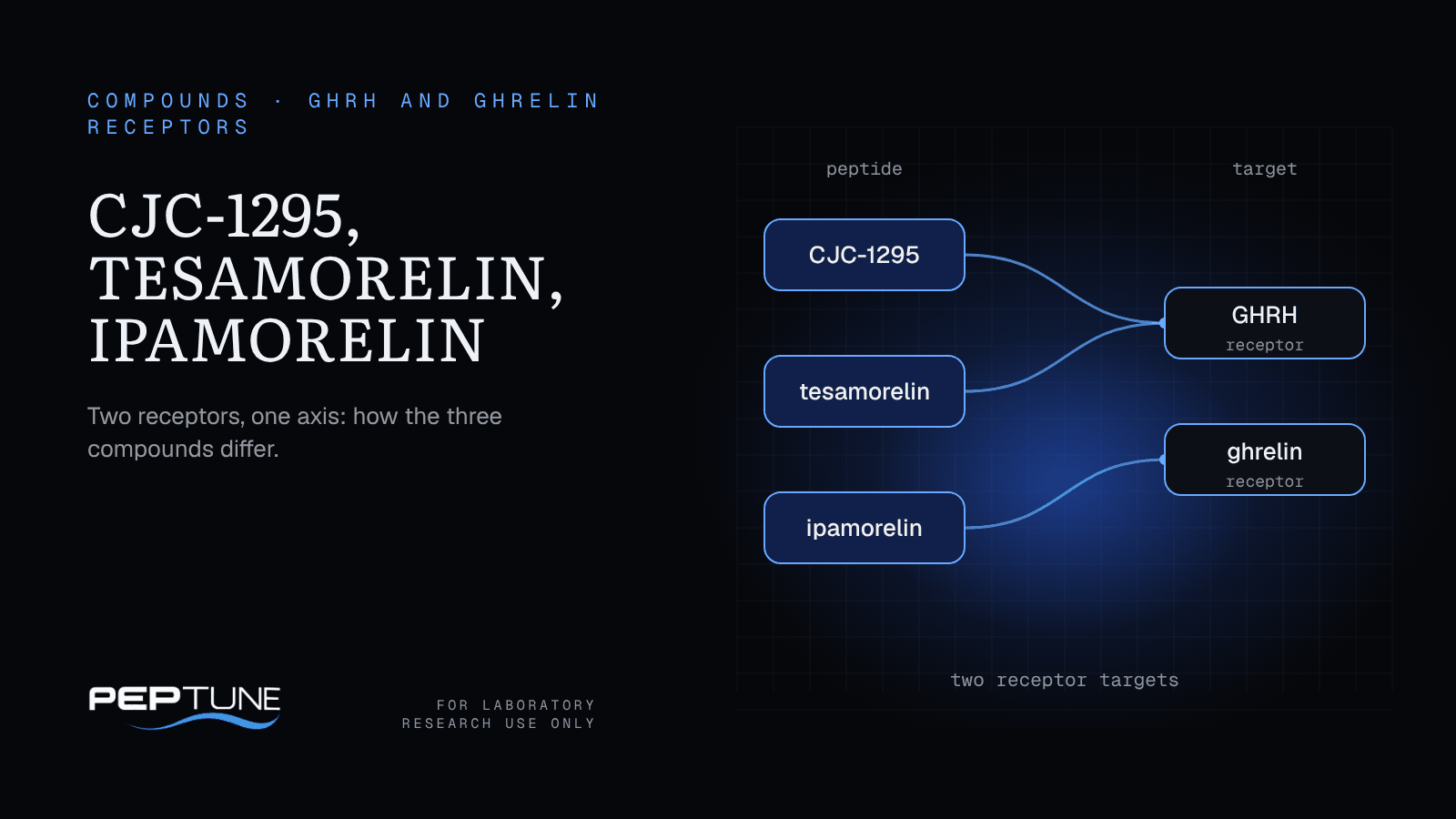
Several peptides in the Peptune catalogue act on the growth-hormone axis, through two different receptors. The pairing researchers ask about most is CJC-1295 ipamorelin: a growth hormone-releasing hormone (GHRH) analogue studied alongside a ghrelin-receptor agonist. This article explains how the GHRH analogues differ from one another, how ipamorelin differs from all of them, and why the two receptor classes are so often examined together.
The growth-hormone axis in brief
Growth hormone is released from somatotroph cells in the anterior pituitary. Two signals from the hypothalamus set the pace: GHRH stimulates release and somatostatin inhibits it. A third input comes from ghrelin, a peptide hormone produced mainly in the stomach, which acts on the growth hormone secretagogue receptor type 1a (GHS-R1a).
The compounds below are synthetic tools for probing those receptors. Each was designed to answer a narrow question about structure, stability or selectivity, and that is how they are best compared.
GHRH receptor agonists
These are analogues of GHRH. Native human GHRH is 44 residues long, but the first 29 residues carry its activity at the receptor. The native hormone is also broken down quickly in circulation, partly by the enzyme dipeptidyl peptidase-4 (DPP-4), which cuts between residues 2 and 3. Each analogue tackles that weakness in a different way:
- Tesamorelin: the full 44-residue GHRH sequence with an N-terminal trans-3-hexenoyl group that resists dipeptidyl peptidase-4.
- CJC-1295 without DAC (modified GRF 1-29): the active first 29 residues, with four amino acid substitutions for stability.
- CJC-1295 with DAC: the same 29-residue analogue with a drug affinity complex that binds albumin, studied for its much longer half-life.
All three act on the GHRH receptor, a G protein-coupled receptor that signals mainly through Gs. Activation raises cyclic AMP inside the cell and switches on protein kinase A signalling.
Ghrelin receptor agonist
- Ipamorelin: a pentapeptide that activates GHS-R1a, the ghrelin receptor. Early work described it as more selective than older secretagogues, with little effect on other pituitary hormones in the models tested.
GHS-R1a is also a G protein-coupled receptor, but it signals mainly through Gq. Activation stimulates phospholipase C and raises the calcium concentration inside the cell. Ipamorelin belongs to the family of synthetic growth hormone secretagogues, and its selectivity is the main reason it is used as a reference compound in that family.
Why researchers study CJC-1295 ipamorelin together
GHRH receptors and ghrelin receptors act on the same pituitary cells through different signalling routes. Research that studies the two together is asking how the routes interact: whether activating both gives an additive response or something greater, and how somatostatin tone changes each one.
The CJC-1295 + Ipamorelin blend supports that question, with each component run alone as controls. A sound design usually includes:
- each compound alone, at matched amounts;
- the combination;
- a vehicle-only control;
- material from documented batches, with the certificate for each kept on file.
Using single vials alongside the blend lets a study separate the contribution of each receptor from the effect of combining them.
Comparing the GHRH analogues
Tesamorelin, CJC-1295 and CJC-1295 with DAC differ mostly in length and stabilisation strategy:
- Tesamorelin keeps the full native length and protects the N-terminus with a chemical group.
- CJC-1295 without DAC is shorter and relies on amino acid substitutions within the sequence.
- CJC-1295 with DAC adds albumin binding on top of those substitutions, which greatly extends how long it persists in the models studied.
Side-by-side receptor-binding and stability assays show how each modification changes behaviour. Because the three share a receptor, they also make useful comparators for one another in the same assay.
Quality matters for receptor work
Receptor assays are sensitive to impurities. A truncated GHRH analogue or an oxidised residue can bind differently from the intact sequence and blur the result. Before relying on a batch, check its identity and purity data; our guides to HPLC peptide purity and reading a certificate of analysis explain what to look for. For storage between experiments, see lyophilized peptide storage.
Order GHRH and ghrelin-receptor peptides in Canada
Peptune's catalogue includes CJC-1295 + Ipamorelin, Tesamorelin and Ipamorelin. Certificates of analysis are published on each product page as they arrive, and in the certificate library. Peptune ships across Canada by tracked mail. Shipping is $20 or $25 depending on the province and free on orders of $150 or more, and payment is by Interac e-Transfer or crypto.
For laboratory research use only. Nothing in this article is medical advice or a suggestion to use any compound on people or animals.
For laboratory research use only. Not for human or veterinary use. Nothing here is medical advice.