
Quality & testing · 4 min read
HPLC: how peptide purity is measured
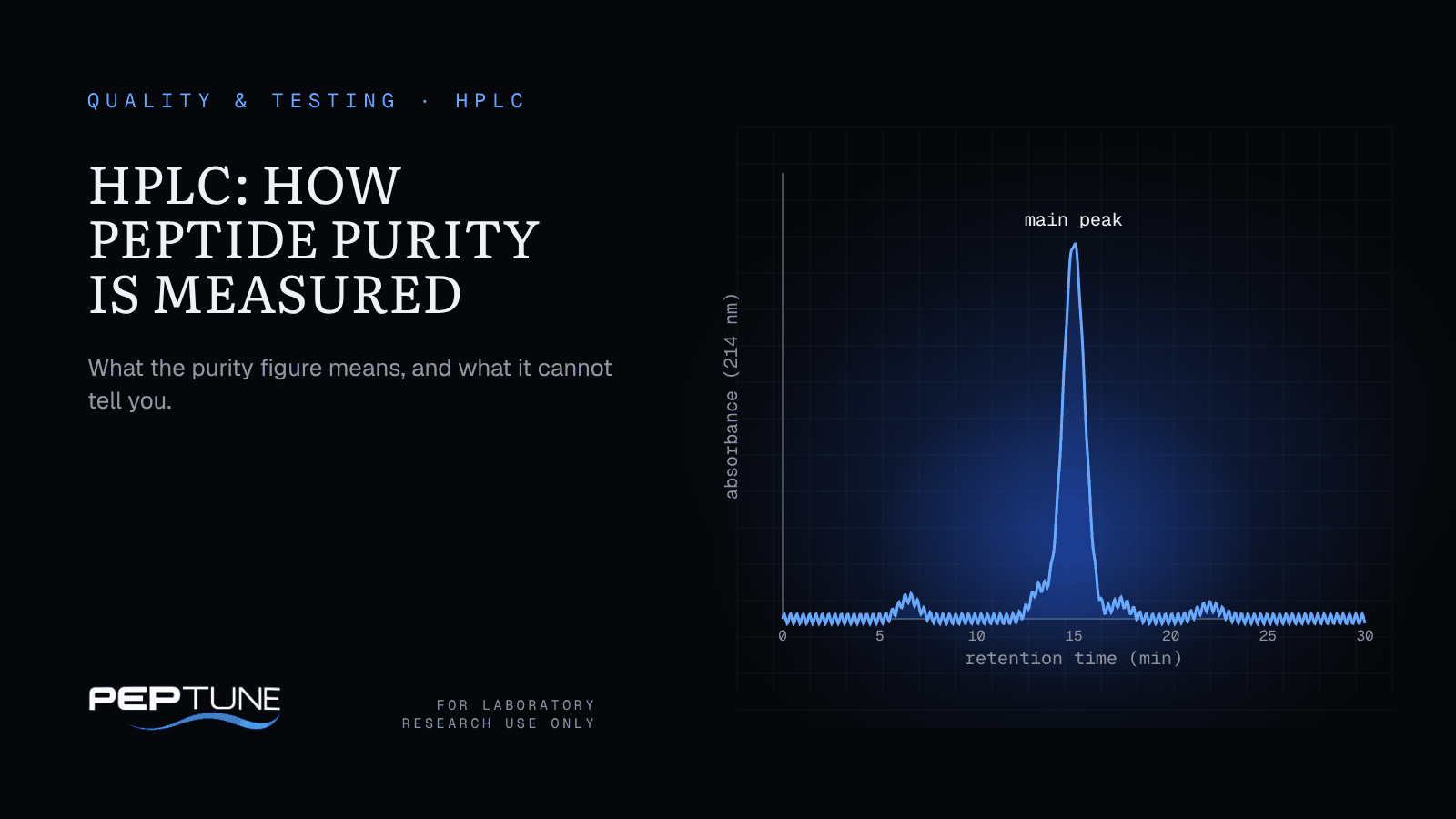
Almost every research peptide certificate states a purity figure, and almost every one of those figures comes from the same technique: high-performance liquid chromatography, or HPLC. HPLC peptide purity is the number most buyers look at first, yet few know exactly what it measures. Knowing how the method works makes the figure far more useful, and far harder to misread.
How HPLC works
A small amount of the sample is dissolved and pushed under high pressure through a narrow steel column packed with fine particles, often only a few micrometres across. The particles are the stationary phase. The liquid pumped through them is the mobile phase. Molecules that cling to the stationary phase move slowly; molecules that prefer the mobile phase move quickly. That difference is what separates them.
In reversed-phase HPLC, the method used for most peptides, the particles are coated with a water-repelling layer, commonly C18 (chains of eighteen carbon atoms). The mobile phase changes gradually from mostly water to mostly organic solvent, usually acetonitrile, in a programme called a gradient. A small amount of an acid such as trifluoroacetic acid is often added to sharpen the peaks. Each molecule leaves the column at the point in the gradient where the solvent pulls it free, so more hydrophobic sequences generally elute later.
The detector and the chromatogram
A detector at the end of the column, usually measuring ultraviolet absorbance around 214 to 220 nanometres where the peptide bond absorbs, draws a trace called a chromatogram. Time runs along the horizontal axis and absorbance up the vertical one. Each substance appears as a peak at its own retention time, and the area under each peak reflects how much of that substance absorbed light.
Because every peptide bond absorbs at this wavelength, the method sees the target peptide and its close relatives alike: deletion sequences missing one residue, truncated chains, oxidised or deamidated forms, and fragments left over from synthesis. These usually appear as small peaks near the main one.
Reading the HPLC peptide purity figure
Purity by HPLC is the area of the main peak divided by the total area of all integrated peaks, expressed as a percentage. A result of 98% means that 98% of the ultraviolet-absorbing material in the sample came out as the main peak.
That is a relative measure, and it has limits worth knowing:
- It does not count water, salts or counter-ions such as acetate or trifluoroacetate, which absorb little or no ultraviolet light at that wavelength.
- It cannot tell you whether the main peak is the right molecule. That is the job of a second technique, mass spectrometry.
- An impurity that leaves the column at the same time as the main peak (co-elution) is counted as part of it.
- The result depends on the method. A different column, gradient or wavelength can give a slightly different figure for the same sample.
Purity is also not the same as the amount of peptide in the vial. Our note on what a purity percentage means explains how purity, net peptide content and gross weight relate.
What a good HPLC report shows
- the chromatogram itself, not only the figure;
- the column, wavelength and gradient used;
- the retention time of the main peak;
- the peak table, with each integrated peak's area;
- the batch number of the material tested.
A purity figure without its trace is a claim, not a result. With the trace in hand, you can see whether the baseline is flat, whether small peaks sit close to the main one and whether the integration looks sensible. A complete certificate pairs this with identity data. See how to read a certificate of analysis for the full checklist, and certificate red flags for what should make you look twice.
Why purity matters in research
Impurities are not inert bystanders. A truncated sequence may bind the same receptor more weakly, and an oxidised form may behave differently in a stability study. Knowing the purity of each batch, and recording it alongside your results, helps explain variation between experiments and makes the work easier to reproduce. It also helps to store material properly once it arrives; our guide to lyophilized peptide storage covers the basics.
Research peptides with published certificates
Peptune publishes certificates of analysis on each product page as they arrive, and collects them in the certificate library, so the chromatogram can be read before an order is placed. Browse the single vials, from GHK-Cu to Tirzepatide, or the full catalogue. Peptune ships across Canada by tracked mail. Shipping is $20 or $25 depending on the province and free on orders of $150 or more, and payment is by Interac e-Transfer or crypto.
For laboratory research use only. Nothing in this article is medical advice or a suggestion to use any compound on people or animals.
For laboratory research use only. Not for human or veterinary use. Nothing here is medical advice.