
Quality & testing · 4 min read
How to read a certificate of analysis
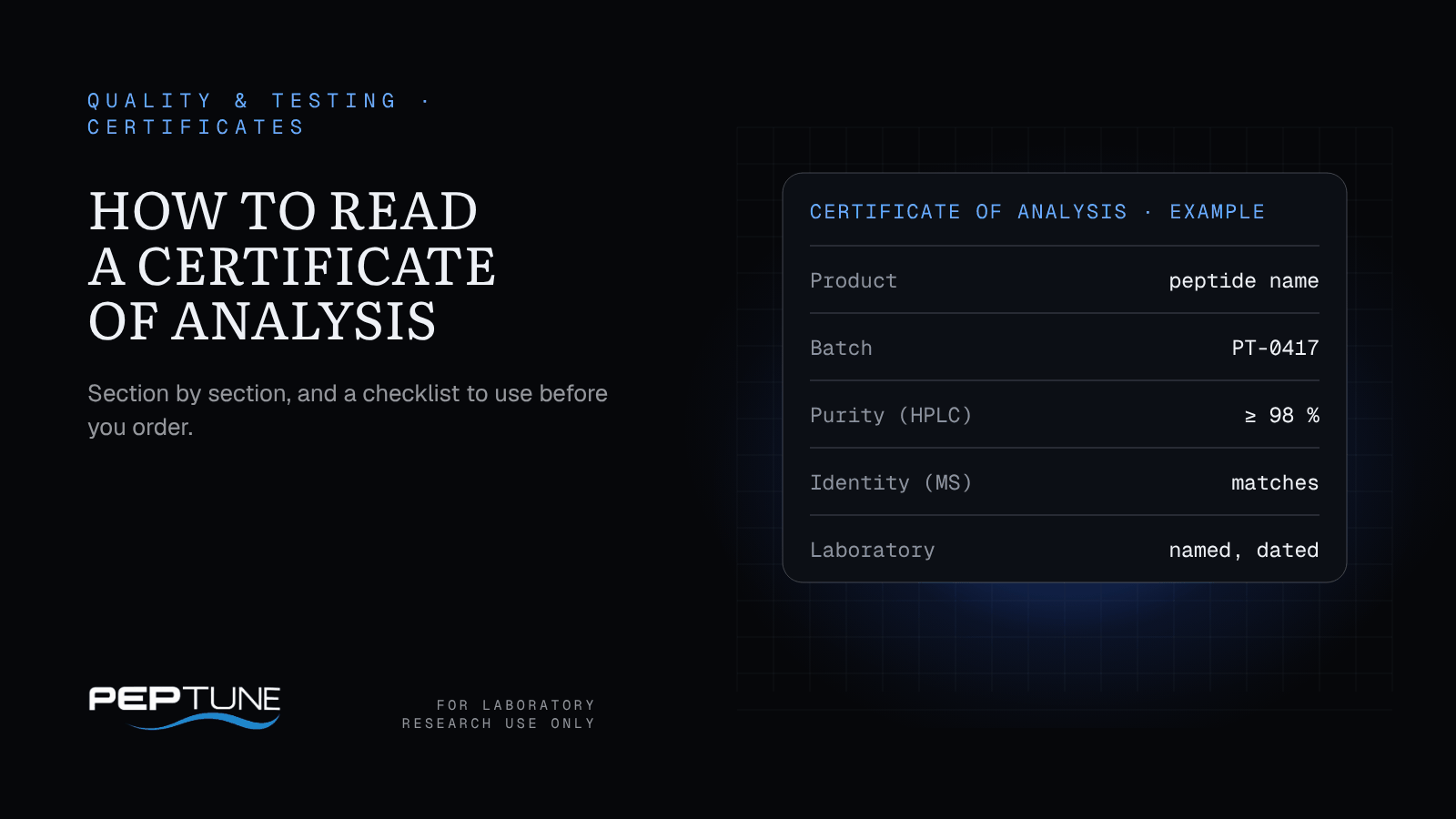
A certificate of analysis, or COA, is the record of what was measured in one batch. A peptide certificate of analysis, read well, answers three questions: is this the right compound, how pure is it, and does this document belong to the vial in front of me? This guide walks through a typical certificate section by section, then gives a short checklist you can use on any batch.
What a peptide certificate of analysis is
A COA is issued for a specific batch, or lot, of material. It is not a product description or a marketing sheet; it reports results measured on samples taken from that batch. Many certificates list a specification next to each result. The specification is the target, for example a minimum purity, and the result is what the laboratory actually found. A complete certificate shows both and states whether each result passed.
Because it describes one batch, a certificate cannot be carried over to the next one. A new synthesis means new material and a new analysis.
Header
The header should name the compound, the batch or lot number, the date of analysis and the laboratory that carried it out. The batch number is the link between the paper and the vial. If it does not match the label, the certificate does not describe your material. Our guide to batch number verification explains how to check it.
Many headers also give the amino acid sequence, the molecular formula and the theoretical molecular mass. Compare these with a trusted reference for the compound; a sequence or formula that does not match is a problem before any result is read.
Identity
Identity is usually established by mass spectrometry. Expect the theoretical molecular mass, the observed mass and a spectrum. The two masses should agree within the tolerance the laboratory states. See our note on mass spectrometry for how the measurement works and what small differences can mean.
Purity
Purity is usually measured by HPLC and given as a percentage with the chromatogram attached. Look at the trace, not just the number: there should be one dominant peak, a handful of small impurity peaks and a peak table listing their areas. The column, wavelength and gradient should be stated. See how HPLC purity works.
Content and appearance
Some certificates also report net peptide content, water content, appearance ("white lyophilized powder") and solubility. These help when a protocol depends on an exact amount of peptide rather than the gross weight of powder. Purity and content are different numbers, and the difference matters when you calculate a concentration; our explainer on purity percentages sets out how they relate.
Some reports add tests such as residual solvents, counter-ion content or endotoxin. Not every batch needs every test, but each test listed should show a method and a result.
Signatures and method details
A credible report names the analyst or approver and states the methods used. Method details let another laboratory repeat the measurement, which is the whole point of recording them. A date of issue and, where the document has been revised, a version number make it possible to tell which copy is current.
What a certificate does not tell you
A certificate reports the tests that were run, on the sample that was tested, on the date shown. It says nothing about anything else.
- An HPLC purity figure does not show water, salt, residual solvents, microbes or endotoxin. Those need their own tests, listed only if they were run. See what each contamination test can detect.
- A result describes the sample, not every vial. Even filling across the batch depends on the manufacturer's process.
- A result is a snapshot. Storage after testing can change the material, and the certificate will not show it.
If a test your work depends on is not listed, ask the supplier rather than assuming it was done.
A quick checklist
- The batch number matches the vial label.
- The compound name and amount match what was ordered.
- The observed mass matches the theoretical mass.
- The HPLC chromatogram is attached, with its conditions.
- The laboratory and methods are named.
- The document is dated and signed or approved.
If any of these is missing, read our list of certificate red flags before relying on the document. Keep a copy of each certificate with your lab records, next to the results it supports.
Certificates at Peptune
Peptune publishes certificates of analysis on each product page as they arrive, and in the certificate library, so they can be read before an order is placed. Start with a product such as Retatrutide, NAD+ or MOTS-c, or browse the full catalogue. Peptune ships across Canada by tracked mail. Shipping is $20 or $25 depending on the province and free on orders of $150 or more, and payment is by Interac e-Transfer or crypto.
For laboratory research use only. Nothing in this article is medical advice or a suggestion to use any compound on people or animals.
For laboratory research use only. Not for human or veterinary use. Nothing here is medical advice.