
Quality & testing · 3 min read
Mass spectrometry: confirming a peptide is what the label says
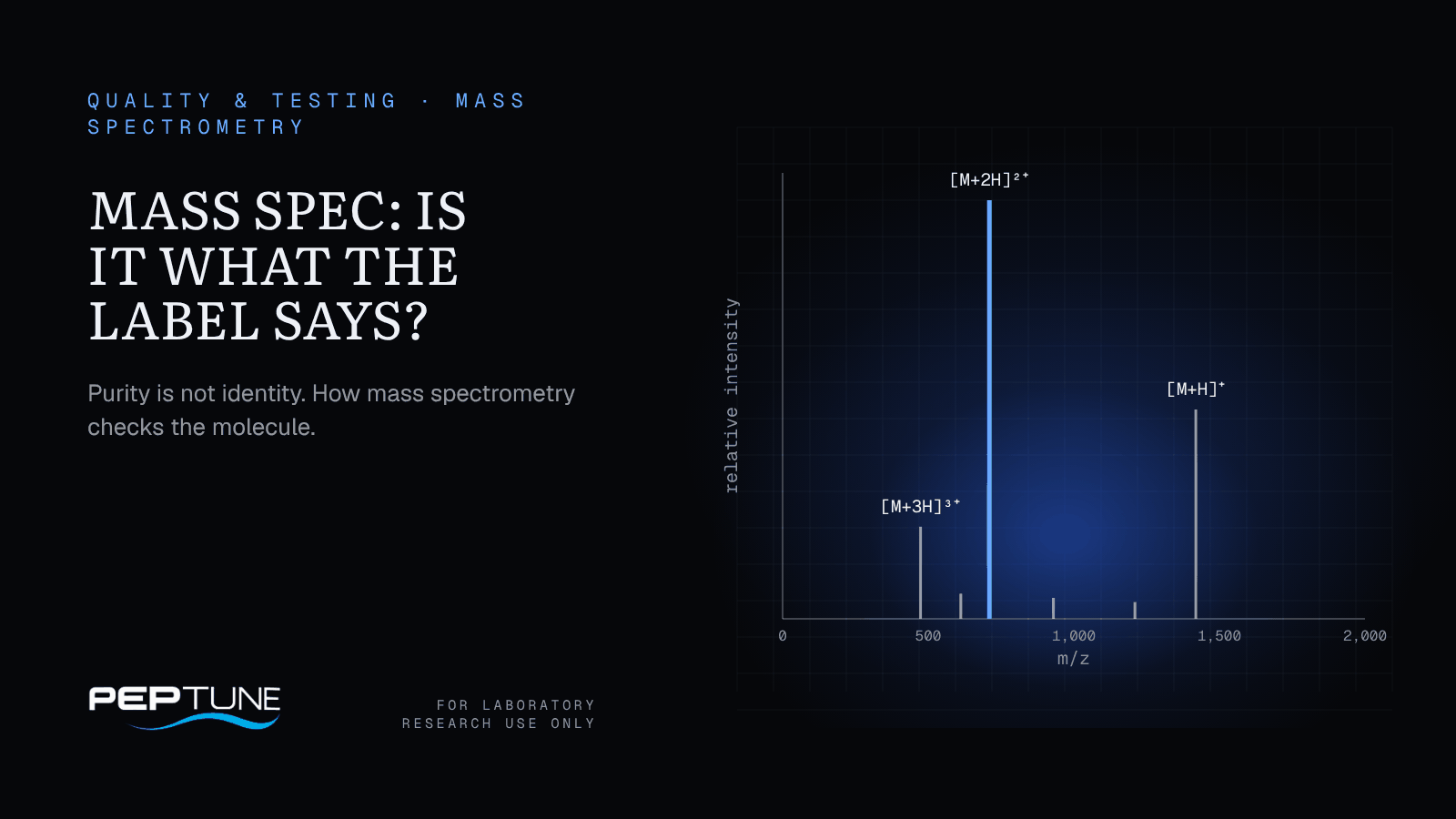
A sample can be very pure and still be the wrong compound. HPLC tells you how much of the material is one substance; peptide mass spectrometry tells you what that substance is. Together they form the backbone of any credible certificate of analysis, and knowing what each one proves helps you judge the paperwork that comes with a research batch.
How peptide mass spectrometry works
Mass spectrometry turns molecules into charged ions, separates them by their mass-to-charge ratio (m/z) and counts them. Every instrument has three parts: an ion source, a mass analyser and a detector. The output is a spectrum, a plot of signal intensity against m/z.
For peptides, the usual ionisation method is electrospray (ESI). The sample, dissolved in a solvent, is sprayed from a fine needle held at high voltage, and the droplets shrink until charged peptide molecules are released into the gas phase. Electrospray tends to produce several ions from one molecule, each carrying a different number of extra protons, so a single peptide appears as a series of peaks. Software combines these, in a step called deconvolution, into a single measured molecular mass.
A second common method is MALDI (matrix-assisted laser desorption/ionisation). The peptide is mixed with a light-absorbing matrix and released by a laser pulse. MALDI usually produces singly charged ions and is often paired with a time-of-flight (TOF) analyser, which measures how long each ion takes to travel a fixed distance.
Comparing measured and theoretical mass
The measured mass is compared with the theoretical mass calculated from the sequence, including any modifications such as C-terminal amidation, acetylation or a disulfide bond. For a fifteen-residue peptide such as BPC-157, the expected mass is about 1,419 daltons. A match within the instrument's stated tolerance supports the identity of the compound.
Reports may quote either of two masses. The monoisotopic mass uses the most common isotope of each element; the average mass reflects the natural mix of isotopes. They differ slightly, so a good report says which one it uses.
Small differences from the expected value can be informative:
- a gain of about 16 daltons often points to oxidation, commonly of methionine;
- a gain of about 1 dalton can indicate deamidation of asparagine or glutamine;
- a loss equal to one residue's mass suggests a deletion sequence.
LC-MS: separation and identity together
Many laboratories couple the two techniques. In LC-MS, the HPLC column separates the sample and the mass spectrometer measures each peak as it leaves. The main peak should carry the expected mass, and the smaller peaks can often be identified too, for example as truncated sequences or oxidised forms. This ties the HPLC purity figure to a confirmed identity for the main peak, which neither technique can do alone.
Limits of a mass match
A correct mass is strong evidence, but not absolute proof.
- Two sequences with the same amino acids in a different order have the same mass.
- Leucine and isoleucine have identical masses, so a simple mass measurement cannot tell them apart.
- Mass spectrometry is not a reliable measure of quantity on its own, because signal strength depends on how readily each molecule ionises.
Where sequence matters, fragmentation methods (MS/MS) break the peptide along its backbone and read parts of the sequence directly from the fragment masses.
What to look for on a certificate
- the theoretical mass, and whether it is monoisotopic or average;
- the observed mass;
- the spectrum itself, with the main ions labelled;
- the ionisation method and instrument type;
- the batch number, matching the vial label.
A certificate that says only "conforms" leaves you trusting the word rather than the data. Our guides to reading a certificate of analysis and checking a batch number cover the rest of the document.
Research peptides from Peptune
Peptune publishes certificates of analysis on each product page as they arrive, and in the certificate library, so identity data can be checked before you order. Browse the catalogue, from BPC-157 + TB-500 to Semax and Selank. Peptune ships across Canada by tracked mail. Shipping is $20 or $25 depending on the province and free on orders of $150 or more, and payment is by Interac e-Transfer or crypto.
For laboratory research use only. Nothing in this article is medical advice or a suggestion to use any compound on people or animals.
For laboratory research use only. Not for human or veterinary use. Nothing here is medical advice.