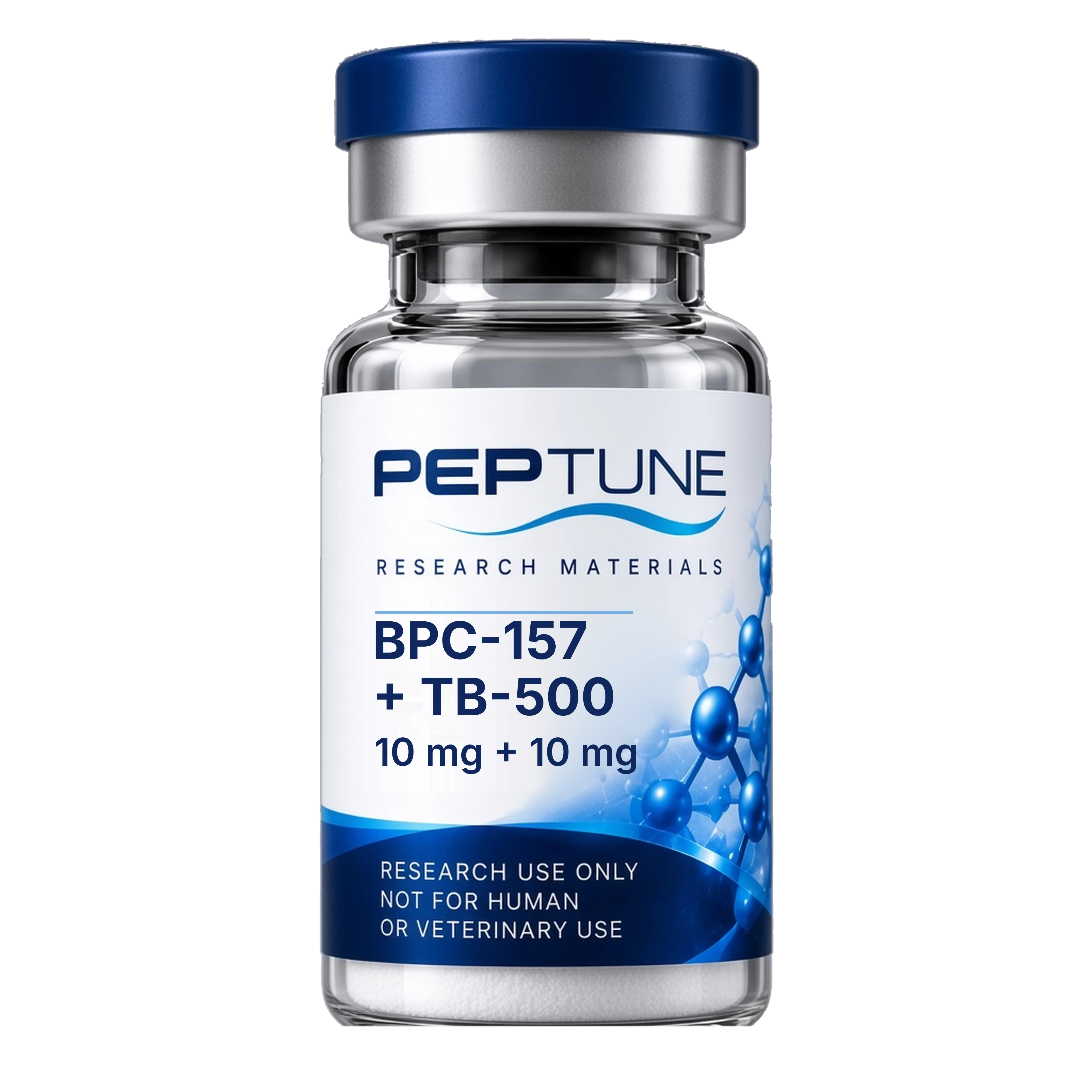
Peptune BPC-157 + TB-500
Two well-studied repair-research peptides, BPC-157 and TB-500, combined in one lyophilized vial.
$89.00
In stock
- Class
- Two-peptide blend
- Amount per vial
- 10 mg BPC-157 and 10 mg TB-500
- Form
- Lyophilized powder
- Length
- BPC-157: 15 residues
- Appearance
- White powder
For laboratory research use only · Certificate of analysis · Full specifications
Documentation
Certificate of analysis
No certificate is published for this product yet. Contact us to check the documentation for the current batch before you order; published certificates are listed in the documentation library.
Overview
About this product
A two-peptide research blend. BPC-157 is a synthetic fifteen-residue fragment first described from a gastric protein sequence. TB-500 is the name used for a synthetic fragment related to thymosin beta-4, a small actin-binding protein. Each has its own literature in cell and animal models of tissue remodelling, cell migration and signalling. Combining them in one vial lets a laboratory study the pair under identical preparation conditions. It also adds variables, so a sound design runs each peptide on its own alongside the blend, with vehicle controls, before reading anything into the combination. Supplied as a lyophilized powder in a sealed vial, labelled with both components and their amounts. What the research shows No published study has tested the two peptides together. For BPC-157, a 2003 study in rats with a transected Achilles tendon reported a higher load of failure and smaller tendon defects than saline controls, and found no effect of the peptide alone on the growth of cultured tendon cells. A 2026 systematic review found three human studies with 30 participants in total, all judged of poor methodological quality, and rated the certainty of evidence very low. For thymosin beta-4, the parent protein of the TB-500 fragment, a 1999 rat study reported 42% more re-epithelialisation of full-thickness wounds than saline at 4 days and up to 61% at 7 days. Sources: Staresinic et al., Journal of Orthopaedic Research, 2003, PMID 14554208. Poolton et al., Acta Orthopaedica Belgica, 2026, PMID 42885452. Malinda et al., Journal of Investigative Dermatology, 1999, PMID 10469335. For laboratory research use only. Not for human or veterinary use. Purity and identity are stated on the batch certificate, published on this page once it is on file.
Research profile
BPC-157 + TB-500 in the literature
Research areas · 0–5
- BPC-157
- Thymosin β4 (TB-500)
The molecule
About this compound
One vial holds two synthetic peptides. The label reads 10 mg of BPC-157 and 10 mg of TB-500. Those figures are the contents of this vial. BPC-157 is a pentadecapeptide, fifteen residues, sequence Gly-Glu-Pro-Pro-Pro-Gly-Lys-Pro-Ala-Asp-Asp-Ala-Gly-Leu-Val, a fragment of a larger gastric protein sequence in the research literature. TB-500 is the name used for a synthetic fragment related to thymosin beta-4. Commercial use of that name is not uniform, so the lot certificate is the identity record for the fragment in the vial.
- Class
- Two-peptide blend
- Also known as
- BPC-157: Body Protection Compound-157, PL 14736
- CAS number
- BPC-157 137525-51-0; TB-500 885340-08-9 (acetylated 17–23 fragment, Ac-LKKTETQ), 77591-33-4 (full thymosin beta-4)
- Sequence
- BPC-157: Gly-Glu-Pro-Pro-Pro-Gly-Lys-Pro-Ala-Asp-Asp-Ala-Gly-Leu-Val
- Length
- BPC-157: 15 residues
- Molecular formula
- BPC-157 C62H98N16O22; TB-500 fragment C38H68N10O14
- Molecular weight
- BPC-157 1,419.5 g/mol; TB-500 fragment 889.0 g/mol
- Target in the literature
- BPC-157: fragment of a gastric protein sequence, no single receptor identified. TB-500: fragment related to thymosin beta-4, an actin-binding protein
- Half-life (published)
- BPC-157: under 30 minutes in rats and dogs (PMID 36588717)
- Form
- Lyophilized powder
- Amount per vial
- 10 mg BPC-157 and 10 mg TB-500
- Appearance
- White powder
- Solubility
- Sterile water or bacteriostatic water
- Storage (unopened)
- −20 °C long term, 2 to 8 °C short term; sealed and away from light
- Storage (in solution)
- 2 to 8 °C, away from light; do not freeze
- Packaging
- Sealed vial
- Notes
- TB-500: synthetic fragment related to thymosin beta-4
Published research
These are published papers about the molecule. A paper is not a dose, not medical advice, and not evidence that this vial is for human or veterinary use.
- The beneficial effect of BPC 157, a 15 amino acid peptide BPC fragment, on gastric and duodenal lesions induced by restraint stress, cysteamine and 96% ethanol in rats.
Life Sciences · 1994 · PMID 7904712
An early rat experiment on the 15-residue peptide. The title states the model. It is not a protocol for this vial.
- The promoting effect of pentadecapeptide BPC 157 on tendon healing involves tendon outgrowth, cell survival, and cell migration.
Journal of Applied Physiology · 2011 · PMID 21030672
Cell and rat experiments on tendon tissue. Listed so the methods can be read. Not a result claimed for this blend.
- Subcellular distribution of thymosin beta4.
Annals of the New York Academy of Sciences · 2007 · PMID 17567947
Where the parent protein thymosin beta-4 is found inside cells. TB-500 is a fragment related to that protein, not the full sequence.
For laboratory research use only. Not for human or veterinary use. The amount on the label is the contents of the vial, not a dose.
Ordering in Canada
Buying Peptune BPC-157 + TB-500 in Canada
- Can I buy Peptune BPC-157 + TB-500 in Canada?
- Yes. Peptune sells Peptune BPC-157 + TB-500 online for laboratory research use only, with tracked delivery to every province and territory in Canada.
- How much is Peptune BPC-157 + TB-500?
- 10 mg + 10 mg: $89, in Canadian dollars. Free shipping on orders of $150 or more.
- Is there a certificate of analysis for Peptune BPC-157 + TB-500?
- The certificate of analysis for the current batch of Peptune BPC-157 + TB-500 is published on this page and in the COA library as soon as it is on file.
- How is Peptune BPC-157 + TB-500 supplied?
- As a lyophilized powder in a sealed vial, labelled with the compound and the amount: 10 mg BPC-157 and 10 mg TB-500. The amount is the contents of the vial, not a dose. Keep it sealed, dry, cold and away from light.
- How do I pay?
- By Interac e-Transfer or crypto. The payment instructions arrive by email after you place the order, and nothing is charged before that step.
Verified buyers
Reviews
No reviews yet. Reviews come from verified buyers only, and each one is checked before it appears.
Bought this? Write a review
Loading…