
Quality & testing · 3 min read
Impurities, microbes and endotoxin: what each test can detect
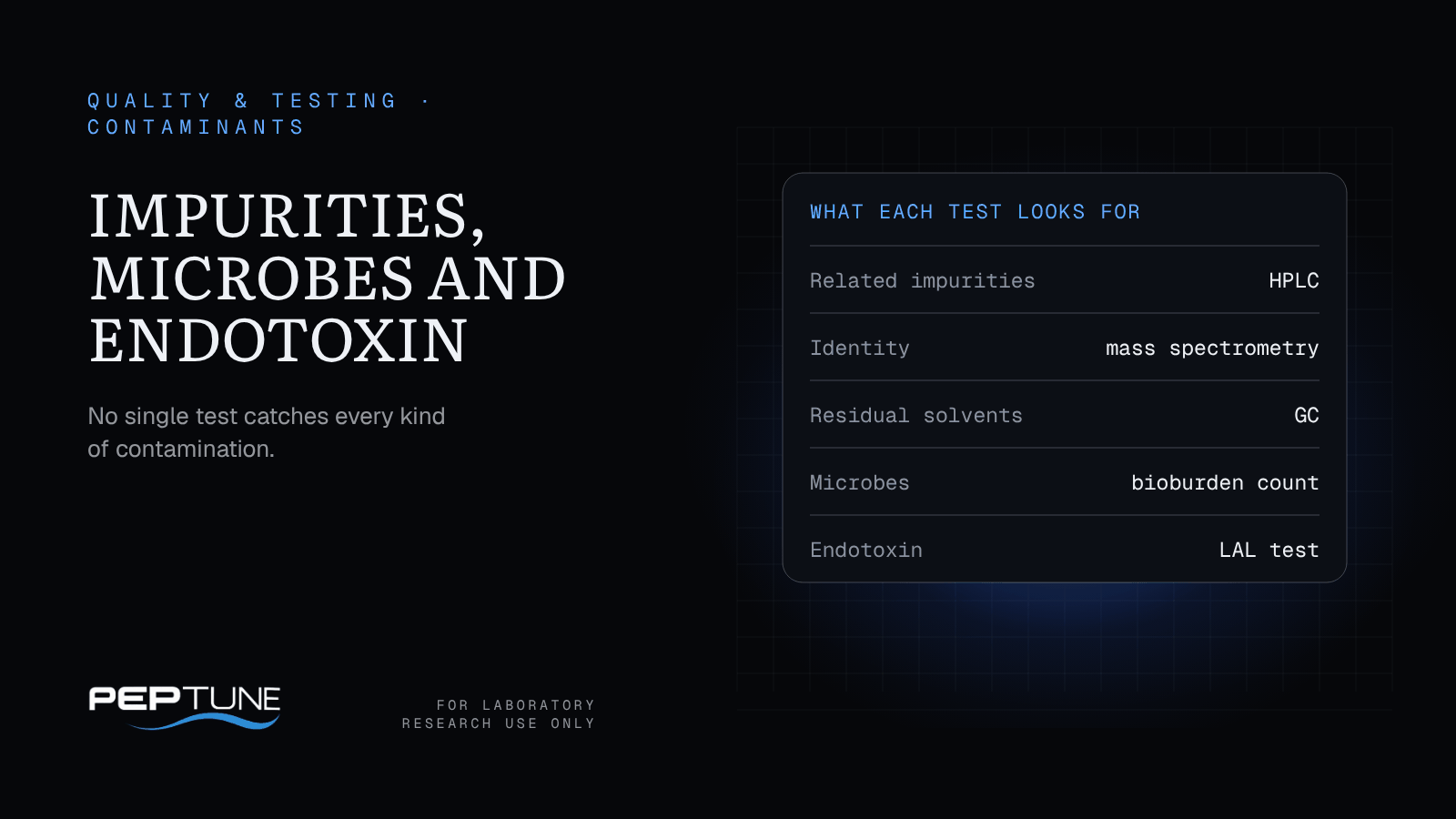
"Contamination" is used loosely, but in a laboratory it covers several different problems. A peptide sample can contain related peptide impurities, leftover solvents or reagents, water, unrelated substances, microorganisms or endotoxin. Each needs its own test, and a clean result on one says nothing about the others. This guide sets out what each common test looks for, so a certificate can be read for what it covers and what it does not.
Related peptide impurities
These are the most common impurities in a synthetic peptide: chains that are one residue short, chains with a leftover protecting group, oxidised or deamidated forms and similar near-copies of the target. They come from the synthesis itself.
- HPLC separates them from the main peak and reports their combined share. See HPLC and peptide purity.
- Mass spectrometry, often coupled to HPLC as LC-MS, can help identify what a given impurity is from its mass. See mass spectrometry for peptide identity.
Water and counter-ions
Freeze-dried peptides hold some water and the salts left from purification, usually acetate or trifluoroacetate. They are expected rather than contamination, but they reduce how much peptide is in a given weight of powder. Water is often measured by Karl Fischer titration, and counter-ions by ion chromatography. See what a purity percentage means.
Residual solvents and reagents
Synthesis and purification use organic solvents and reagents. Small amounts can remain after drying. Gas chromatography is the usual method for residual solvents. A standard HPLC purity test does not measure them.
Elemental impurities
Metals can enter from reagents, catalysts or equipment. They are measured with specific techniques such as inductively coupled plasma mass spectrometry (ICP-MS). Again, an HPLC purity figure does not cover them.
Microorganisms
Bacteria and fungi are a separate category altogether. Microbial tests, such as a total count or a sterility test, culture the sample under defined conditions and look for growth. Chemical purity methods cannot detect microbes: a sample can be 99% pure by HPLC and still not be sterile.
Endotoxin
Endotoxin is a component of the outer membrane of certain bacteria. It can remain even after the bacteria themselves are gone, so a sterility test does not rule it out. Endotoxin is measured with its own assay, most commonly the LAL (Limulus amebocyte lysate) test or a recombinant alternative. It matters most in cell culture, where it can change how cells respond and confound a result.
What "not detected" means
A negative result means the target was not found above the method's detection or reporting limit, under the conditions used. It does not mean the substance is absolutely absent. A good report states the limit, so you can judge whether it is low enough for your work.
Reading a certificate for coverage
When you read a certificate, list what was actually tested and compare it with what your experiment needs:
- Identity and related impurities: mass spectrometry and HPLC are the core of nearly every peptide certificate.
- Water, counter-ions or net peptide content: listed on some certificates.
- Residual solvents, elemental impurities, microbial count and endotoxin: separate tests, listed only if they were run.
A test that is not on the report was not done. Do not fill the gap with assumptions; ask the supplier, or test a retained sample yourself if your protocol depends on it. Our guides to reading a certificate and third-party testing cover the rest of the document.
Common questions
Does an HPLC purity test detect bacteria?
No. HPLC measures chemical components. Microorganisms and endotoxin need their own tests.
Is a sterile sample also free of endotoxin?
Not necessarily. Endotoxin can remain after bacteria are removed or killed, so it is tested separately.
Certificates you can read before ordering
Peptune publishes each batch's certificate of analysis on its product page as it arrives, and in the certificate library, so you can see exactly which tests were run. Browse the full catalogue.
For laboratory research use only. Nothing in this article is medical advice or a suggestion to use any compound on people or animals.
For laboratory research use only. Not for human or veterinary use. Nothing here is medical advice.