
Quality & testing · 3 min read
Why third-party testing matters
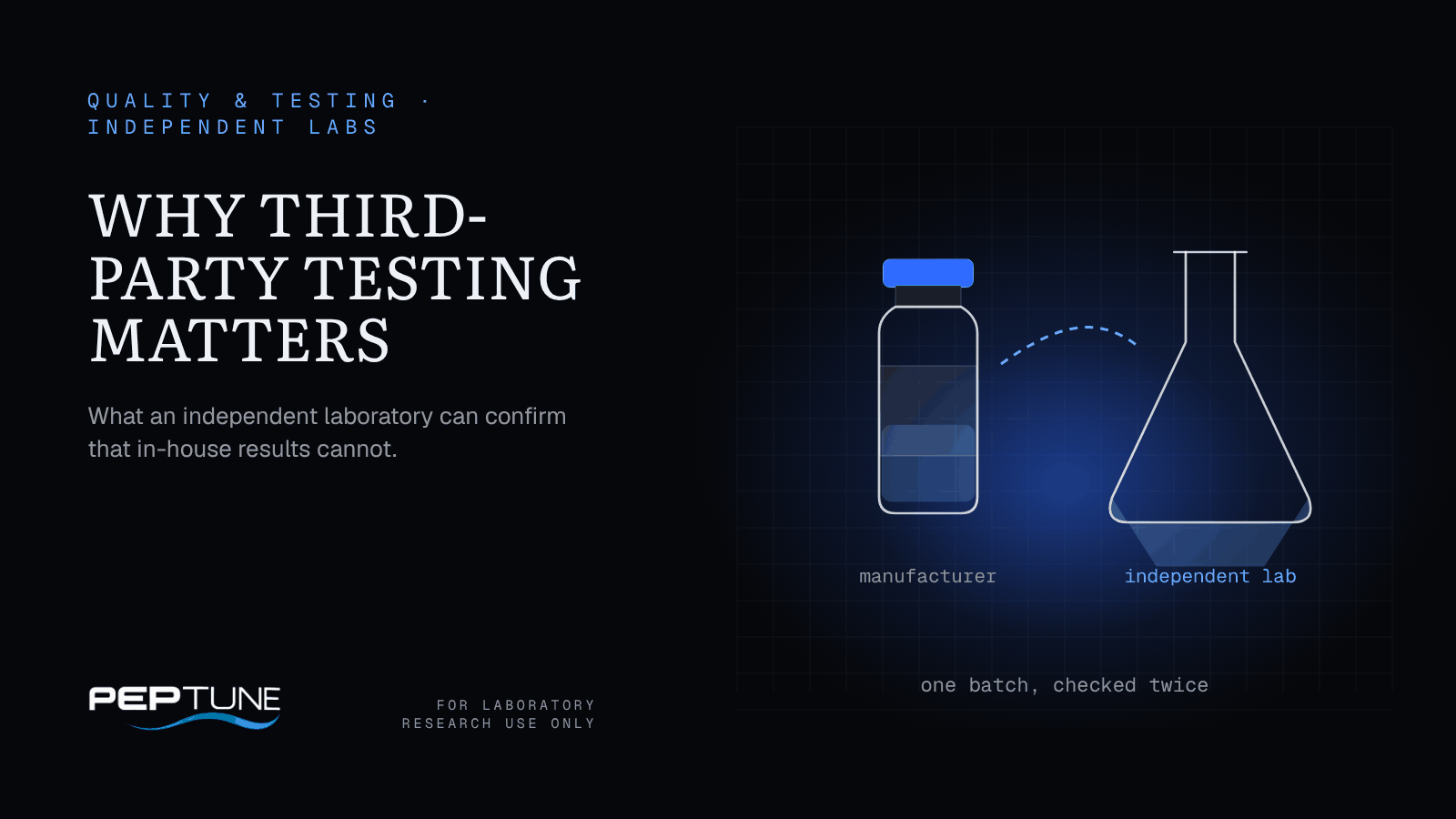
Any manufacturer can test its own material, and most do. Third-party peptide testing adds something in-house testing cannot: a result from a laboratory that has no stake in the outcome. For researchers choosing a supplier, knowing the difference between the two, and what each can and cannot tell you, makes certificates much easier to judge.
In-house versus independent testing
In-house quality control is useful for catching problems during production. A synthesis team checks crude material, monitors purification and confirms the final product before it is released. That work is valuable, and a good supplier does it routinely.
But in-house testing has one structural weakness: the same organisation makes the product, runs the test and reports the result. Nobody outside that loop has looked at the sample.
An independent laboratory works differently. It receives a sample, analyses it with its own methods and instruments, and issues its own report under its own name. It is paid for the analysis, not for a particular result.
What third-party peptide testing usually covers
The two core questions for any synthetic peptide are identity and purity.
- Identity: is this the expected molecule? Mass spectrometry measures the molecular mass and compares it with the theoretical value for the sequence. See mass spectrometry for peptide identity.
- Purity: how much of the material is the target peptide rather than related impurities? Reversed-phase HPLC separates the components, and the main peak is reported as a share of the total. See HPLC and peptide purity.
Some reports add net peptide content, residual solvents, counter-ion content (such as acetate or trifluoroacetate) or endotoxin results. These are useful extras, but identity and purity are the foundation.
What to look for in an independent report
- The laboratory is named and can be contacted.
- The report carries the laboratory's own identifiers, such as a report or sample number, not only the supplier's.
- Methods are stated, so the result can be repeated: column, detection wavelength and gradient for HPLC, ionisation method for mass spectrometry.
- The raw output is shown: a chromatogram with labelled peaks and a mass spectrum, not only a summary figure.
- The batch number on the report matches the vial.
- The report is dated, and the date makes sense against the batch.
Accreditation to ISO/IEC 17025, the international standard for testing laboratories, is a further sign that a laboratory's methods and quality system have been assessed. It is worth noting where it is stated, but a report should still be judged on its contents.
For a step-by-step walk-through, see how to read a certificate. For warning signs, see certificate red flags.
What third-party testing does not do
Third-party testing describes the sample that was sent. It does not, on its own, show that every vial in a batch is identical, or that storage after testing was correct.
- It covers one batch. A result for one batch says nothing certain about the next.
- It covers the sample tested. Uniform filling and labelling across the batch still depend on the manufacturer's process.
- It is a snapshot. A peptide stored badly after testing can degrade, and the certificate will not show it.
This is why good handling and batch traceability are still needed. Testing tells you what the material was at the time of analysis. Your own storage and records protect what it is when you use it.
How to use certificates in your own work
Treat a certificate as part of your experimental record. File it with the batch number, note the date of analysis, and record the purity figure you rely on when you calculate quantities. If a result later looks unusual, you can return to the certificate and check whether the material could explain it.
If your work depends heavily on exact content, some laboratories commission their own confirmatory analysis of a retained sample. That is a decision for your protocol and budget, not a requirement.
Peptune's approach
Peptune publishes certificates of analysis on each product page, matched by batch, as they are received, and collects them in the certificate library. We do not quote purity figures that are not backed by a certificate on file.
Browse single vials such as Semax and Selank, or the full catalogue. Orders ship across Canada by tracked mail; shipping is $20 or $25 depending on the province and free on orders of $150 or more, and payment is by Interac e-Transfer or crypto.
For laboratory research use only. Nothing in this article is medical advice or a suggestion to use any compound on people or animals.
For laboratory research use only. Not for human or veterinary use. Nothing here is medical advice.