
Quality & testing · 3 min read
Certificate red flags: what should make you look twice
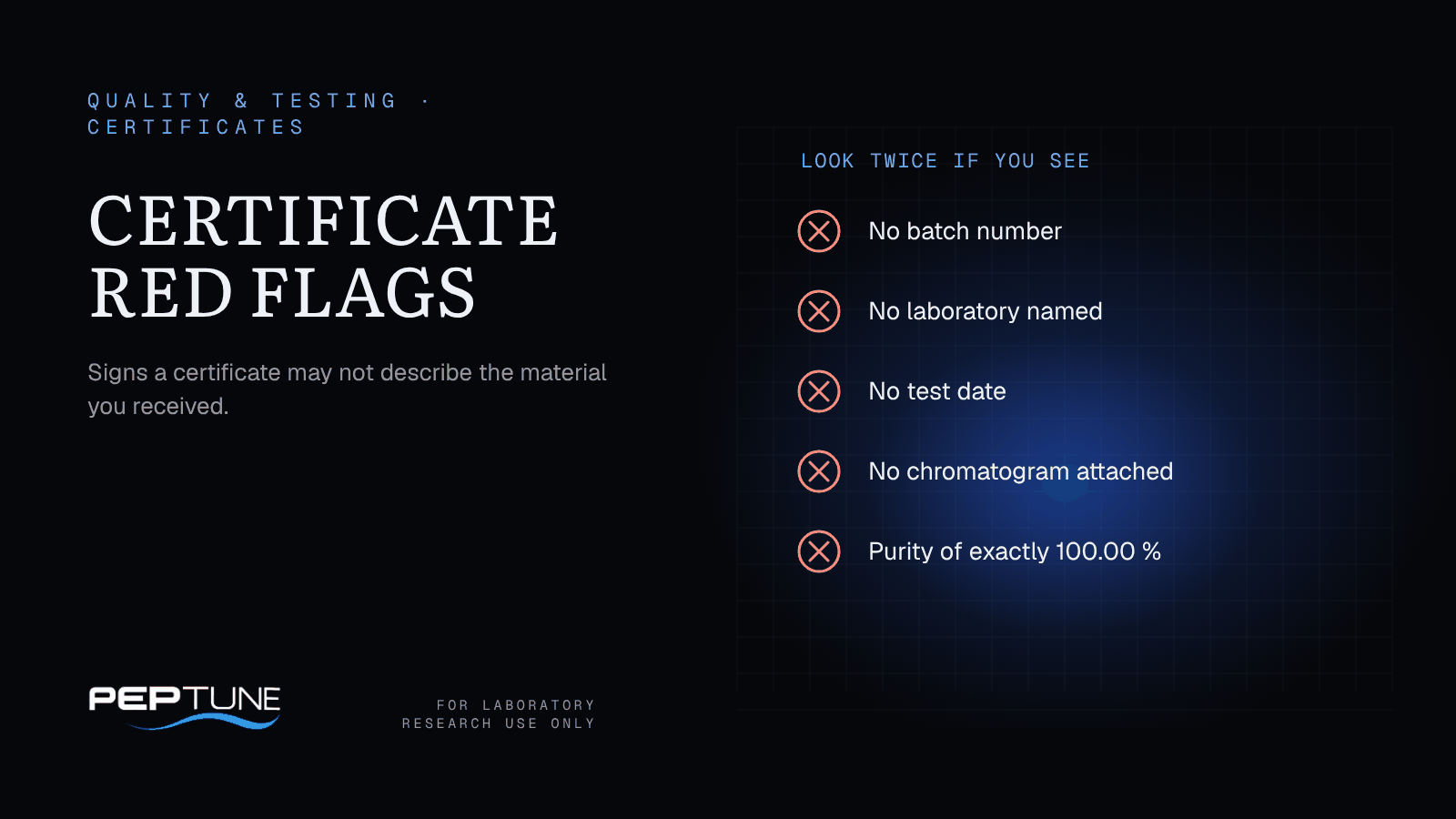
A certificate of analysis is only useful if it is genuine and belongs to your batch. A fake peptide COA rarely announces itself; more often it is a real-looking document with something quietly missing, reused or altered. These are the signs that deserve a second look, grouped by the kind of problem they reveal.
Missing data
- A purity figure with no chromatogram.
- "Identity: conforms" with no observed mass or spectrum.
- No method, column, wavelength or instrument stated.
- No date of analysis.
Each of these turns a measurement into an assertion. A real analysis produces raw output, and a laboratory that ran the test has it. See how HPLC purity works and how mass spectrometry confirms identity for what that output should look like.
Mismatches
- The batch number on the certificate differs from the vial label.
- The compound name or amount differs from what was ordered.
- The same certificate, with the same batch number, appears for several different products.
- The theoretical mass on the certificate does not match the published sequence of the compound.
- The date of analysis falls after the date the material was shipped, or long before the compound was synthesised.
Mismatches are the easiest red flags to check and the most telling. A certificate that does not match the vial does not describe the vial, however good its numbers look.
Signs of a fake peptide COA in the document itself
Some problems show up in the file rather than the data:
- fonts, spacing or alignment that change part-way through a table;
- a laboratory logo that is blurred or stretched while the text around it is sharp;
- a chromatogram image with a different resolution from the rest of the page;
- identical traces, including the same noise, on certificates for different batches or compounds.
None of these proves a document is false, but each is a reason to ask for the original report.
A genuine certificate is also stable over time. The same batch number should always lead to the same document, and any revision should carry a new version number and date. If the certificate for a batch changes between visits with no revision note, ask why. Equally, a supplier who shows one certificate for every batch they have ever sold is showing you a single analysis, not a record of what you received.
Numbers that are too neat
Real chromatograms have small peaks, baselines with noise and purities such as 98.6%. A trace with one perfectly clean peak and a round 100.0% result is unusual for a synthetic peptide and worth questioning. Solid-phase synthesis almost always leaves some related sequences behind, such as deletion or truncated chains, and a sensitive method normally detects them.
The same applies to mass. An observed mass that matches the theoretical value to every decimal place, on an instrument whose tolerance is stated as wider than that, deserves a closer look.
No traceable source
A certificate should name the laboratory that did the analysis. If it cannot be traced to anyone, it cannot be checked. Where a laboratory is named, it should be possible to find it independently and, in many cases, to ask whether a report with that number was issued. Our article on third-party testing explains why independent analysis matters.
What to do
- Ask the supplier for the full report, including the raw chromatogram and spectrum.
- Ask for the laboratory's name and contact details.
- Compare the batch number with your label; see batch number verification.
- Keep the certificate with your lab records, next to the results it supports.
Our guide to reading a certificate covers what a complete one contains, section by section.
Check before you order
Peptune publishes certificates of analysis on each product page as they arrive, and in the certificate library, so you can read them against this list before placing an order. Browse single vials such as Tesamorelin and Ipamorelin, or the blends. Peptune ships across Canada by tracked mail. Shipping is $20 or $25 depending on the province and free on orders of $150 or more, and payment is by Interac e-Transfer or crypto.
For laboratory research use only. Nothing in this article is medical advice or a suggestion to use any compound on people or animals.
For laboratory research use only. Not for human or veterinary use. Nothing here is medical advice.