
Quality & testing · 4 min read
Batch numbers: the link between a vial and its data
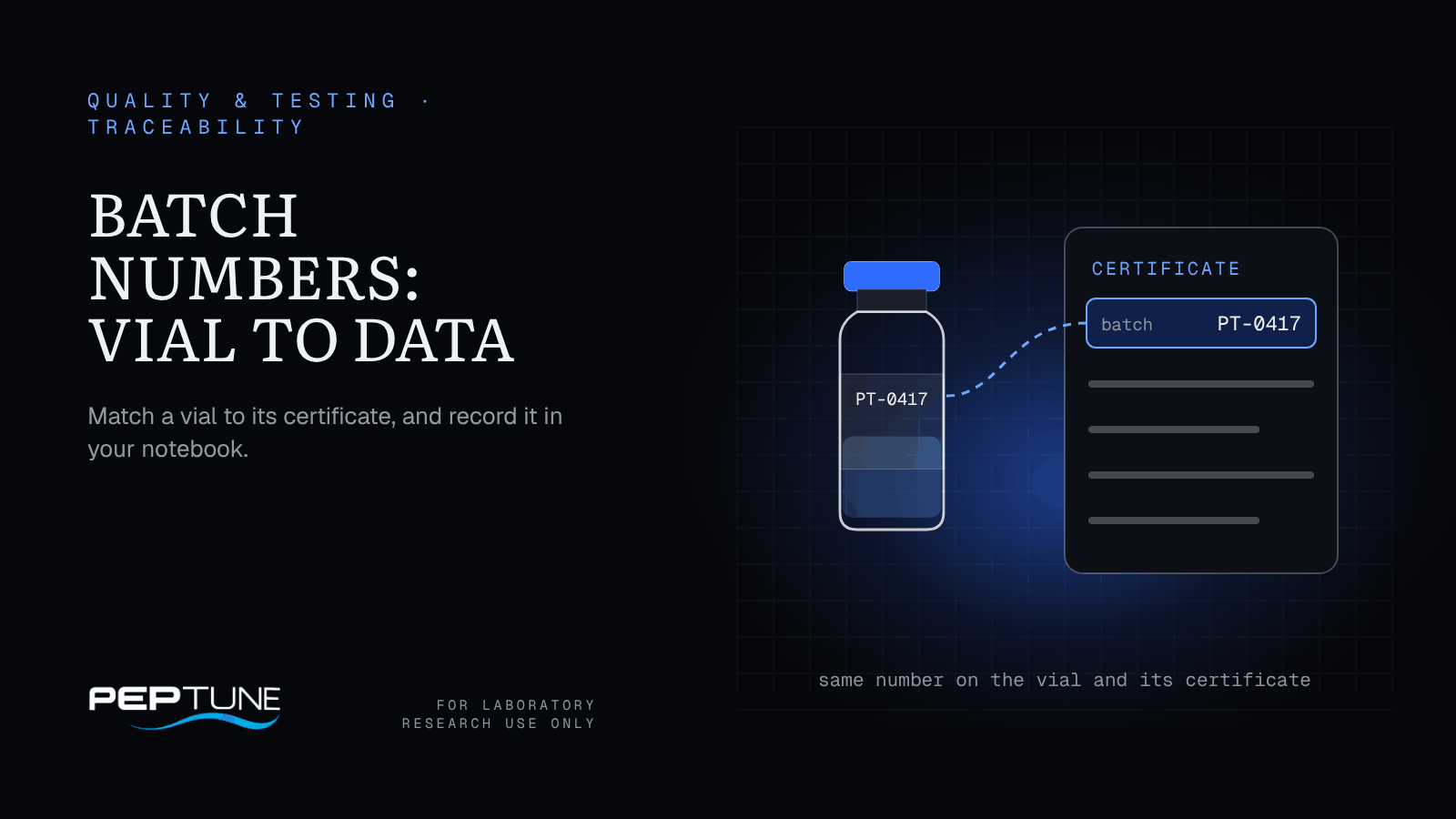
A batch, or lot, is a quantity of material made in one production run under the same conditions. Every vial from that run shares one peptide batch number, and every test result for that run is filed under it. That simple code is the thread that connects the vial on your bench to the analytical data behind it.
This guide explains why the batch number matters, how to verify it in a few minutes, and how to keep the record so your results stay traceable.
Why the peptide batch number matters
Analytical results describe a batch, not a product name. Two batches of the same compound can differ in purity, peptide content and impurity profile, because synthesis, purification and freeze-drying never run exactly the same way twice.
The batch number is the only reliable way to know which results apply to your vial. A certificate for a different batch of the same compound tells you about that other batch. It may be reassuring, but it is not evidence about the material you are using.
This is also why a certificate with no batch number, or with a batch number that does not appear on any vial, has little value. Without the link, the data float free of the material.
What a batch number looks like
There is no single format. Batch numbers are usually a mix of letters and digits, sometimes with a date code built in. What matters is that the same string appears in three places:
- On the vial label.
- On the certificate of analysis for that batch.
- In the supplier's own records, so a question about the batch can be answered.
Some labels also carry a manufacturing date or a retest date. These are useful context, but the batch number is the key that ties everything together.
How to verify a vial
Do this when a vial arrives, before it goes into storage:
- Find the batch number on the vial label.
- Find the batch number on the certificate.
- Check that they match exactly, character for character. Watch for look-alike characters such as O and 0, or I and 1.
- Check that the compound name and the stated amount also match.
- Check that the certificate shows identity data, usually by mass spectrometry, and purity data, usually by HPLC.
If any of these do not line up, set the vial aside and ask the supplier before using it. A mismatch is often a simple labelling or filing slip, but it should be resolved before the material produces data.
For a closer look at the certificate itself, see how to read a certificate and the list of certificate red flags.
Reading the data behind the number
Once the numbers match, the certificate tells you what was measured for that batch. Two results matter most:
- Identity: the measured mass should agree with the expected molecular weight of the sequence. See mass spectrometry for peptide identity.
- Purity: the share of the main peak in an HPLC chromatogram. See HPLC and peptide purity and what a purity percentage means.
Purity by HPLC and net peptide content are different measurements. A certificate may report one, the other or both, and it helps to know which you are looking at.
Keep the record
Write the batch number into your lab notebook every time a vial is opened or a solution is prepared. A useful entry includes:
- Compound, amount and batch number.
- Date received and storage location.
- Date opened and what was prepared, with the solvent used.
- Where the certificate for that batch is filed.
If a result later looks unusual, the batch number lets you check whether other work with the same material shows the same pattern. If two batches behave differently, your notes let you separate a material difference from a change in method.
When you prepare solutions, label each container with the batch number as well. An unlabelled aliquot in a freezer box is material whose history has been lost. For more on this, see peptide handling best practices.
When you hold more than one batch
Laboratories that reorder the same compound often end up with two batches on the shelf. Keep them physically separate, use one batch at a time within a series of experiments where you can, and note any switch from one to the other. Mixing batches within one experiment makes it much harder to explain an odd result.
At Peptune
Peptune publishes certificates of analysis on each product page as they arrive, and in the certificate library, so you can match your vial to its data. Compounds such as BPC-157 and TB-500 and GHK-Cu are listed with their documentation alongside the rest of the catalogue.
Orders ship across Canada by tracked mail. Shipping is $20 or $25 depending on the province and free on orders of $150 or more, and payment is by Interac e-Transfer or crypto.
For laboratory research use only. Nothing in this article is medical advice or a suggestion to use any compound on people or animals.
For laboratory research use only. Not for human or veterinary use. Nothing here is medical advice.