
Quality & testing · 3 min read
What a purity percentage does and does not mean
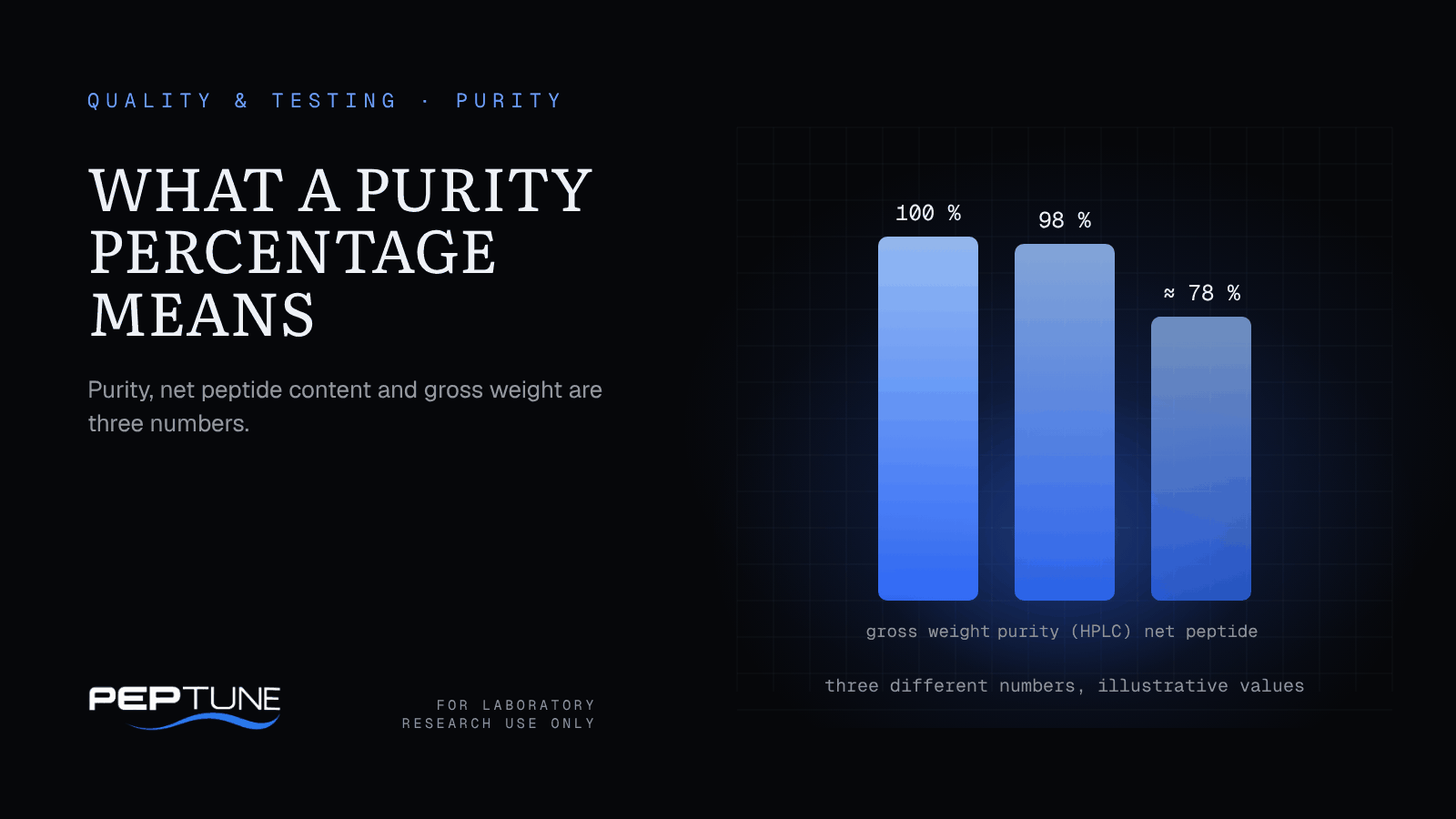
Two vials can both be "99% pure" and still contain different amounts of peptide. The reason is that purity, net peptide content and weight measure different things. This article explains each number, how they fit together and how to use them when a protocol depends on an exact concentration.
Purity
HPLC purity is the share of the ultraviolet-absorbing material that elutes as the main peak. It describes how much of the peptide-like material is the target sequence rather than related impurities, such as deletion or truncated sequences, oxidised forms or chains with a leftover protecting group.
Because the detector responds mainly to peptide bonds, purity is blind to anything that does not absorb at that wavelength. It answers "how much of the peptide is the right peptide?" and nothing more. It is also a share of peak area, not of weight: different compounds absorb light differently, and an impurity that is not separated from the main peak, or not detected at all, cannot be counted. Our guide to HPLC peptide purity explains how the figure is produced and how to read the chromatogram behind it.
Net peptide content
Lyophilized peptides also contain water and counter-ions, the salts left from synthesis and purification, commonly acetate or trifluoroacetate. These do not show up in HPLC purity. Net peptide content is the share of the total powder mass that is actually peptide. For many synthetic peptides it falls somewhere between 60% and 90%.
Several factors push the figure up or down:
- Counter-ions: Basic residues such as arginine and lysine each carry a positive charge that pairs with a counter-ion, so sequences rich in them tend to carry more salt by weight.
- Water: Lyophilized powder is hygroscopic and takes up moisture from the air, especially if a cold vial is opened before it reaches room temperature.
- Peptide size: In a short peptide, the same number of counter-ions makes up a larger share of the total mass.
How net peptide content is measured
The most common method is amino acid analysis. The peptide is broken down into its individual amino acids by acid hydrolysis, each amino acid is measured, and the total is compared with the expected composition to work out how much peptide was present. Nitrogen analysis is an alternative: because the nitrogen content of the sequence is known, measuring total nitrogen in a weighed sample gives the peptide fraction. Water content is often measured separately, by Karl Fischer titration.
Gross weight
The amount on the label usually refers to the peptide as supplied. Whether that means total powder or peptide content depends on the manufacturer, which is why the certificate matters. Our guide to reading a certificate of analysis shows where these figures appear.
Putting the numbers together
The three figures multiply rather than add. Take a vial with 10 mg of powder, a net peptide content of 80% and an HPLC purity of 98%:
- peptide in the vial: 10 mg × 0.80 = 8.0 mg;
- of which target sequence: 8.0 mg × 0.98 = about 7.8 mg.
The rest is water, counter-ions and related peptide impurities. A second vial with the same purity but a net peptide content of 70% would hold about 6.9 mg of target sequence. The purity figures match; the amounts do not.
Why net peptide content matters in the lab
If a protocol depends on a precise concentration, the calculation should use net peptide content where it is reported. Using gross weight alone can overstate concentration. Recording both figures from the batch certificate keeps results comparable between batches, and helps explain differences that would otherwise look like changes in the compound itself.
Handling affects the numbers too. Moisture taken up after opening raises the water share of the powder, so let vials reach room temperature before opening and store them as our guide to lyophilized peptide storage describes. Once a peptide is in solution, see peptide stability after reconstitution.
Batch certificates for every order
Peptune publishes certificates of analysis on each product page as they arrive, and in the certificate library, so the figures for a batch can be read before you order. Browse single vials such as IGF-1 LR3 and Semax, or blends such as the KLOW blend. Peptune ships across Canada by tracked mail. Shipping is $20 or $25 depending on the province and free on orders of $150 or more, and payment is by Interac e-Transfer or crypto.
For laboratory research use only. Nothing in this article is medical advice or a suggestion to use any compound on people or animals.
For laboratory research use only. Not for human or veterinary use. Nothing here is medical advice.