
Storage & handling · 3 min read
Peptide stability after reconstitution
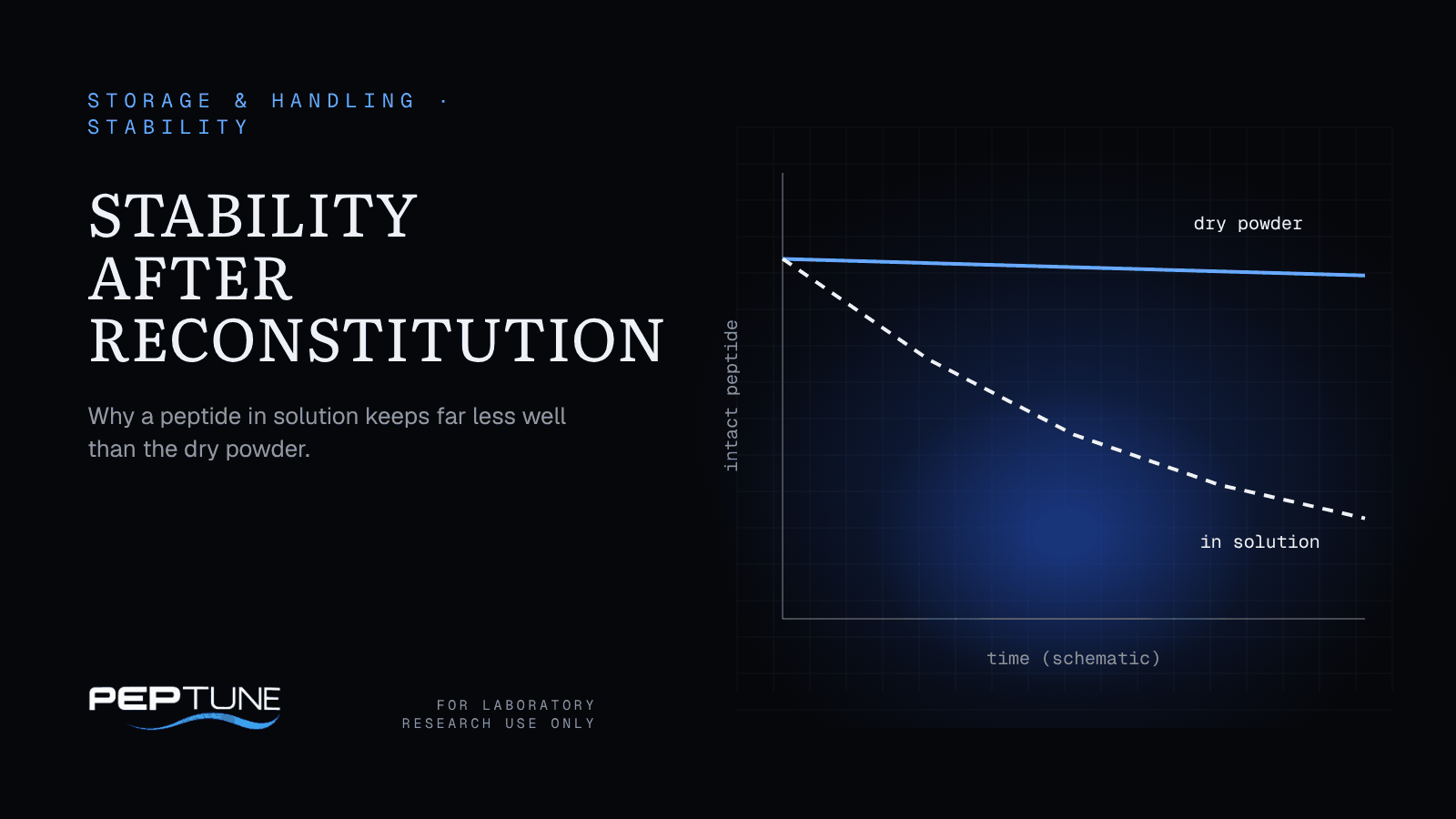
Once water is added back, the chemistry that lyophilization paused starts again. A peptide that keeps for a long time as a dry powder may change within days or weeks in solution. Understanding peptide stability in solution is what lets you prepare material that still matches its certificate when you use it.
What happens to peptide stability in solution
Several reactions run at once, at rates that depend on the sequence and the conditions.
- Hydrolysis: water slowly breaks peptide bonds, especially next to aspartic acid.
- Deamidation: asparagine and glutamine residues can convert to acidic forms. Asparagine followed by glycine is a well-known weak point.
- Oxidation: methionine and cysteine are the usual targets; tryptophan can also be affected.
- Disulfide exchange: free cysteines can pair up between molecules, forming dimers or larger species.
- Aggregation and adsorption: some peptides clump or stick to container walls at low concentrations, so less material is free in solution than you expect.
Each of these changes the material without necessarily changing how the solution looks. A clear solution is not proof of an intact peptide.
What affects the rate
Temperature, pH, the solvent used, concentration and exposure to air all matter.
- Temperature: every reaction above runs faster when warm. Solutions are generally kept refrigerated and protected from light.
- pH: many peptides are most stable in mildly acidic conditions, often around pH 5 to 6. Strongly basic conditions speed up deamidation and disulfide exchange.
- Air: dissolved oxygen drives oxidation. Degassed solvents help for sensitive sequences.
- Container: low-binding plastic or glass reduces losses to the walls for peptides that adsorb.
Choosing a laboratory solvent
The right solvent depends on the sequence. Sterile, high-purity water suits many peptides. Basic peptides often dissolve more easily in dilute acetic acid, and acidic peptides in a dilute basic buffer. Very hydrophobic peptides may need a small amount of an organic solvent such as DMSO before dilution, although DMSO can oxidise methionine and cysteine, so it is avoided for those sequences.
Test solubility on a small portion first rather than committing the whole vial. Work with sterile technique: clean surfaces, sterile pipette tips and closed containers reduce both contamination and microbial growth, which also degrades peptides. Filtering through a 0.22 µm filter is a common step where sterility matters for cell work.
Aliquoting and freezing
Repeated freeze-thaw cycles damage peptides in solution. The standard answer is to divide a fresh solution into single-use aliquots straight away, freeze them, and thaw only one at a time. Any portion left over after an experiment is discarded rather than refrozen.
Size the aliquots to the experiment, not to the vial. If each run needs a small volume, many small aliquots waste less than a few large ones, and each thaws faster and more evenly.
- Prepare only what the experiment needs.
- Record the solvent, concentration, date and batch number on the container.
- Use tubes that seal well and are rated for freezer storage.
- Define in the protocol how long a solution may be used, based on published stability data or your own checks.
Checking stability yourself
Where a study runs over weeks, it is worth confirming stability under your own conditions. Running the same solution by HPLC at the start and at intervals shows whether the main peak shrinks or new peaks appear. Mass spectrometry can then help identify what a new peak is: a mass increase of 16 suggests oxidation, and an increase of about 1 suggests deamidation. See HPLC and peptide purity for how to read the trace.
Compound-specific notes
Blends combine sequences with different weak points, so a solution is only as stable as its least stable component; see BPC-157 and TB-500 as a blend and the BPC-157 and TB-500 vial. Larger molecules such as IGF-1 LR3 are more prone to aggregation and adsorption at low concentrations.
When in doubt
If a solution is cloudy, discoloured or has been stored outside its planned conditions, it should not be used for data that matter. A fresh preparation costs less than a confounded result. See also storing lyophilized peptides and peptide handling best practices.
Start from documented material
Stability planning begins with material you can trace. Peptune publishes certificates of analysis on each product page as they arrive, so the batch you reconstitute is linked to its data. Browse the catalogue. Orders ship across Canada by tracked mail; shipping is $20 or $25 depending on the province and free on orders of $150 or more, and payment is by Interac e-Transfer or crypto.
For laboratory research use only. Nothing in this article is medical advice or a suggestion to use any compound on people or animals.
For laboratory research use only. Not for human or veterinary use. Nothing here is medical advice.