
Storage & handling · 3 min read
Handling NAD+ in the laboratory
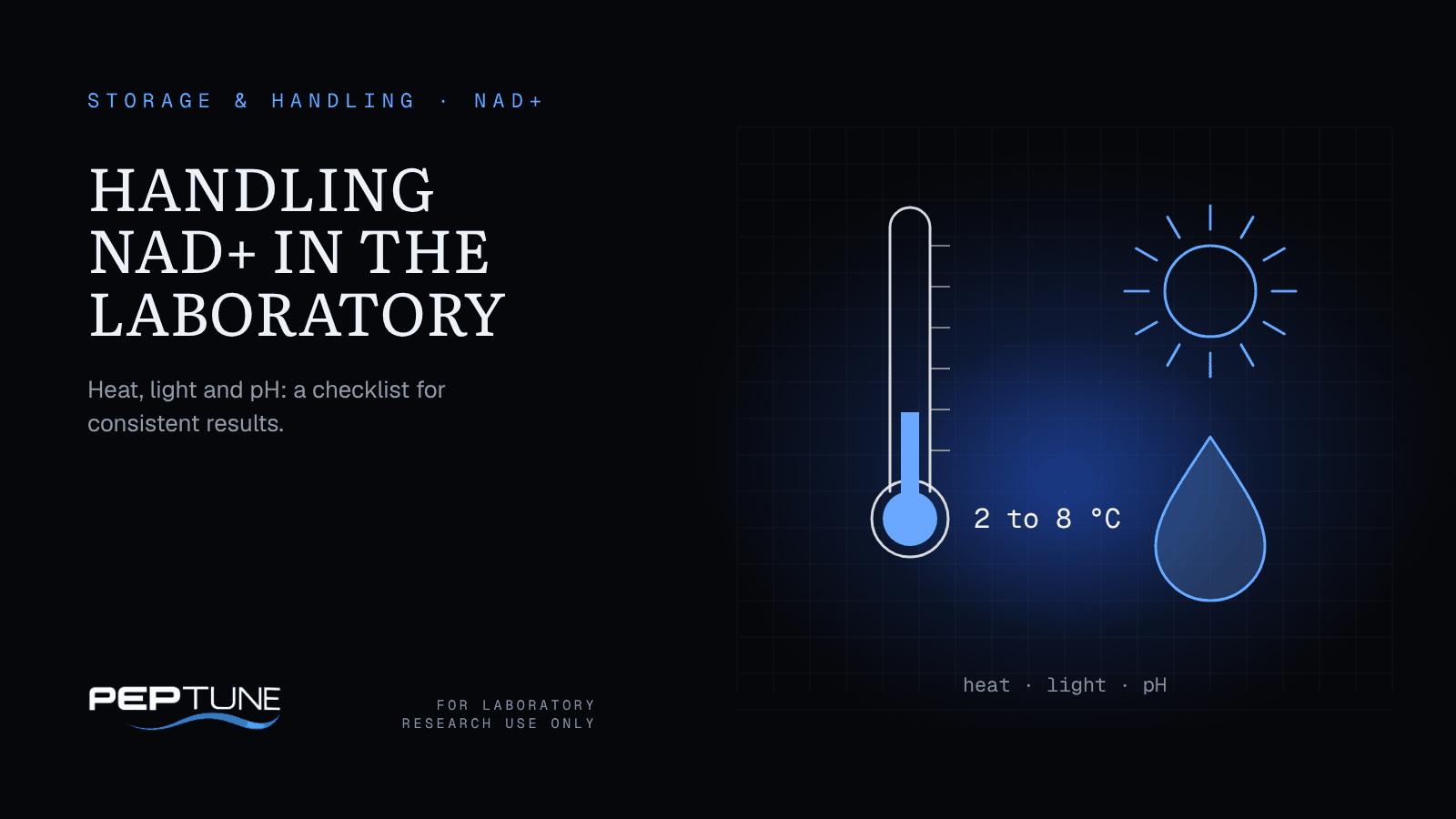
NAD+ is stable as a dry powder and much less forgiving in solution. Most variability in NAD+ experiments comes from preparation, not from the material. Good NAD+ storage and handling come down to a few rules about pH, temperature, light and time, plus records that let you trace any odd result back to its cause.
This checklist covers the vial as supplied, solutions, aliquots, records and a quick identity check you can run with a spectrophotometer.
NAD+ storage as supplied
NAD+ arrives as a lyophilized powder in a sealed vial. Keep it sealed, cold and dark until use, and let it reach room temperature before opening to avoid condensation.
Moisture is the main enemy of the dry powder. Water drawn in by a cold vial opened in warm air can start hydrolysis long before the solution is made. A few habits help:
- store the vial in its outer packaging or a dark box;
- keep it away from the freezer door, where the temperature swings most;
- reseal promptly if you weigh out part of the contents;
- note the date the vial was first opened.
General principles for dry material are covered in lyophilized peptide storage. NAD+ is not a peptide, but the same logic applies.
NAD+ in solution
- pH. NAD+ is most stable in mildly acidic to neutral conditions and degrades faster in alkaline solutions. NADH is the opposite.
- Temperature. Prepare solutions cold and keep them on ice during use.
- Light. Protect solutions from prolonged light exposure.
- Time. Prepare fresh for each run where possible, or aliquot and freeze single-use portions.
The buffer matters too. Some buffer components can react with or accelerate the breakdown of nicotinamide nucleotides, so choose a buffer that is documented for your assay and keep it the same across runs.
Aliquots and freezing
If you cannot prepare fresh every time, aliquoting is the next best option:
- divide the stock into single-use volumes straight after preparation;
- freeze them promptly and label each with the batch, concentration, pH and date;
- thaw each aliquot once, on ice, and discard what is left;
- never refreeze a thawed aliquot.
Repeated freeze-thaw cycles are a common cause of drift between experiments. Our guide to stability after reconstitution explains why, with examples from peptide work that carry over to coenzymes.
Records worth keeping
- batch number and date opened;
- solvent or buffer, with pH;
- concentration, checked by absorbance at 260 nm where the method allows;
- time from preparation to use;
- storage temperature of any aliquots.
These five lines turn a puzzling result into a traceable one. If a run looks wrong, you can see at once whether the solution was old, warm or at the wrong pH. Match the batch number to the certificate as described in batch number verification.
A quick identity check
NAD+ absorbs strongly at 260 nm. NADH has an additional peak at 340 nm. A 340 nm reading on a fresh NAD+ solution indicates reduction or contamination.
A simple routine:
- blank the spectrophotometer with the same buffer used for the sample;
- scan or read at 260 nm and 340 nm;
- confirm that the 260 nm reading fits the expected concentration;
- confirm that the 340 nm reading is close to baseline.
The molar absorption coefficient of NADH at 340 nm is 6,220 per molar per centimetre, so even small amounts of NADH show up clearly. This is not a full purity analysis, but it is a fast way to catch a degraded or mislabelled solution before it costs a day of work.
Why it matters
NAD+ assays often measure ratios, such as NAD+/NADH, or enzyme rates that depend on substrate concentration. A few percent of degradation can change both. Handling errors also tend to be invisible: the solution still looks clear and colourless. Consistent preparation is the only reliable defence. For the biochemistry behind these assays, see what is NAD+.
Ordering NAD+ in Canada
Peptune supplies NAD+ for laboratory research and ships across Canada by tracked mail. Shipping is $20 or $25 depending on the province, free on orders of $150 or more, with Canada Post Priority available at checkout. Payment is by Interac e-Transfer or crypto.
Certificates of analysis are published on each product page as they arrive, so you can read the batch data alongside the product before you order.
Laboratories studying mitochondrial signalling sometimes pair NAD+ work with MOTS-c, a mitochondrial-derived peptide.
For laboratory research use only. Nothing in this article is medical advice or a suggestion to use any compound on people or animals.
For laboratory research use only. Not for human or veterinary use. Nothing here is medical advice.