
Compounds · 3 min read
NAD+: the coenzyme behind redox chemistry
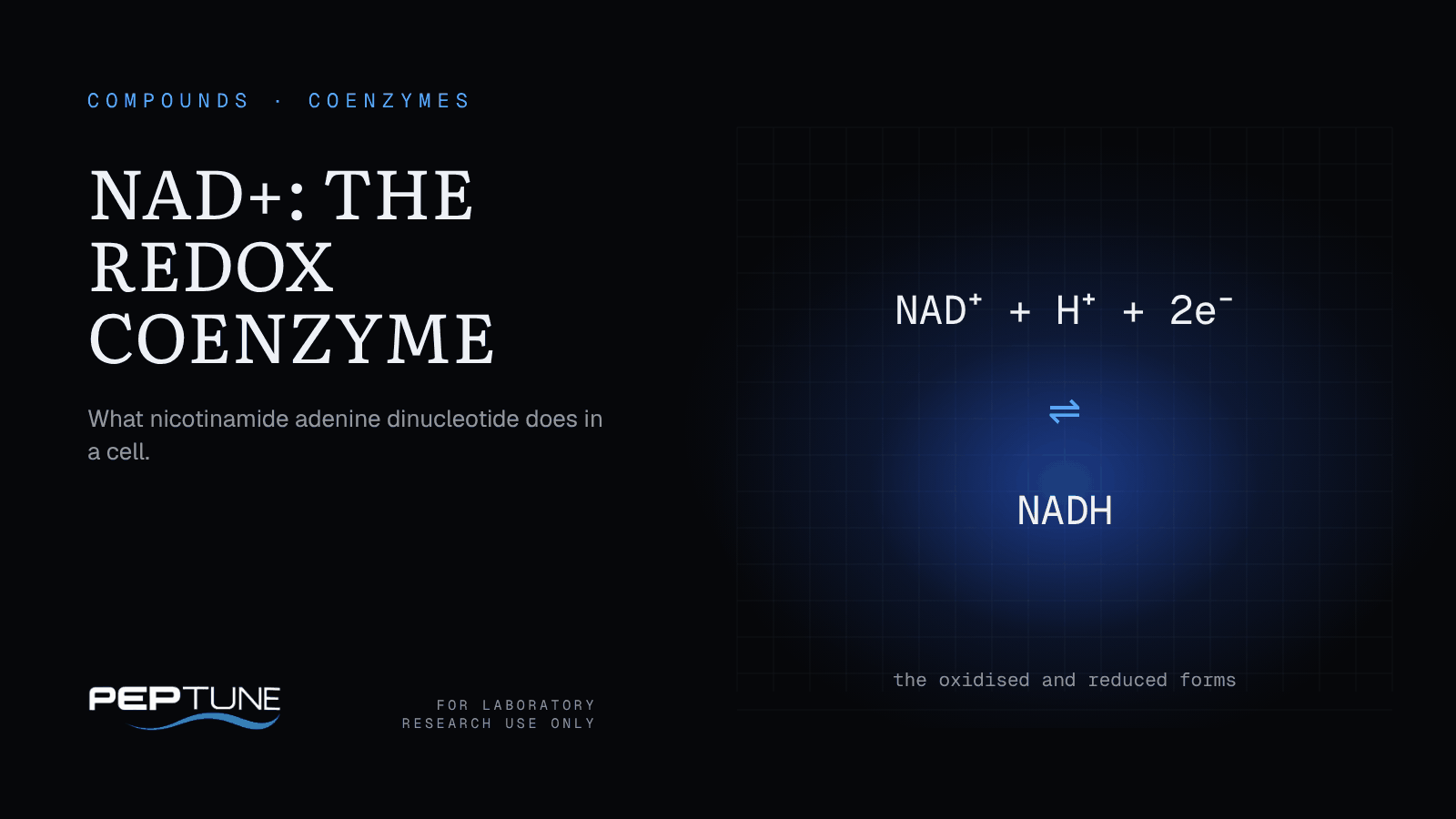
NAD+ is not a peptide. It is a dinucleotide coenzyme, and it is one of the most important small molecules in cellular biochemistry. If you are asking what is NAD+, the short answer is that it is the cell's main carrier of electrons in oxidation-reduction reactions, and a substrate that several signalling enzymes consume.
This guide covers its structure, its two roles, the research areas that rely on it and how to measure it reliably.
What is NAD+ made of?
Nicotinamide adenine dinucleotide is two nucleotides joined through their phosphate groups:
- one nucleotide carries adenine;
- the other carries nicotinamide, the reactive part of the molecule.
Its molecular formula is C21H27N7O14P2 and its molar mass is about 663.4 g/mol. The "+" refers to the positive charge on the nitrogen of the nicotinamide ring in the oxidised form. The reduced form, NADH, carries two extra electrons and a proton on that ring.
NAD was first identified in 1906 by Arthur Harden and William John Young, as a heat-stable factor needed for fermentation in yeast extracts. More than a century later it remains a central subject of enzyme and metabolic research.
A close relative, NADP+, has an extra phosphate on the adenine ribose. It does a separate job, mostly in biosynthesis and antioxidant defence, so assays need to keep the two apart.
Two roles
NAD+ works in two distinct ways:
- As an electron carrier. It cycles between NAD+ and NADH in hundreds of oxidation-reduction reactions, including glycolysis, the citric-acid cycle and the electron transport chain.
- As a substrate that is consumed. Enzymes such as sirtuins (protein deacylases), PARPs (poly-ADP-ribose polymerases) and CD38 break NAD+ apart, linking its supply to signalling and DNA-repair processes.
The first role recycles NAD+. The second uses it up, releasing nicotinamide, which the cell must then rebuild into NAD+.
NAD+ is also not evenly spread through the cell. The cytosol, the mitochondria and the nucleus hold separate pools, and the NAD+/NADH ratio differs between them. A whole-cell measurement averages these pools, which is worth remembering when interpreting results.
Where NAD+ comes from
Cells make NAD+ by more than one route:
- the de novo pathway, starting from the amino acid tryptophan;
- the Preiss-Handler pathway, starting from nicotinic acid;
- the salvage pathway, which recycles nicotinamide, with nicotinamide phosphoribosyltransferase (NAMPT) as a key step.
Precursors such as nicotinamide riboside (NR) and nicotinamide mononucleotide (NMN) enter these routes and are widely used in cell-model research on NAD+ supply.
Research areas
- enzyme kinetics for NAD+-dependent dehydrogenases and sirtuins;
- redox balance, measured as the NAD+/NADH ratio;
- mitochondrial function in cell models;
- NAD+ biosynthesis and salvage pathways, including its precursors;
- PARP activity and DNA-repair assays.
NAD+ also appears in work alongside mitochondrial peptides. Our article on MOTS-c covers a peptide studied in related metabolic models, available as MOTS-c.
What to measure
NAD+ and NADH interconvert readily, and both degrade under some conditions. Assays should state which form is being measured, quench samples quickly and use extraction conditions suited to that form: acid for NAD+, base for NADH.
Common methods include:
- UV absorbance: both forms absorb at 260 nm, and only NADH absorbs at 340 nm;
- enzymatic cycling assays, which amplify small amounts for sensitive detection;
- liquid chromatography with mass spectrometry, which separates NAD+, NADH and related metabolites in one run.
Whatever the method, record sample handling time and temperature. A delay of minutes at room temperature can shift the measured ratio.
Handling NAD+ in the laboratory
As a dry powder NAD+ is stable. In solution it is sensitive to pH, temperature and light, and it degrades faster in alkaline conditions. See our note on handling NAD+ in the laboratory for a practical checklist, and lyophilized peptide storage for general dry-storage practice that applies equally here.
Ordering NAD+ in Canada
Peptune supplies NAD+ for laboratory research and ships across Canada by tracked mail. Shipping is $20 or $25 depending on the province, free on orders of $150 or more, with Canada Post Priority available at checkout. Payment is by Interac e-Transfer or crypto.
Certificates of analysis are published on each product page as they arrive, so you can read the batch data alongside the product before you order.
For laboratory research use only. Nothing in this article is medical advice or a suggestion to use any compound on people or animals.
For laboratory research use only. Not for human or veterinary use. Nothing here is medical advice.