
Compounds · 3 min read
MOTS-c: a peptide encoded in mitochondrial DNA
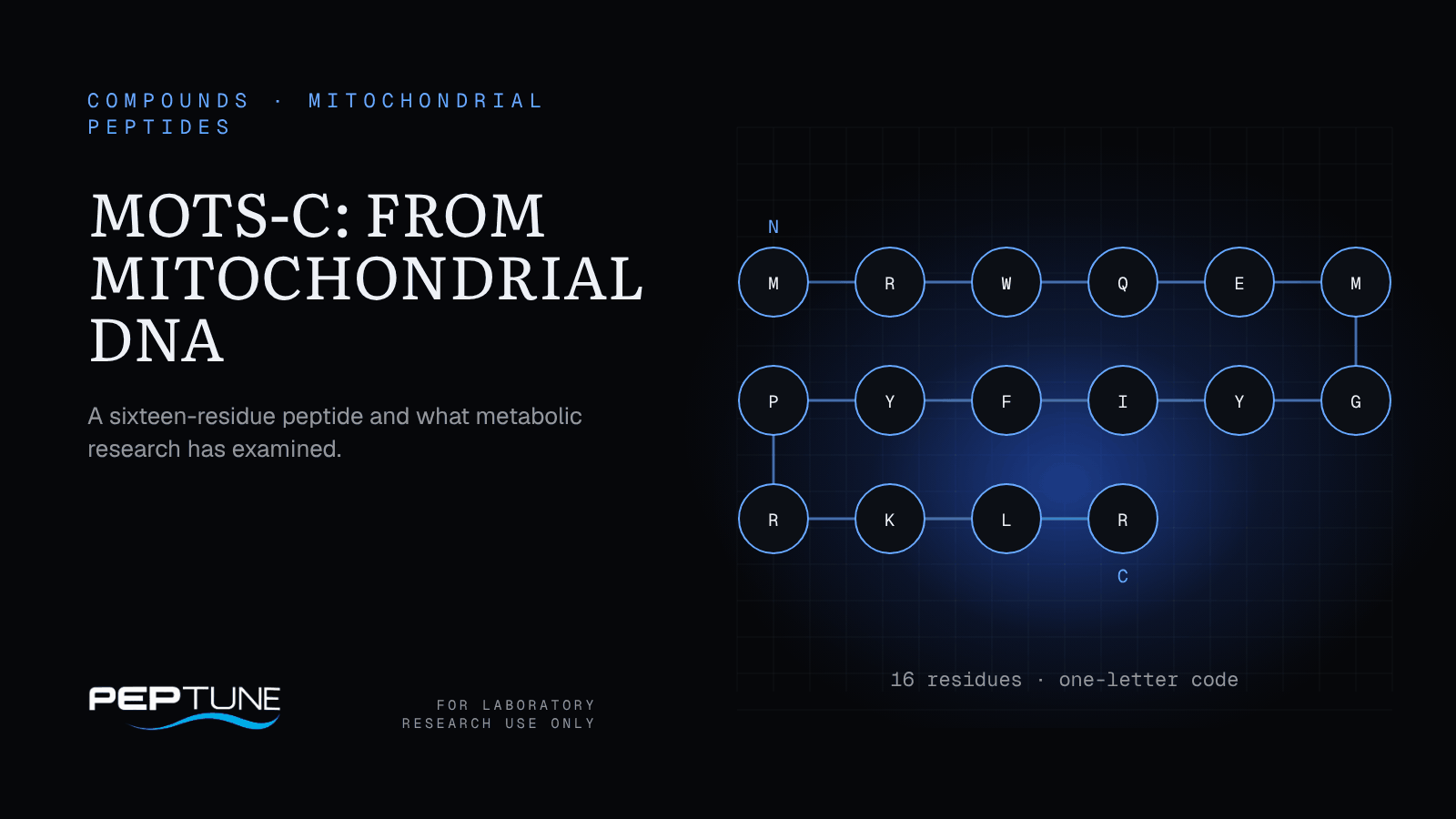
Most peptides are encoded in the cell nucleus. MOTS-c is encoded in the mitochondrion's own small genome, inside the gene for 12S ribosomal RNA. So what is MOTS-c? It is a sixteen-amino-acid peptide from an unexpected source, and one of the best-studied members of a small family of mitochondrial-derived peptides.
This guide covers the molecule, its origin, the research themes so far, how to design experiments around it and how to check a batch.
What is MOTS-c?
MOTS-c (mitochondrial open reading frame of the 12S rRNA type-c) is a sixteen-amino-acid peptide, first described in 2015. Its sequence is MRWQEMGYIFYPRKLR.
Key facts:
- length: 16 residues;
- molecular weight: about 2,174.6 g/mol, calculated from the sequence;
- source: a short open reading frame within the mitochondrial 12S rRNA gene (MT-RNR1);
- character: a basic peptide, rich in arginine and lysine at the C-terminal end, with several aromatic residues (tryptophan, tyrosine, phenylalanine).
A family of mitochondrial-derived peptides
MOTS-c belongs to a small family of mitochondrial-derived peptides that also includes humanin and the small humanin-like peptides (SHLPs), which are encoded in the 16S rRNA gene.
The existence of this family changed how researchers think about the mitochondrial genome. In humans it is a circle of about 16,600 base pairs, tiny compared with the nuclear genome. Its 37 classic genes encode proteins of the respiratory chain, ribosomal RNAs and transfer RNAs. Short open reading frames hidden inside those genes suggest the mitochondrion may also send signals of its own to the rest of the cell.
For MOTS-c, that idea is the central research question: whether and how a peptide made from mitochondrial DNA reports on the state of the mitochondria to the nucleus and to other cells.
Research themes
- Metabolic signalling. Cell and rodent studies have examined MOTS-c in relation to AMPK activation and the folate-methionine cycle.
- Mitochondria-nucleus communication. Some studies report that MOTS-c can move to the nucleus under stress, which makes it a model for retrograde signalling.
- Exercise and ageing models. Animal work has looked at how MOTS-c levels change with physical activity and age.
The field is young. Many findings come from a few laboratories and are still waiting for independent replication. Treat any single result as a starting point for your own controls rather than an established mechanism.
NAD+ metabolism is a frequent companion topic in these models. See what is NAD+ for the coenzyme side, available as NAD+.
Design considerations
Baseline mitochondrial activity varies between cell types and culture conditions, including glucose concentration. Defining and recording these conditions matters as much as the peptide itself.
Points worth fixing in the protocol:
- cell type and passage number;
- glucose and serum concentration in the medium;
- time from medium change to treatment;
- a scrambled-sequence or vehicle control prepared the same way;
- readouts measured at more than one time point.
Handling MOTS-c
MOTS-c is supplied as a lyophilized powder. Keep the vial sealed, cold and dark, and let it reach room temperature before opening.
Its sequence has practical consequences:
- two methionine residues, which can oxidise in solution, so prepare fresh or aliquot and freeze;
- a tryptophan residue, which is light-sensitive;
- a strongly basic C-terminal region, which can stick to glass and some plastics at low concentration, so low-binding consumables help.
See peptide handling best practices and stability after reconstitution for the full routine.
Checking a MOTS-c batch
For a 16-residue peptide, identity and purity checks are straightforward:
- mass spectrometry should show a mass that matches the calculated value for the sequence; an increase of 16 Da can point to methionine oxidation;
- HPLC shows the share of the main peak;
- the batch number on the certificate should match the vial.
Our guides to mass spectrometry for peptide identity and how to read a certificate explain what to look for. Published certificates are collected on the COA studies page.
Ordering MOTS-c in Canada
Peptune supplies MOTS-c for laboratory research and ships across Canada by tracked mail. Shipping is $20 or $25 depending on the province, free on orders of $150 or more, with Canada Post Priority available at checkout. Payment is by Interac e-Transfer or crypto.
Certificates of analysis are published on each product page as they arrive, so you can read the batch data alongside the product before you order.
For laboratory research use only. Nothing in this article is medical advice or a suggestion to use any compound on people or animals.
For laboratory research use only. Not for human or veterinary use. Nothing here is medical advice.