
Compounds · 3 min read
TB-500 and thymosin beta-4: what the name refers to
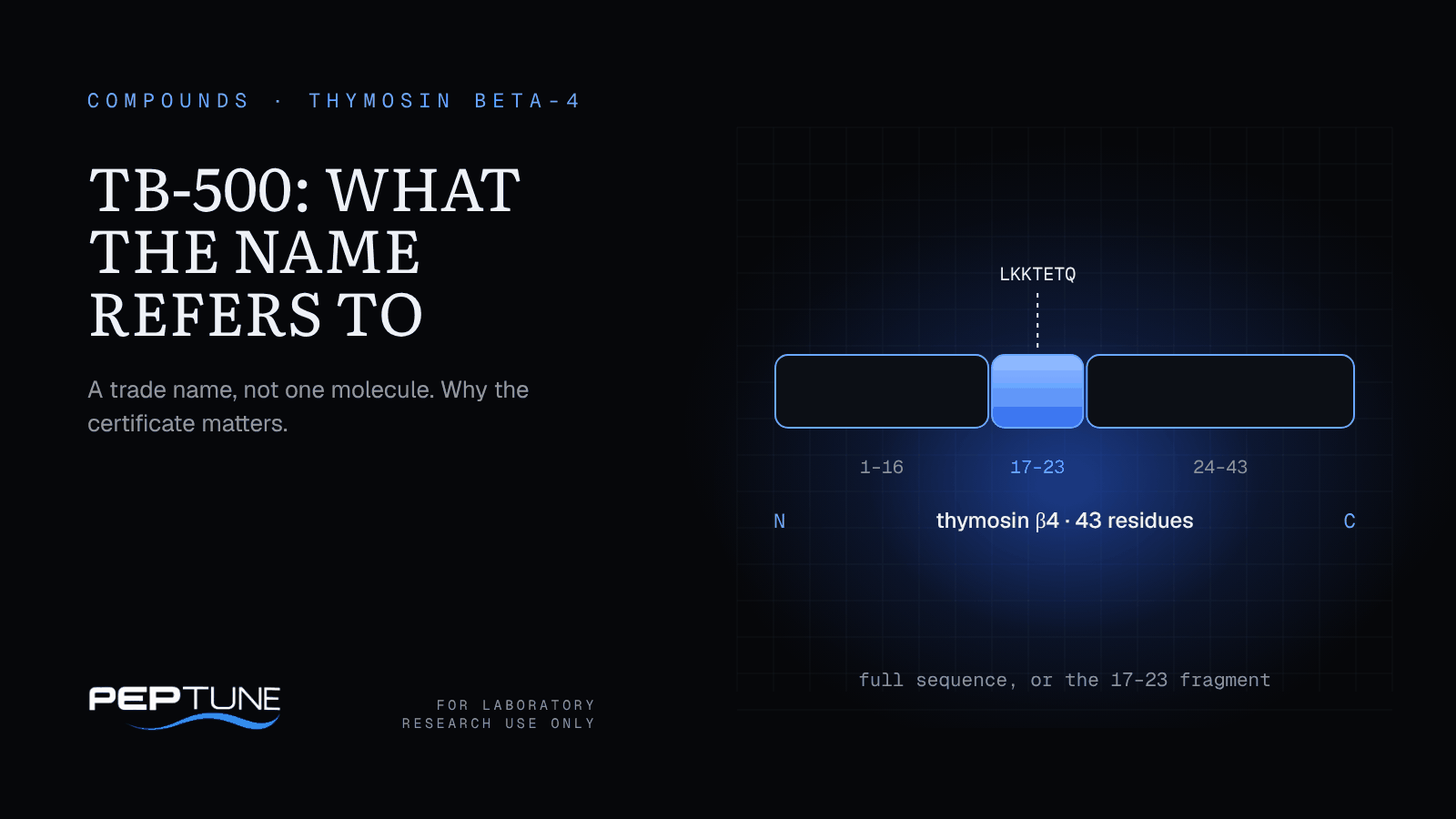
What is TB-500? Few research compounds are named as loosely. TB-500 is a commercial name, not a single defined molecule, and it is used for synthetic peptides related to thymosin beta-4. Understanding what the name refers to is the first step in using it well.
Thymosin beta-4
Thymosin beta-4 (Tβ4) is a naturally occurring protein of 43 amino acids, acetylated at its N-terminus. It was originally isolated from thymus tissue, which gave it its name, but it is found in most cell types and is not specific to the thymus. It belongs to the beta-thymosin family of small actin-binding proteins.
Tβ4 is one of the most abundant actin-sequestering proteins in cells. It binds monomeric G-actin and so influences how the cytoskeleton assembles. That role connects it to cell migration, a process studied in tissue-repair, angiogenesis and developmental models.
Its N-terminal tetrapeptide, Ac-SDKP, can be released by enzymatic cleavage and has its own separate literature. It is a reminder that "thymosin beta-4 research" covers several distinct molecules.
What is TB-500 in practice
"TB-500" is used for a synthetic peptide related to thymosin beta-4, but usage is not uniform:
- some suppliers use it for the full 43-residue sequence;
- others use it for a short fragment around the actin-binding motif, LKKTETQ (residues 17 to 23), often N-terminally acetylated.
Because of this, the name alone does not tell a researcher exactly what is in the vial. Two products both labelled TB-500 can differ more than fivefold in molecular weight. The same care applies when reading a paper: check the methods section for the sequence or form that was used before comparing results.
How TB-500 is supplied
TB-500 is supplied as a lyophilized powder. Like most synthetic peptides purified by reversed-phase HPLC, it is usually a salt, such as acetate or trifluoroacetate, and the counter-ion adds to the weighed mass. When a protocol needs an exact peptide concentration, work from the peptide content on the certificate rather than the gross weight of powder.
Why the certificate matters more for TB-500
Mass spectrometry confirms the molecular weight, and so tells you which sequence was supplied:
- full-length Tβ4 is near 4,960 daltons, and electrospray spectra show it as a series of multiply charged ions;
- the acetylated LKKTETQ fragment is about 889 daltons, well under 1,000.
The full-length sequence also contains a methionine near its N-terminus. Oxidation of that residue adds 16 daltons, which shows up as a satellite peak in the mass spectrum. The short fragment contains no methionine. HPLC then reports how much of the material is the main peptide.
A certificate that states only "TB-500" and a purity figure, with no mass, leaves the main question unanswered. Our guides to mass spectrometry for peptide identity and certificate red flags explain what to look for.
What has been studied
Published research on thymosin beta-4 includes:
- cell-migration and actin-dynamics studies in culture;
- endothelial-cell assays related to angiogenesis;
- rodent models of dermal and corneal wound repair;
- cardiac-tissue models examining progenitor-cell signalling.
These are model-specific findings. They describe what was observed under defined experimental conditions, and most were made with full-length Tβ4 rather than a short fragment. Results from one form should not be assumed for the other.
Laboratory handling
Store TB-500 as a lyophilized powder, dry, cold and dark. Let the vial reach room temperature before opening, reconstitute only what the run needs, and avoid repeated freeze-thaw cycles. For the full-length form, minimising air exposure in solution limits methionine oxidation. Record every preparation against the batch number. Our peptide handling best practices guide covers the routine.
TB-500 and BPC-157
TB-500 is often named with BPC-157, a fifteen-residue peptide with a different origin and proposed mechanism. See what BPC-157 is and the comparison in BPC-157 vs TB-500. Researchers who want both in one preparation can read about the BPC-157 + TB-500 blend and how to design controls around it.
Ordering TB-500 in Canada
TB-500 appears in the BPC-157 + TB-500 blend and in the GLOW and KLOW blends. There is no standalone TB-500 vial. Peptune ships across Canada by tracked mail. Shipping is $20 or $25 depending on the province, free on orders of $150 or more, with Canada Post Priority available at checkout. Payment is by Interac e-Transfer or crypto, and certificates of analysis are published on each product page as they arrive. Check the certificate for the mass of the TB-500 component in your batch.
For laboratory research use only. Nothing in this article is medical advice or a suggestion to use any compound on people or animals.
For laboratory research use only. Not for human or veterinary use. Nothing here is medical advice.