
Comparisons · 3 min read
BPC-157 vs TB-500: two different molecules
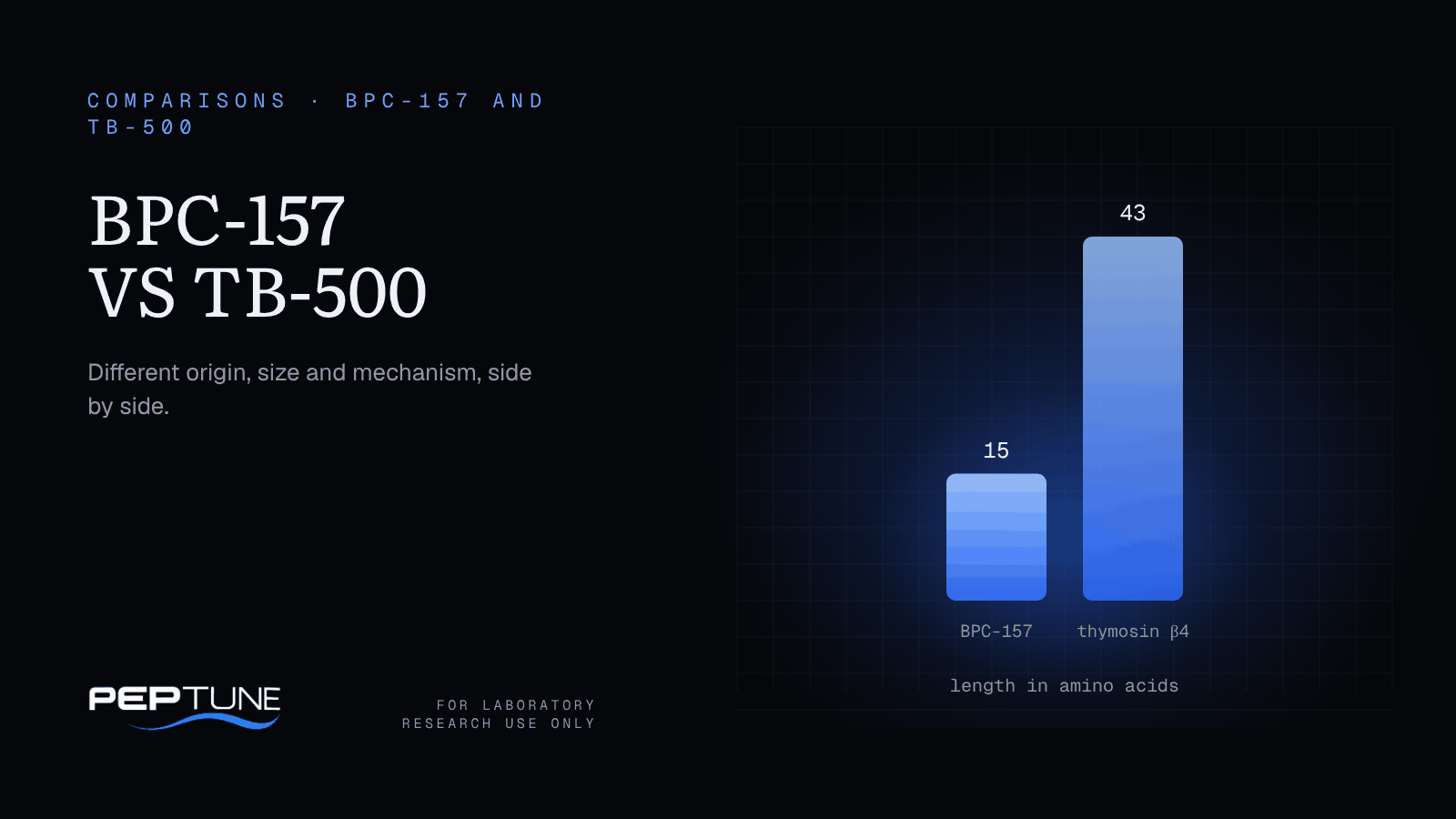
BPC-157 and TB-500 are so often named together that they are sometimes treated as interchangeable. They are not. This BPC-157 vs TB-500 comparison sets out how the two molecules differ in origin, size, proposed mechanism, stability and analytical identity, and what that means when choosing between them.
BPC-157 vs TB-500 at a glance
- BPC-157: synthetic, 15 residues, about 1,419 daltons, described from a protein in gastric juice.
- TB-500: synthetic, related to thymosin beta-4, either 43 residues (near 4,960 daltons) or a short fragment (under 1,000 daltons), depending on the supplier's definition.
The detail behind each line follows.
Origin
BPC-157 is a synthetic fifteen-residue fragment described from a protein in gastric juice. The name stands for "body protection compound", given by the group that first described it in the early 1990s.
TB-500 is a synthetic peptide related to thymosin beta-4 (Tβ4), an abundant intracellular actin-binding protein. Tβ4 was originally isolated from thymus tissue but is found in most cell types. "TB-500" is a commercial name rather than a defined molecule.
Size and structure
- BPC-157: 15 amino acids, sequence GEPPPGKPADDAGLV, about 1.4 kDa. Proline-rich, no cysteine, no methionine.
- TB-500: depends on the supplier's definition. It ranges from a seven-residue fragment around the actin-binding motif LKKTETQ (residues 17 to 23 of Tβ4) to the full 43-residue sequence (about 5 kDa), which is acetylated at the N-terminus and contains one methionine.
So a vial of TB-500 may hold a molecule smaller than BPC-157, or one more than three times its size. The certificate is the only way to know.
Proposed mechanisms in research models
- BPC-157: studied for interactions with growth-factor receptor signalling (including VEGFR2), the nitric oxide system, focal adhesion kinase signalling and fibroblast migration.
- TB-500 / Tβ4: studied mainly through actin sequestration and its downstream effects on cell motility and angiogenesis.
These are proposed mechanisms drawn from cell culture and rodent models. For both peptides, controlled human data are very limited, and much of the BPC-157 literature comes from a small number of groups. Treat each as a hypothesis about a particular model.
Research models examined
- BPC-157 has been examined in tendon and ligament fibroblast culture and in rat models of gastric and intestinal lesions.
- Thymosin beta-4 has been examined in cell-migration assays, rodent models of dermal and corneal wound repair, and cardiac-tissue models of progenitor-cell signalling.
The overlap is in cell migration and angiogenesis-related signalling, which is why the two are sometimes studied together.
Stability
BPC-157 is reported to be unusually stable in acidic conditions for a peptide of its size. Thymosin beta-4 fragments behave more like typical short peptides: best stored dry and cold. Full-length Tβ4 adds one more concern, since its methionine can oxidise in solution. Our guide to lyophilized peptide storage covers storage for both.
Analytical identity
Because the two differ so much in mass, mass spectrometry tells them apart easily. BPC-157 gives a singly protonated ion near 1,420 m/z. Full-length Tβ4 shows a series of multiply charged ions that deconvolute to near 4,960, while the short fragment sits under 1,000. That also makes it straightforward to confirm both components in a blend. See mass spectrometry for peptide identity and HPLC peptide purity for how each analysis works.
Choosing between them
The choice depends entirely on the research question:
- a study of actin dynamics points to thymosin beta-4 and its fragments;
- a study of gastric-mucosa models has historically used BPC-157;
- a study that wants both signals present at once can use a blend, with single-component arms as controls.
For more on each molecule, read what BPC-157 is and what TB-500 is. For the design of a combined study, see the BPC-157 + TB-500 blend.
Ordering BPC-157 and TB-500 in Canada
Peptune supplies both peptides together in the BPC-157 + TB-500 blend, and both are also components of GLOW and KLOW. Peptune ships across Canada by tracked mail. Shipping is $20 or $25 depending on the province, free on orders of $150 or more, with Canada Post Priority available at checkout. Payment is by Interac e-Transfer or crypto, and certificates of analysis are published on each product page as they arrive.
For laboratory research use only. Nothing in this article is medical advice or a suggestion to use any compound on people or animals.
For laboratory research use only. Not for human or veterinary use. Nothing here is medical advice.