
Comparisons · 3 min read
Semax and Selank: two stabilised heptapeptides
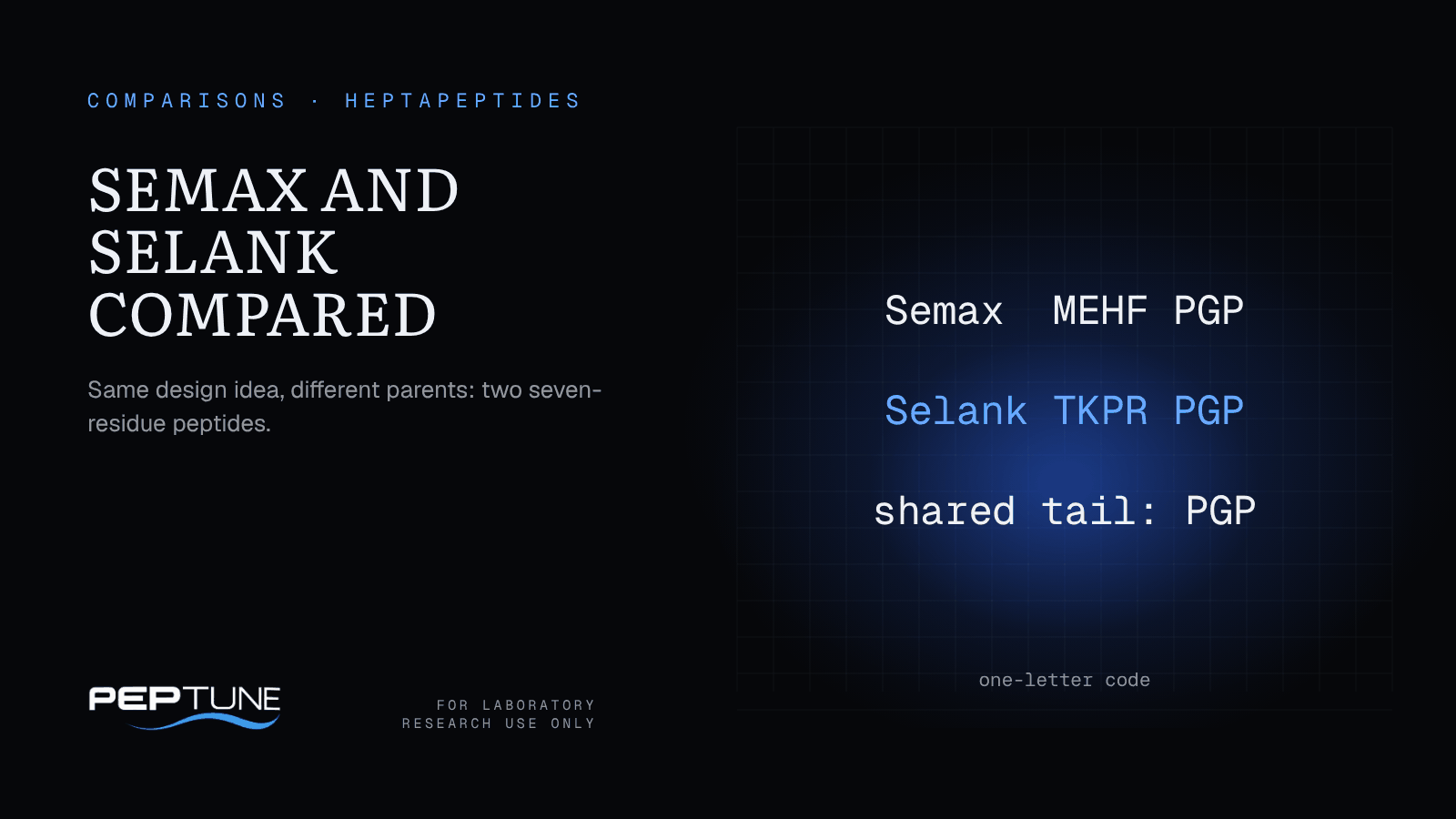
Semax and Selank were developed with the same strategy: take a short, biologically active natural peptide and add a Pro-Gly-Pro tail to protect it from enzymes. Semax vs Selank is therefore a comparison of two parent molecules wearing the same stabilising tail.
Both were developed in Russia, and both are seven-residue peptides, or heptapeptides. This guide compares their sequences, explains the Pro-Gly-Pro design and summarises what research models have examined.
Sequences
- Semax: Met-Glu-His-Phe-Pro-Gly-Pro, built on the ACTH(4-7) fragment.
- Selank: Thr-Lys-Pro-Arg-Pro-Gly-Pro, built on tuftsin, a tetrapeptide from the immunoglobulin G heavy chain.
Calculated from their sequences, Semax has a molecular weight of about 813.9 g/mol and Selank about 751.9 g/mol.
Semax vs Selank: the parent peptides
The two share their last three residues and nothing else. Their first four residues come from very different sources.
- Semax starts with ACTH(4-7), Met-Glu-His-Phe, a short fragment of adrenocorticotropic hormone. On its own, a fragment this short lacks the parts of ACTH needed for its classic hormonal activity, which is why researchers use it as a neuropeptide model rather than a hormone analogue.
- Selank starts with tuftsin, Thr-Lys-Pro-Arg, released from the Fc region of immunoglobulin G. Tuftsin was first studied for its activity on phagocytic immune cells.
At a glance:
- shared: seven residues, a C-terminal Pro-Gly-Pro tail, supplied as lyophilized powder;
- Semax: parent ACTH(4-7), about 813.9 g/mol, contains methionine;
- Selank: parent tuftsin, about 751.9 g/mol, rich in basic residues.
The contrast matters. Semax is acidic and contains methionine and histidine; Selank is basic, carrying lysine and arginine. They behave differently in solution and on chromatography columns as well as in signalling studies.
Why Pro-Gly-Pro
Short linear peptides are cleared quickly by peptidases. The Pro-Gly-Pro tripeptide resists many of them and is itself a degradation product of collagen, which makes it a well-tolerated stabilising sequence in experimental systems.
Proline residues restrict the peptide backbone and are poor substrates for many common peptidases. Adding the tail to the C-terminus protects the active N-terminal part from enzymes that work from that end.
Research areas
- Semax has been studied in rodent and cell models for its effects on the expression of neurotrophic factors such as BDNF, and in models of neuronal stress.
- Selank has been examined in rodent behavioural models and in gene-expression studies, including work on GABAergic and monoaminergic signalling genes.
Much of the literature on both comes from the institutes where they were developed, so independent replication is a recurring theme. Read primary papers closely and plan controls that would let your own results stand on their own.
Using them together
Their shared design makes them a natural pair for stability studies. Their different parent molecules make them useful contrasts in signalling studies.
Because the tail is identical, any difference between the two in a stability assay reflects the parent sequence. Because the parents differ, any shared effect in a signalling assay deserves a closer look at the tail itself.
Possible designs include:
- comparing degradation of each peptide with and without the Pro-Gly-Pro tail in the same enzyme or serum preparation;
- running the parent fragments, ACTH(4-7) and tuftsin, as controls alongside the stabilised versions;
- testing both peptides in the same model to separate effects of the shared tail from effects of the parent sequence.
Handling and storage
Both are supplied as lyophilized powders. Keep vials sealed, cold and dark, and let them reach room temperature before opening. Semax contains methionine, which can oxidise in solution, so prepare fresh solutions or freeze single-use aliquots.
Our guides to lyophilized peptide storage and peptide handling best practices cover the details.
Checking a batch
Short peptides are simple to verify. Mass spectrometry should match the calculated mass for each sequence, and HPLC shows the share of the main peak. Check that the batch number on the certificate matches the vial. See how to read a certificate and the COA studies page.
Ordering Semax and Selank in Canada
Peptune supplies Semax and Selank for laboratory research and ships across Canada by tracked mail. Shipping is $20 or $25 depending on the province, free on orders of $150 or more, with Canada Post Priority available at checkout. Payment is by Interac e-Transfer or crypto.
Certificates of analysis are published on each product page as they arrive, so you can read the batch data for both peptides before you order. Browse all single vials.
For laboratory research use only. Nothing in this article is medical advice or a suggestion to use any compound on people or animals.
For laboratory research use only. Not for human or veterinary use. Nothing here is medical advice.