
Storage & handling · 3 min read
Storing lyophilized peptides
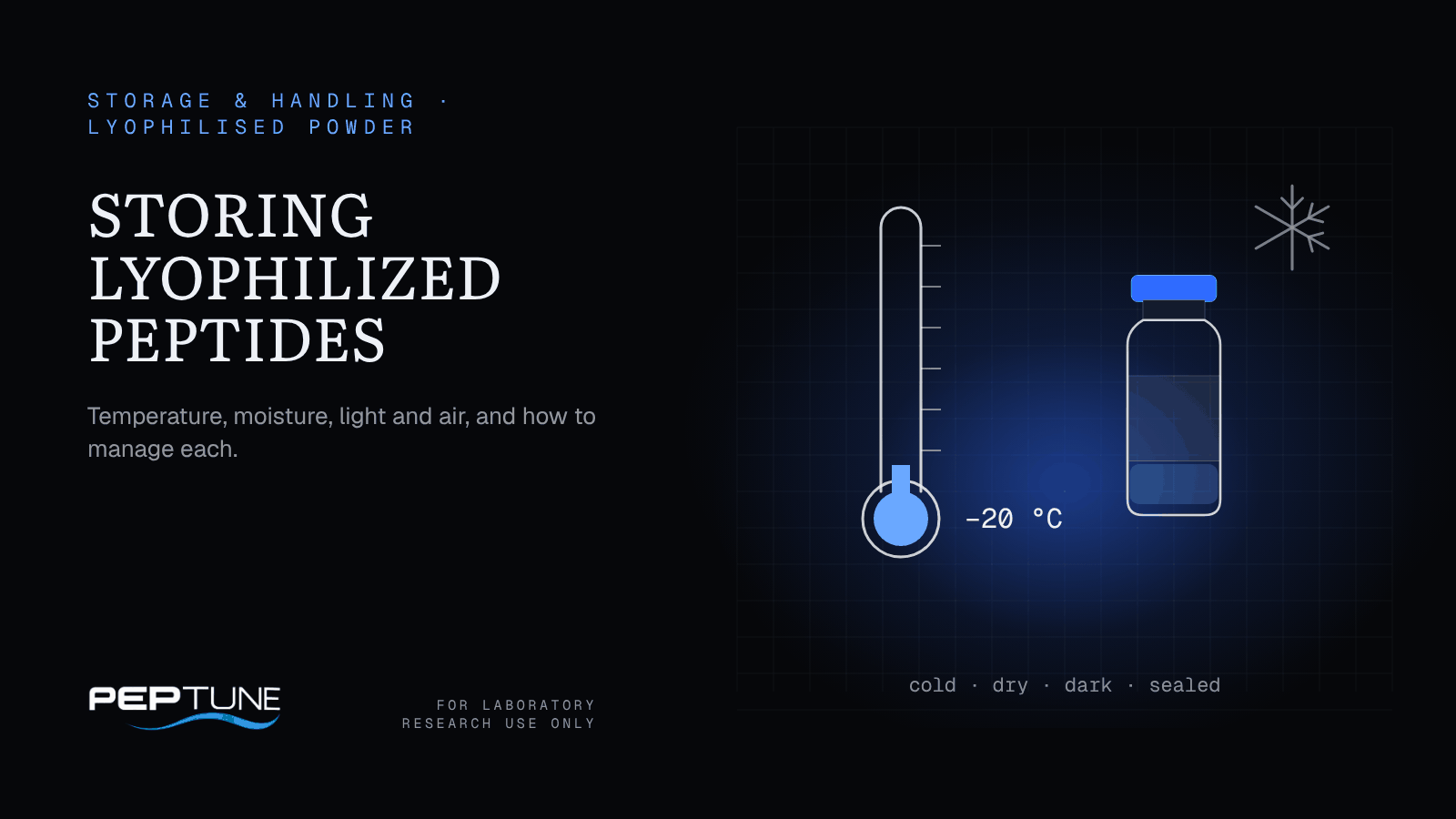
Lyophilization, or freeze-drying, removes water from a peptide solution under vacuum and leaves a dry cake or powder. Without water, most of the chemical reactions that break peptides down slow to a crawl. That is why research peptides are shipped dry, and why good lyophilized peptide storage is mostly about keeping that dryness and that chemistry paused.
Four factors decide how long a dry peptide stays intact: temperature, moisture, light and air. Each is easy to control once you know what it does.
Temperature
Cold slows degradation further. For storage beyond a few weeks, freezer temperatures (around -20 °C) are the common choice. For long-term storage of reference material or of sensitive sequences, many laboratories use -80 °C.
Many lyophilized peptides tolerate room temperature for short periods such as shipping, but that is not a storage plan. Move vials to their planned storage as soon as they arrive.
A few practical points:
- Use a freezer without an automatic defrost cycle if you can. Frost-free freezers warm up periodically, which adds small temperature swings.
- Keep peptides away from the freezer door, where temperature changes most each time it opens.
- A fridge (around 2 to 8 °C) is fine for short-term storage of a dry vial, but less suitable for months.
Moisture: the main enemy of lyophilized peptide storage
Lyophilized peptides are often hygroscopic: they attract water from the air. Even a small amount of absorbed moisture restarts hydrolysis and other reactions, and can make the powder clump, which also makes weighing less accurate.
Before opening a vial that has been in the cold, let it reach room temperature while still sealed, so condensation does not form inside. This can take from a few minutes to half an hour, depending on vial size. Close it promptly after use.
Further steps that help:
- Store vials in a sealed container with a desiccant, especially in a shared or frequently opened freezer.
- Keep the original seal intact until the vial is actually needed.
- Weigh out quickly, in a low-humidity area where possible.
Light and air
Some residues, such as methionine, cysteine and tryptophan, oxidise readily. Light can drive photo-oxidation, and air supplies the oxygen.
Keep vials in their packaging or in the dark, and minimise how often and how long they are open. For particularly oxidation-prone sequences, some laboratories flush the vial headspace with an inert gas such as nitrogen or argon before resealing.
Peptides containing free cysteine can also form disulfide bonds between molecules when exposed to air, which changes the material you are working with.
Freeze-thaw cycles
Repeated warming and cooling adds moisture and stress each time. Where a vial will be used several times, plan ahead: decide what will be prepared and when, rather than taking the vial in and out of the freezer repeatedly.
A common approach is to weigh the dry powder into several smaller portions in one session, under dry conditions, so each later experiment opens only one portion. Another is to reconstitute once and divide the solution into single-use aliquots. Solutions are far less stable than dry powder, so read peptide stability after reconstitution before choosing that route.
Compound-specific notes
General rules cover most sequences, but some materials need extra care. Copper complexes such as GHK-Cu are best kept dry and dark. Coenzymes like NAD+ are sensitive to moisture and heat; see handling NAD+. Where the supplier gives storage conditions on the label or certificate, follow those.
Record it
Note the date received, storage location and each opening against the batch number. If a later result looks odd, a clear storage history helps you rule the material in or out. See batch number verification and peptide handling best practices.
Signs a dry peptide may have degraded
- The powder has turned sticky, glassy or clumped.
- There is visible discolouration.
- The cake has shrunk or collapsed after a storage problem such as a freezer failure.
None of these proves degradation, but each is a reason to check the material analytically or replace it before using it for data that matter.
Order dry, store well
Peptune supplies research peptides as lyophilized powder, with certificates of analysis published on each product page as they arrive. Browse single vials, blends or the full catalogue. Orders ship across Canada by tracked mail; shipping is $20 or $25 depending on the province and free on orders of $150 or more, and payment is by Interac e-Transfer or crypto.
For laboratory research use only. Nothing in this article is medical advice or a suggestion to use any compound on people or animals.
For laboratory research use only. Not for human or veterinary use. Nothing here is medical advice.