
Comparisons · 3 min read
KLOW vs GLOW: how the two blends differ
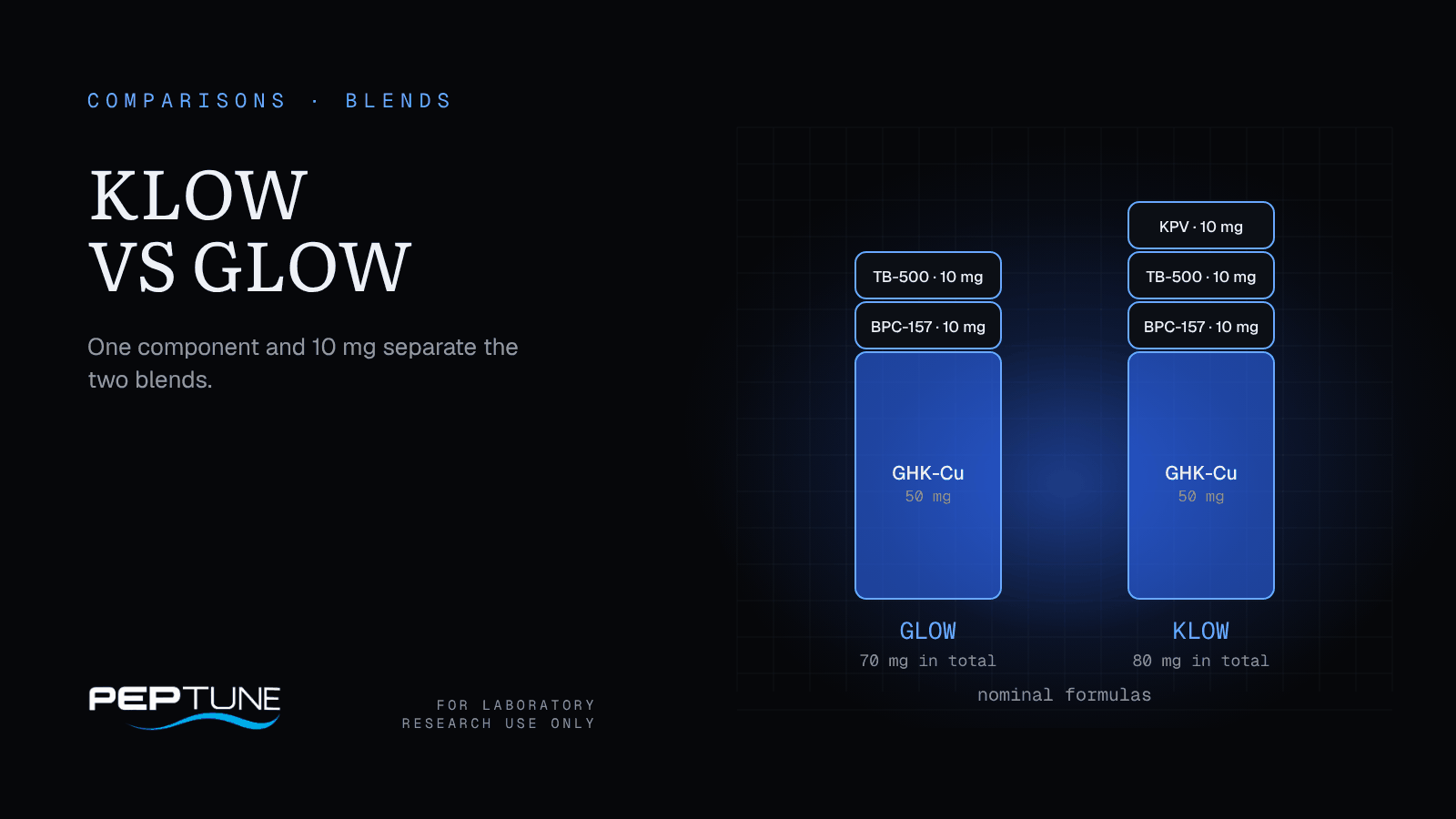
KLOW and GLOW are closely related research blends. In KLOW vs GLOW, the difference is one component: KPV. This guide compares the two formulas, explains what the extra tripeptide is, and shows how to use the pair in a study.
KLOW vs GLOW side by side
- GLOW, 70 mg: GHK-Cu 50 mg, BPC-157 10 mg, TB-500 10 mg.
- KLOW, 80 mg: GHK-Cu 50 mg, BPC-157 10 mg, TB-500 10 mg, KPV 10 mg.
These are the formulas as commonly listed. The batch certificate is the record for a given vial.
Mass share of each component
Because the totals differ, the same 10 mg is a different share of each vial:
- in GLOW, GHK-Cu is about 71 percent of the mass, and BPC-157 and TB-500 are about 14 percent each;
- in KLOW, GHK-Cu is 62.5 percent, and BPC-157, TB-500 and KPV are 12.5 percent each.
This matters when a protocol is written per milligram of blend rather than per component. A given mass of KLOW contains less of the three shared components than the same mass of GLOW. Calculating each component's concentration separately avoids that trap.
The shared core
Both blends contain the same three components:
- GHK-Cu, the copper complex of glycyl-histidyl-lysine, examined in fibroblast culture and extracellular-matrix models (see what is GHK-Cu);
- BPC-157, a synthetic fifteen-residue peptide examined in fibroblast culture and rat gastrointestinal models (see what is BPC-157);
- TB-500, a synthetic peptide related to thymosin beta-4, examined through actin dynamics and cell migration (see what is TB-500).
The same pair without GHK-Cu is available as the BPC-157 + TB-500 blend.
What KPV adds
KPV is the tripeptide Lys-Pro-Val, the C-terminal end of alpha-MSH, with a molecular weight of about 342 daltons. In research it has been examined in epithelial-cell and inflammatory-signalling models, including work on its uptake by the PepT1 peptide transporter in intestinal epithelial cells. Adding it makes KLOW a four-signal preparation instead of three.
KPV contains no aromatic residues, so it absorbs only weakly at longer UV wavelengths. Peptide HPLC methods usually detect near 214 to 220 nm, where the peptide bond itself absorbs, which is how a small tripeptide still shows up clearly on a blend chromatogram. The full breakdown is in what is in KLOW.
Using the pair
Because the two blends share three components in the same amounts, they make a natural matched pair. A direct way to ask what the fourth component contributes in a given model is to run:
- a vehicle control;
- GLOW;
- KLOW;
- KPV alone, at the amount present in KLOW.
If KLOW differs from GLOW and KPV alone does not reproduce the difference, that points to an interaction with the shared core. Match volumes and component concentrations across arms so that KPV is the only variable between the two blends.
Verifying either blend
Both blends should be checked against a certificate that identifies every listed component by mass. For KLOW, look for four labelled components. Free GHK and KPV are close in mass, about 340 and 342 daltons, so both should appear as separate, labelled peaks. For TB-500, the mass also shows whether the full-length sequence or a short fragment was supplied. Our guides to how to read a certificate and certificate red flags cover the checks.
Practical notes
Both blends are mostly GHK-Cu by mass, so both reconstitute to a blue solution. Both should be stored dry, cold and dark. Both should be kept away from copper-chelating buffers unless that is part of the design, and both should be recorded against the batch number at every preparation. See lyophilized peptide storage for the routine.
Which to choose
Choose GLOW when the question concerns the three shared components. Choose KLOW when KPV is part of the question. Choose both when the question is what KPV adds.
Running both blends from batches with certificates on file also makes an unexpected difference easier to explain. If GLOW and KLOW behave differently, the first check is whether the shared components measured the same in both batches.
Ordering KLOW and GLOW in Canada
KLOW and GLOW are listed with Peptune's other blends. Peptune ships across Canada by tracked mail. Shipping is $20 or $25 depending on the province, free on orders of $150 or more, with Canada Post Priority available at checkout. Payment is by Interac e-Transfer or crypto, and certificates of analysis are published on each product page as they arrive.
For laboratory research use only. Nothing in this article is medical advice or a suggestion to use any compound on people or animals.
For laboratory research use only. Not for human or veterinary use. Nothing here is medical advice.