
Compounds · 3 min read
What is in KLOW: four components, one vial
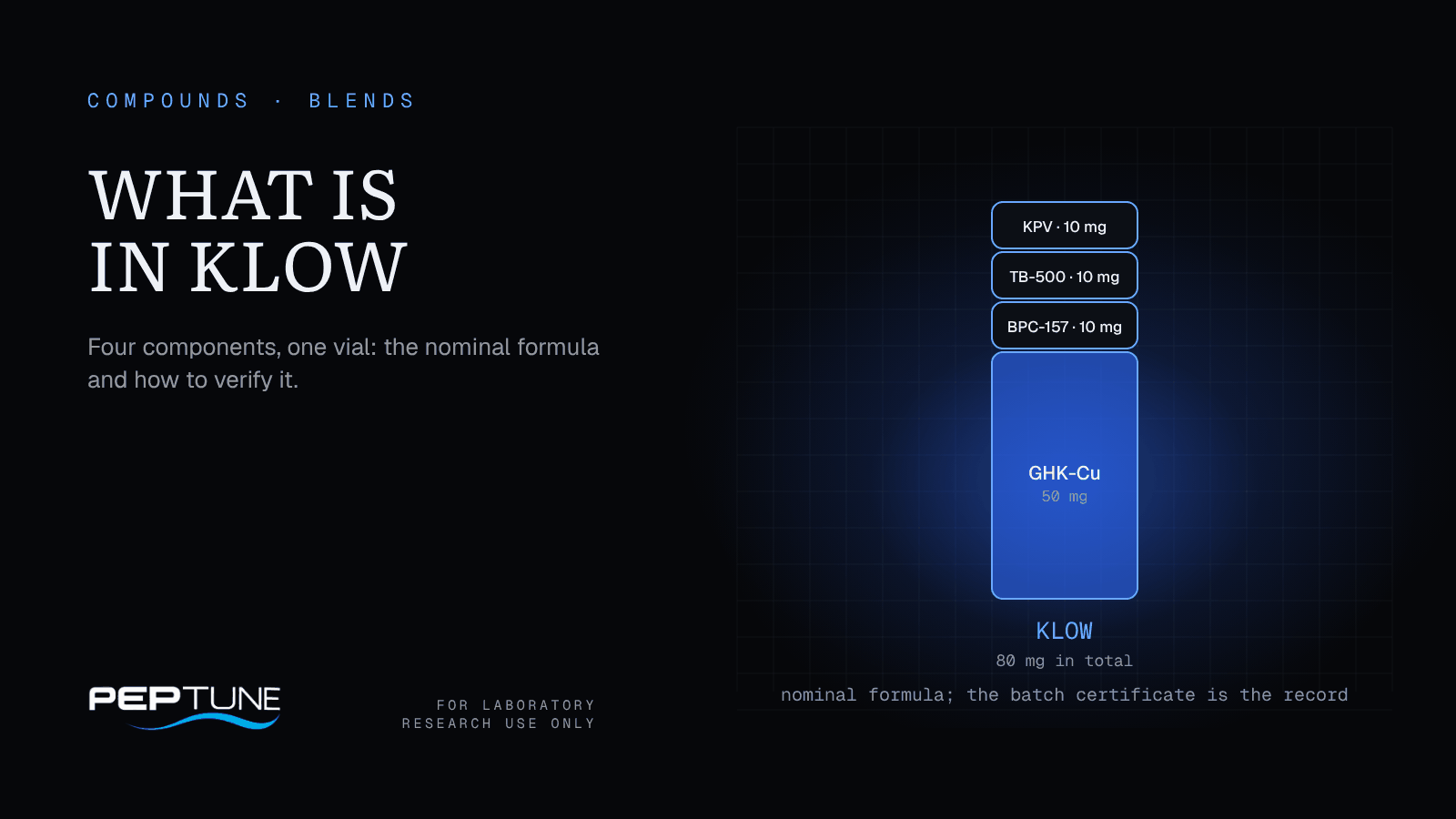
KLOW is a four-component research blend. Knowing what each part of the KLOW peptide blend is, and how much of the vial it makes up, is essential to interpreting any result. This guide sets out the formula, the components, and how to check a batch.
The KLOW peptide blend formula
As commonly listed, the 80 mg formulation contains:
- GHK-Cu, 50 mg: the copper complex of the tripeptide glycyl-histidyl-lysine;
- BPC-157, 10 mg: a synthetic fifteen-residue peptide;
- TB-500, 10 mg: a synthetic peptide related to thymosin beta-4;
- KPV, 10 mg: the tripeptide lysyl-prolyl-valine, the C-terminal fragment of alpha-melanocyte-stimulating hormone.
GHK-Cu is therefore well over half the mass, at 62.5 percent. Each of the other three makes up one eighth.
The four components
GHK-Cu is a tripeptide of about 340 daltons that binds copper(II) in a stable, blue complex. It has been examined in fibroblast culture, extracellular-matrix remodelling and gene-expression studies. More in what is GHK-Cu.
BPC-157 has the sequence GEPPPGKPADDAGLV and a molecular weight of about 1,419 daltons. It has been examined in fibroblast culture and rat models of gastrointestinal lesions. More in what is BPC-157.
TB-500 is a commercial name for a peptide related to thymosin beta-4, either the full 43-residue sequence or a short fragment around the actin-binding motif LKKTETQ. More in what is TB-500.
KPV is Lys-Pro-Val, residues 11 to 13 of alpha-MSH, with a molecular weight of about 342 daltons.
KPV, the distinguishing part
KPV is what separates KLOW from GLOW, the three-component blend. It has been studied in epithelial and inflammatory-signalling models, often through the melanocortin pathway or peptide transporters such as PepT1 in intestinal epithelial cells. As a tripeptide without the rest of the alpha-MSH sequence, it is a much smaller molecule than the hormone it comes from. The comparison in KLOW vs GLOW sets out what the extra component means for a study.
Nominal versus measured
The label states the intended formula. A batch certificate reports what was actually measured. For a four-component blend, a good certificate identifies each component by mass spectrometry and, ideally, reports each one's share by HPLC. That separation is easier than it sounds, because the four molecules differ widely in size and polarity.
One detail deserves attention. Free GHK (about 340 daltons) and KPV (about 342 daltons) are close in mass. Mass spectrometry resolves a two-dalton difference easily, but a certificate should show both peaks clearly labelled rather than a single peak in that region. GHK-Cu's copper isotope pattern helps tell the two apart.
How to verify a KLOW batch
Look for:
- a chromatogram with four labelled components;
- a mass for each that matches the expected molecule;
- for TB-500, a mass that shows which sequence was supplied;
- a batch number that matches the vial;
- a blue powder, from the copper complex.
Our guides to how to read a certificate, purity percentages and third-party testing explain each check.
Designing with KLOW
A blend this complex calls for clear controls: each component alone at its blend amount, the full blend and a vehicle control. GLOW makes a useful additional arm when the question is what KPV adds. For GHK-Cu, copper-only and peptide-only controls separate the metal from the complex.
Matching matters. Each single-component arm should contain the same mass of that component as the blend arm, in the same volume and diluent, so that the only difference between arms is what else is present. Record the batch number of every material used, including single-vial controls such as GHK-Cu.
Handling
KLOW is mostly GHK-Cu by mass, so it reconstitutes to a blue solution. Store it dry, cold and dark, let the vial reach room temperature before opening, avoid copper-chelating buffers unless intended, and prepare only what the run needs. Record each preparation against the batch number.
Ordering KLOW in Canada
KLOW is listed with Peptune's other blends, alongside GLOW and the BPC-157 + TB-500 blend. Peptune ships across Canada by tracked mail. Shipping is $20 or $25 depending on the province, free on orders of $150 or more, with Canada Post Priority available at checkout. Payment is by Interac e-Transfer or crypto, and certificates of analysis are published on each product page as they arrive.
For laboratory research use only. Nothing in this article is medical advice or a suggestion to use any compound on people or animals.
For laboratory research use only. Not for human or veterinary use. Nothing here is medical advice.