
Compounds · 3 min read
BPC-157: a fifteen-residue fragment, explained
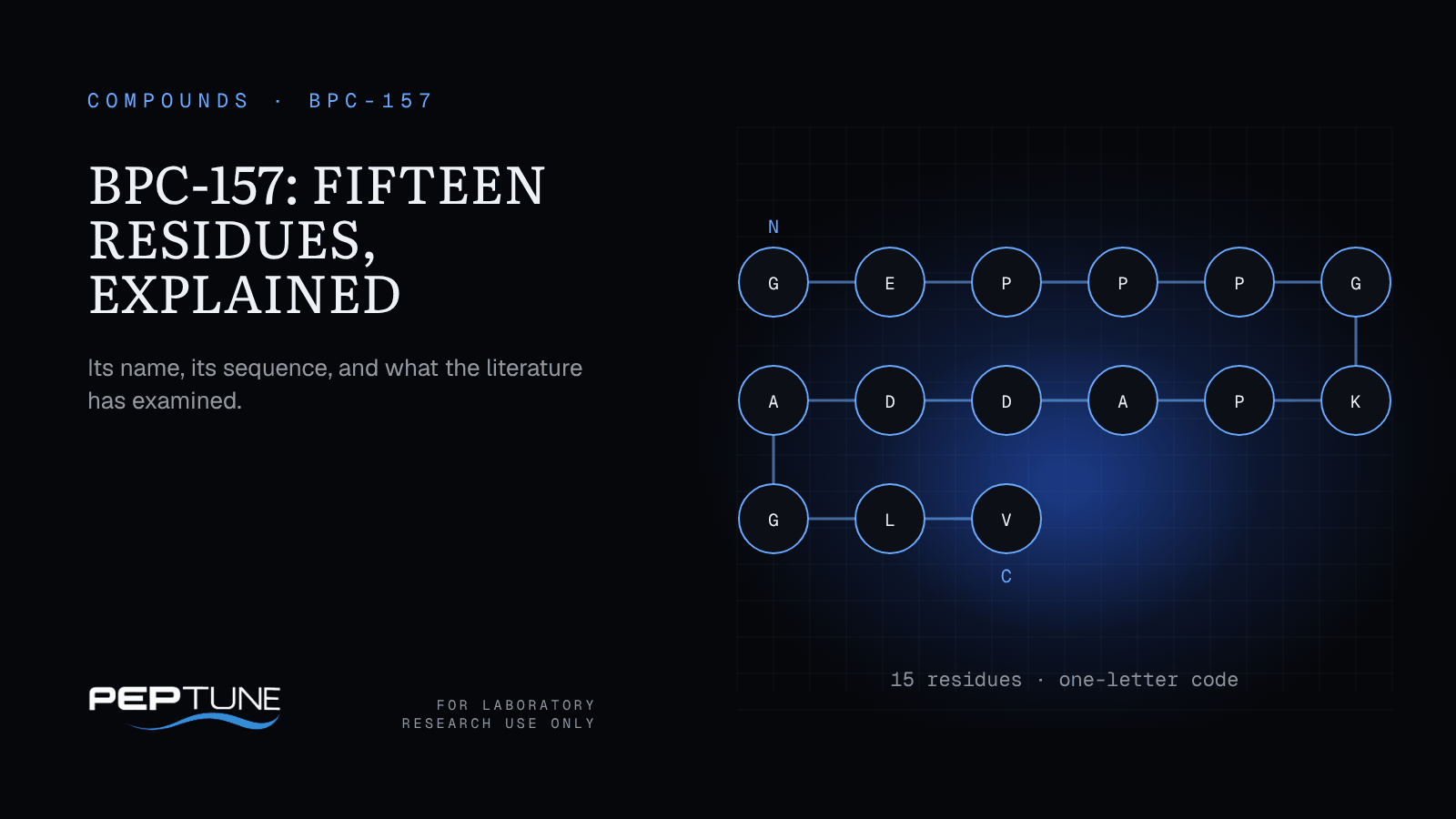
What is BPC-157? It is one of the most discussed peptides in laboratory research, and also one of the most misunderstood. This guide sets out what the molecule is, where the name comes from, what research models have examined and how to check a batch before it goes into an experiment.
What is BPC-157: the molecule
BPC stands for "body protection compound", a name given by the group that first described it in the early 1990s. BPC-157 is a synthetic pentadecapeptide, fifteen amino acids long, with this sequence:
- three-letter code: Gly-Glu-Pro-Pro-Pro-Gly-Lys-Pro-Ala-Asp-Asp-Ala-Gly-Leu-Val;
- one-letter code: GEPPPGKPADDAGLV.
It is described as a partial sequence of a larger protein found in gastric juice. Its molecular weight is about 1,419 daltons.
A few features stand out in the sequence. It is rich in proline, with three in a row near the N-terminus. It contains one glutamic acid and two aspartic acids against a single lysine, so it carries a net negative charge at neutral pH. It has no cysteine, so there are no disulfide bonds to form or break, and no methionine to oxidise.
Stability in acidic conditions
Unlike many peptides, BPC-157 is reported to be relatively stable in acidic conditions. That property is one reason it has attracted attention in experimental gastrointestinal models. Proline-rich stretches are often less accessible to common proteases, which may contribute, although stability in a given buffer is something each lab should confirm rather than assume.
What research models have examined
Most published work on BPC-157 comes from cell culture and rodent models. Topics include:
- tendon and ligament fibroblast behaviour in culture, such as cell migration, spreading and outgrowth;
- focal adhesion kinase signalling in cultured fibroblasts;
- models of gastric and intestinal lesions in rats;
- angiogenesis-related signalling, including VEGF receptor pathways;
- nitric oxide system interactions in isolated tissue.
Much of the literature comes from a small number of research groups, and controlled human data are very limited. A careful reader treats the existing papers as hypotheses about mechanisms in particular models, not as established effects. Independent replication is the main gap in the field.
How BPC-157 is supplied for research
BPC-157 is supplied as a lyophilized powder. Synthetic peptides purified by reversed-phase HPLC are usually supplied as a salt, such as acetate or trifluoroacetate, and the counter-ion contributes to the weighed mass. When a protocol needs an exact peptide concentration, that difference matters.
Laboratory handling
Like most short peptides, BPC-157 is most stable dry, cold and protected from light. A few habits keep results reproducible:
- let the vial reach room temperature before opening, so moisture does not condense on the powder;
- reconstitute only what the run needs, in the diluent the protocol specifies;
- avoid repeated freeze-thaw cycles by preparing single-use aliquots;
- record every preparation against the batch number.
Our guides to lyophilized peptide storage and peptide stability after reconstitution cover these steps in more detail.
How to verify a BPC-157 batch
Two analyses answer the two questions that matter. HPLC shows how much of the material is the main peptide, as a share of the peaks detected. Mass spectrometry confirms that the main peak is the right molecule. For BPC-157, the singly protonated ion appears near 1,420 and the doubly charged ion near 710 on the m/z scale.
A useful certificate names the batch, shows the chromatogram and the mass spectrum, and matches the batch number on the vial. Our guide on how to read a certificate walks through each part, and the COA studies page explains how published certificates are organised.
BPC-157 and TB-500
BPC-157 is often named alongside TB-500, a synthetic peptide related to thymosin beta-4. The two share neither origin, size nor proposed mechanism. See what TB-500 is and the side-by-side comparison in BPC-157 vs TB-500.
Ordering BPC-157 in Canada
Peptune supplies BPC-157 as part of the BPC-157 + TB-500 blend, and it is also a component of the GLOW and KLOW blends. There is no standalone BPC-157 vial. Peptune ships across Canada by tracked mail. Shipping is $20 or $25 depending on the province, free on orders of $150 or more, with Canada Post Priority available at checkout. Payment is by Interac e-Transfer or crypto, and certificates of analysis are published on each product page as they arrive.
For laboratory research use only. Nothing in this article is medical advice or a suggestion to use any compound on people or animals.
For laboratory research use only. Not for human or veterinary use. Nothing here is medical advice.