
Compounds · 3 min read
The BPC-157 + TB-500 blend: composition and study design
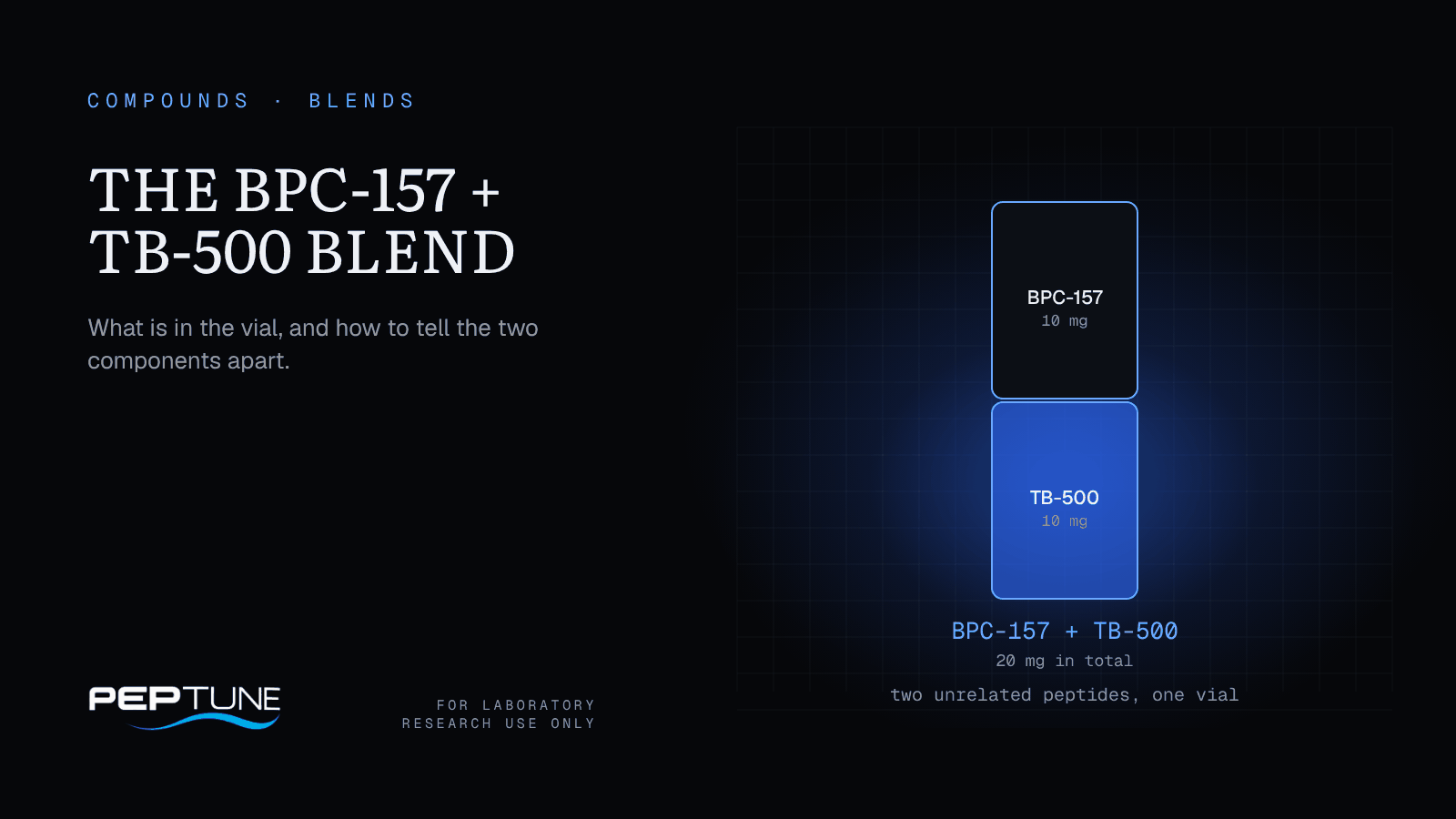
The BPC-157 + TB-500 blend puts two well-studied peptides in a single vial. A BPC-157 TB-500 blend is convenient, but it changes how an experiment has to be designed and how a batch has to be checked. This guide covers both.
What is in a BPC-157 TB-500 blend
The label names both components and states the amount of each. The two are chemically unrelated:
- BPC-157 is a synthetic fifteen-residue peptide, sequence GEPPPGKPADDAGLV, about 1,419 daltons;
- TB-500 is a synthetic peptide related to thymosin beta-4, which, depending on the supplier's definition, is either the full 43-residue sequence (near 4,960 daltons) or a short fragment around the actin-binding motif LKKTETQ (under 1,000 daltons).
They differ in length, charge and molecular weight. That also means they separate cleanly on HPLC. A good certificate for a blend shows both peaks and identifies each one by mass.
For more on each molecule, see what BPC-157 is and what TB-500 is.
Why researchers combine them
The two peptides have been examined in overlapping research areas, including cell migration, tissue-remodelling models and angiogenesis-related signalling. They are proposed to act through different routes:
- BPC-157 has been studied for interactions with growth-factor receptor signalling, including VEGFR2, and with the nitric oxide system;
- thymosin beta-4 has been studied mainly through actin sequestration and its downstream effects on cell motility.
Researchers interested in how such signals interact in a single system sometimes prefer one preparation that delivers both at a fixed ratio. A blend removes one source of variation: the ratio is set at manufacture rather than mixed by hand for each run.
Designing around a blend
A blend introduces a question that single compounds do not: which component produced the observation? A design that can answer it usually includes:
- a vehicle control;
- BPC-157 alone, at the amount present in the blend;
- TB-500 alone, at the amount present in the blend;
- the blend itself.
Without the single-component arms, an effect seen with the blend cannot be attributed to either peptide, or to an interaction between them. If the blend produces more than the sum of the single arms, that is a finding in itself, but only a design with all four arms can show it.
Two practical points help. First, work out each component's concentration separately after reconstitution: it is that component's labelled mass divided by the volume of diluent. Second, source the single-component material with certificates of its own, so that every arm is characterised to the same standard. The side-by-side comparison in BPC-157 vs TB-500 is a useful reference when planning the arms.
How to verify a blend batch
A single-compound certificate answers one identity question. A blend certificate must answer two. Look for:
- a chromatogram with two main peaks, each labelled;
- a mass for each peak that matches the expected component;
- for TB-500, a mass that tells you which sequence was supplied;
- a batch number that matches the vial.
Our guides to how to read a certificate and batch number verification go through each check, and what a purity percentage means explains why a blend's figures are reported per component.
Handling
Treat the blend as you would its most sensitive component. Keep it dry, cold and dark until use. Let the vial reach room temperature before opening. After reconstitution, record the preparation against the batch number, and avoid repeated freeze-thaw cycles by preparing only what the run needs. If the TB-500 component is the full-length sequence, limit air exposure in solution, since its methionine can oxidise.
Related blends
BPC-157 and TB-500 also appear together in two larger blends that add GHK-Cu. GLOW contains three components, and KLOW adds KPV as a fourth. The comparison in KLOW vs GLOW sets out the difference.
Ordering the BPC-157 TB-500 blend in Canada
The BPC-157 + TB-500 blend is listed with Peptune's other blends. Peptune ships across Canada by tracked mail. Shipping is $20 or $25 depending on the province, free on orders of $150 or more, with Canada Post Priority available at checkout. Payment is by Interac e-Transfer or crypto, and certificates of analysis are published on each product page as they arrive.
For laboratory research use only. Nothing in this article is medical advice or a suggestion to use any compound on people or animals.
For laboratory research use only. Not for human or veterinary use. Nothing here is medical advice.