
Compounds · 3 min read
GHK-Cu: the copper tripeptide
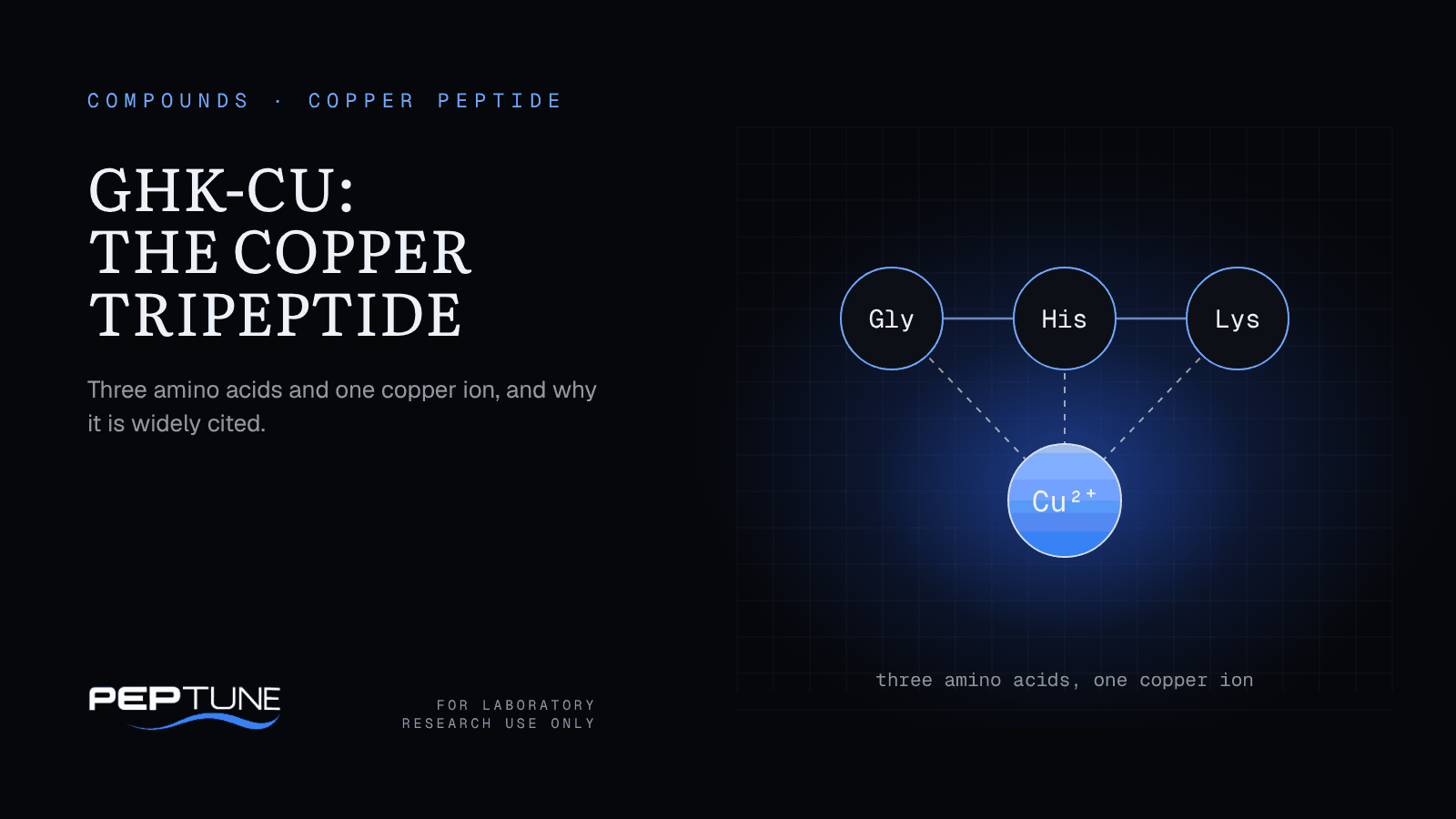
What is GHK-Cu? GHK-Cu is the copper(II) complex of glycyl-L-histidyl-L-lysine, a tripeptide first isolated from human plasma in the 1970s. It is small, but its literature is large. This guide covers its structure, what research models have examined, and how to handle and verify it in the lab.
Origin
GHK was first described by Loren Pickart, who isolated it from human plasma and noted its strong affinity for copper(II) ions. It has since been detected in other biological fluids. Its small size and copper binding have made it a model compound in both cell biology and peptide-metal coordination chemistry.
What is GHK-Cu: structure
The free peptide is GHK: glycine, histidine and lysine, with a molecular weight of about 340 daltons. It binds copper in a 1:1 complex through three nitrogen atoms:
- the free amino group of glycine;
- a deprotonated amide nitrogen from the glycine-histidine peptide bond;
- the imidazole ring of histidine.
The result is a stable, blue complex. The lysine side chain is not part of the copper site, leaving its positively charged amino group free. The complex is GHK-Cu, and it is the form most often studied and supplied.
Copper binding depends on pH. At low pH the amide nitrogen is not deprotonated and the complex is weaker, which is one reason solution conditions need to be recorded.
Research areas
GHK-Cu has been examined in:
- fibroblast culture, including collagen and glycosaminoglycan synthesis;
- extracellular-matrix remodelling and metalloproteinase activity;
- gene-expression profiling, where it has been reported to shift the expression of many genes in cell models;
- copper transport and peptide-metal coordination chemistry.
As with any small, well-cited compound, results vary with cell type, concentration and preparation. Findings describe what was observed in a given model.
Controls that matter
GHK-Cu experiments involve three possible actors: free GHK, free copper and the complex. Useful designs include:
- a vehicle control;
- a copper-only control, using a simple copper salt at the matching copper concentration;
- a peptide-only control, using GHK without copper;
- the complex itself.
They also document how each solution was prepared, including pH, which affects copper binding. Without these arms, an effect cannot be assigned to the peptide, the metal or the complex.
Handling
The lyophilized complex is a blue powder, and it gives a blue solution. Colour is a quick first check on receipt: a vial that is white or colourless deserves a closer look at the certificate. Store it dry, cold and away from light. In solution, avoid buffers that chelate copper, such as EDTA, unless that is part of the design. Our guides to peptide handling best practices and peptide stability after reconstitution cover the general routine.
How GHK-Cu is supplied
GHK-Cu is supplied as a lyophilized powder. The label amount refers to the complex, and synthetic material may also contain a counter-ion such as acetate, which adds to the weighed mass. When a protocol needs a defined copper concentration, calculate it from the content stated on the certificate rather than from the gross weight of powder. A copper-only control should then match that figure.
How to verify a GHK-Cu batch
HPLC reports how much of the material is the main component. Mass spectrometry confirms identity: the free peptide appears near 341 m/z as the singly protonated ion, and copper-containing ions carry a distinctive isotope pattern, because natural copper is a mix of two isotopes, copper-63 and copper-65. A certificate that shows this pattern is evidence that copper is present. See how to read a certificate and mass spectrometry for peptide identity.
GHK-Cu in blends
GHK-Cu is also the main component by mass of the GLOW and KLOW blends, which combine it with BPC-157 and TB-500, and in KLOW's case KPV. That is why both blends reconstitute blue. The breakdown is in what is in KLOW and KLOW vs GLOW.
Ordering GHK-Cu in Canada
GHK-Cu is available as a single vial, listed with Peptune's other single vials. Peptune ships across Canada by tracked mail. Shipping is $20 or $25 depending on the province, free on orders of $150 or more, with Canada Post Priority available at checkout. Payment is by Interac e-Transfer or crypto, and certificates of analysis are published on each product page as they arrive.
For laboratory research use only. Nothing in this article is medical advice or a suggestion to use any compound on people or animals.
For laboratory research use only. Not for human or veterinary use. Nothing here is medical advice.