
Comparisons · 3 min read
Retatrutide vs tirzepatide in receptor research
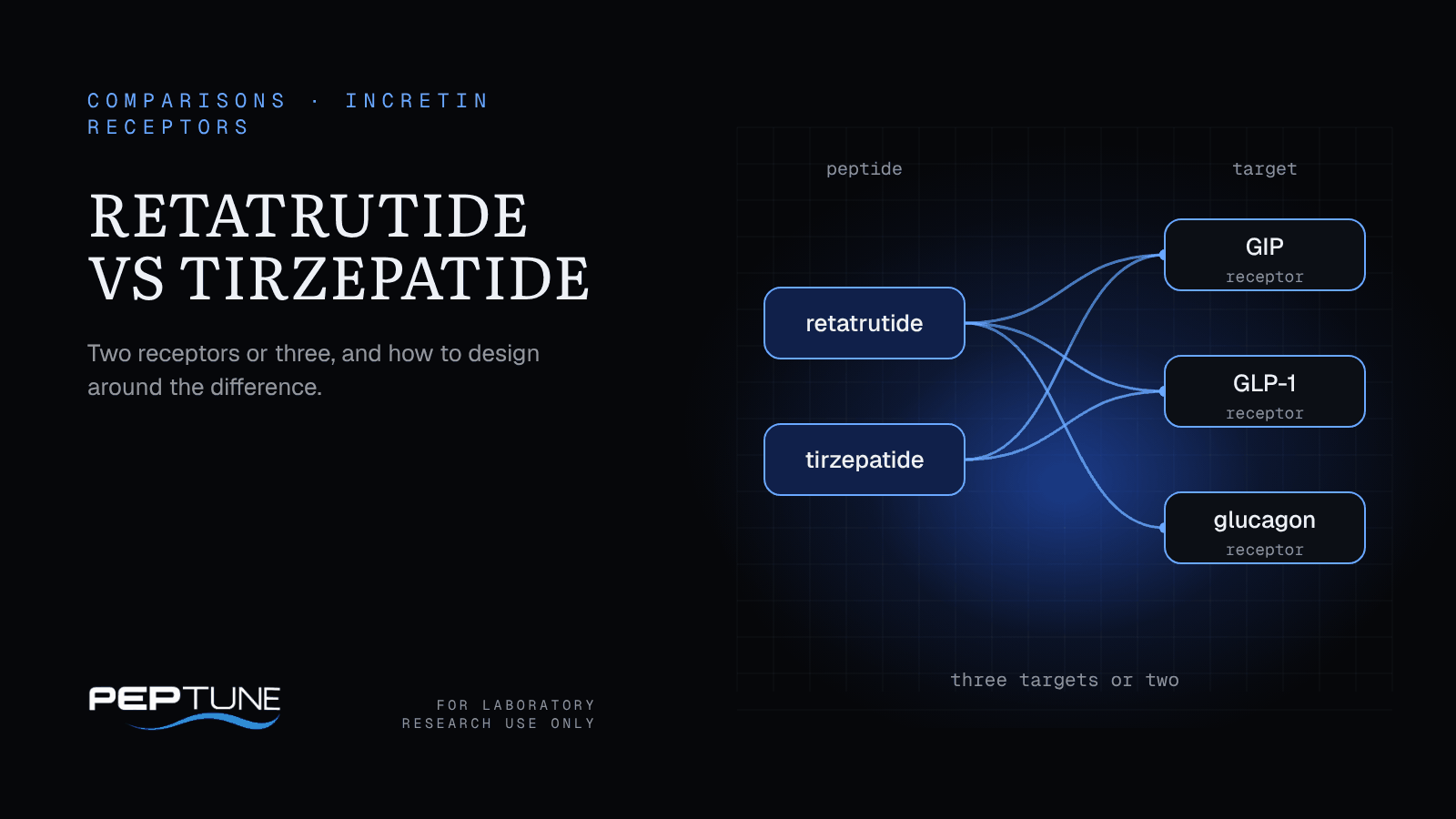
Tirzepatide and retatrutide belong to the same family of engineered incretin peptides. The core of retatrutide vs tirzepatide is one extra receptor, and that difference is exactly what makes the two useful together in the laboratory.
This guide compares their receptor targets and structures, then sets out how to design an experiment that isolates the one variable that separates them.
Retatrutide vs tirzepatide at a glance
- Tirzepatide: GIP receptor and GLP-1 receptor. Development code LY3298176.
- Retatrutide: GIP receptor, GLP-1 receptor and glucagon receptor. Development code LY3437943.
All three receptors are class B G-protein-coupled receptors with related native ligands. Tirzepatide is a dual agonist; retatrutide is a triple agonist.
Structure
Both are 39-residue peptides with non-natural amino acids for stability and a fatty-acid chain for albumin binding. Their sequences differ at the positions that decide receptor recognition, and in particular the residues that give retatrutide its glucagon-receptor activity.
Shared design features include:
- alpha-aminoisobutyric acid (Aib) near the N-terminus, which protects against dipeptidyl peptidase-4;
- a lipidated lysine side chain, attached through a linker, that binds albumin and extends half-life in experimental systems;
- an amidated C-terminus.
Because both are long acylated peptides, both also share the same practical behaviour: a tendency to adsorb to some plastics and to aggregate at high concentration.
Receptor profiles
Published in-vitro pharmacology describes both as imbalanced agonists, though in different ways.
- Tirzepatide is roughly equipotent with native GIP at the GIP receptor and weaker than native GLP-1 at the GLP-1 receptor, with a bias toward cAMP signalling over beta-arrestin recruitment at the GLP-1 receptor.
- Retatrutide is more potent than native GIP at the GIP receptor and less potent than the native hormones at the GLP-1 and glucagon receptors.
The detailed background for each compound is in what is tirzepatide and what is retatrutide.
A matched-pair design
Because the two compounds share most of their design, comparing them is close to adding one variable: glucagon-receptor activation. A typical in-vitro comparison runs:
- each compound in cells expressing a single receptor, to build potency profiles;
- both compounds in cells expressing all three receptors;
- native-hormone reference agonists as positive controls.
Run both compounds in the same plate, from the same solvent, prepared on the same day. Differences in handling can easily be larger than the pharmacological difference you are trying to measure.
When to use one rather than both
Not every study needs the pair. As a rough guide:
- use tirzepatide alone when the question concerns GIP and GLP-1 receptor interplay or biased signalling at the GLP-1 receptor;
- use retatrutide alone when the question is about triple agonism or structure-activity within that class;
- use both when you want to isolate what glucagon-receptor activity adds.
Interpreting results
Differences between the two compounds in a multi-receptor system point to the glucagon receptor, but they are not proof on their own. Receptor-specific antagonists or knockout lines are the controls that confirm it.
Other points to check before drawing a conclusion:
- potency differences at the shared receptors, which can confound a comparison even before the glucagon receptor is considered;
- the readout, since cAMP and beta-arrestin assays can rank the same compounds differently;
- the concentration range, which should span the full response curve for both compounds.
Handling both compounds consistently
Treat the pair identically. Use low-binding consumables, define the solvent in the protocol, aliquot to avoid freeze-thaw cycles and record each batch number. Our guide to peptide stability after reconstitution explains why a fresh, well-documented preparation matters for comparisons like this.
Verifying each batch
A comparison is only as good as the material in each arm. For both compounds, check:
- identity by mass spectrometry, against the expected mass of the acylated molecule;
- purity by HPLC;
- a certificate batch number that matches the vial.
See batch number verification and how to read a certificate. Published certificates are collected on the COA studies page.
Ordering retatrutide and tirzepatide in Canada
Peptune supplies retatrutide and tirzepatide for laboratory research and ships across Canada by tracked mail. Shipping is $20 or $25 depending on the province, free on orders of $150 or more, with Canada Post Priority available at checkout. Payment is by Interac e-Transfer or crypto.
Certificates of analysis are published on each product page as they arrive, so you can read the batch data for both compounds before you order.
For laboratory research use only. Nothing in this article is medical advice or a suggestion to use any compound on people or animals.
For laboratory research use only. Not for human or veterinary use. Nothing here is medical advice.