
Compounds · 3 min read
Retatrutide: one molecule, three receptors
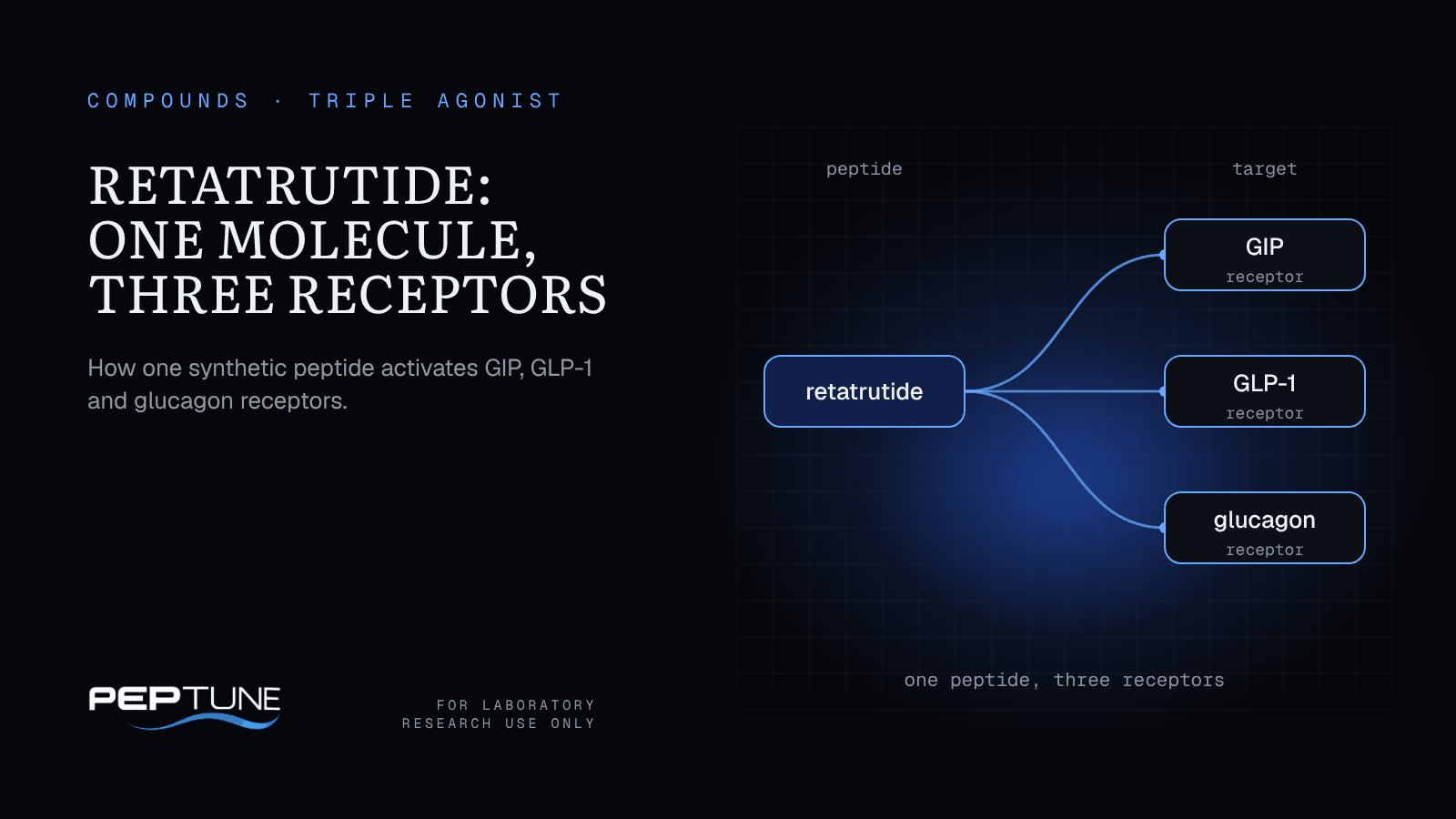
Retatrutide, also known by its development code LY3437943, is a synthetic peptide designed to activate three related receptors with one molecule. If you are asking what is retatrutide in research terms, it is a triple agonist: a single ligand for the GIP, GLP-1 and glucagon receptors.
That makes it unusual. Most reference agonists act on one receptor, and the best-known dual agonist, tirzepatide, acts on two. Retatrutide lets researchers study all three pathways with a single compound.
The three receptors
- GLP-1R, the glucagon-like peptide-1 receptor;
- GIPR, the glucose-dependent insulinotropic polypeptide receptor;
- GCGR, the glucagon receptor.
All three are class B G-protein-coupled receptors that recognise related peptide hormones. Their native ligands share a common ancestry and a similar overall fold, which is why one engineered sequence can be tuned to engage all three.
GIP and GLP-1 are incretin hormones released from the gut. Glucagon comes from the pancreas, and its receptor is expressed most strongly in the liver. Adding glucagon-receptor activity to an incretin agonist therefore brings a different tissue and a different set of downstream pathways into the same experiment.
A ligand that engages all three gives researchers a single tool for studying how the pathways combine, compete or compensate.
What is retatrutide made of?
Retatrutide is a 39-residue peptide. Its design shares several principles with other engineered incretin peptides:
- non-natural amino acids, including alpha-aminoisobutyric acid (Aib), that resist enzymatic breakdown, in particular by dipeptidyl peptidase-4;
- a fatty-acid side chain attached through a linker, which binds albumin and extends its half-life in experimental systems;
- sequence positions chosen to give activity at the glucagon receptor as well as the two incretin receptors.
In published in-vitro pharmacology, retatrutide is more potent than native GIP at the GIP receptor and less potent than the native hormones at the GLP-1 and glucagon receptors. That uneven profile is part of what researchers study: the balance between receptors is a design variable, not a fixed property of the class.
Research questions
Retatrutide appears in laboratory work on questions such as:
- comparative receptor activation in engineered cell lines;
- receptor bias and downstream signalling, for example cAMP accumulation compared with beta-arrestin recruitment;
- structure-activity relationships within the triple-agonist class;
- analytical identity and stability of a long acylated peptide.
Designing around three receptors
With three possible contributors, the controls decide whether a result means anything. Useful ones include:
- cell lines expressing one receptor at a time, to build a potency profile for each;
- receptor-knockout lines or selective antagonists, to remove one pathway and see what changes;
- native-hormone reference agonists as positive controls;
- a dual agonist as a comparator.
Tirzepatide, the GIP and GLP-1 dual agonist, is the most common comparator. Because the two peptides share much of their design, the difference between them comes close to a single variable: glucagon-receptor activation. Our guide to retatrutide vs tirzepatide describes that matched-pair design step by step, and what is tirzepatide covers the comparator itself.
Laboratory handling
Like other acylated peptides, retatrutide can stick to some plastics and aggregate at high concentration. Use low-binding consumables, prepare solutions in a solvent defined in the protocol and avoid repeated freeze-thaw cycles by aliquoting.
Keep the lyophilized powder sealed, cold and dark until use, and let the vial warm to room temperature before opening. See lyophilized peptide storage and peptide handling best practices for the full routine.
Checking a retatrutide batch
A 39-residue acylated peptide gives several opportunities for synthesis errors, such as missing residues or incomplete acylation. Two analyses catch most of them:
- mass spectrometry, which confirms that the observed mass matches the expected mass of the full molecule;
- HPLC, which shows how much of the material is the main product.
Match the batch number on the certificate to the vial, and read our list of certificate red flags before relying on any document. Published certificates are collected on the COA studies page.
Ordering retatrutide in Canada
Peptune supplies retatrutide for laboratory research and ships across Canada by tracked mail. Shipping is $20 or $25 depending on the province, free on orders of $150 or more, with Canada Post Priority available at checkout. Payment is by Interac e-Transfer or crypto.
Certificates of analysis are published on each product page as they arrive, so you can read the batch data alongside the product before you order.
For laboratory research use only. Nothing in this article is medical advice or a suggestion to use any compound on people or animals.
For laboratory research use only. Not for human or veterinary use. Nothing here is medical advice.