
Compounds · 3 min read
Tirzepatide: a dual GIP and GLP-1 receptor agonist
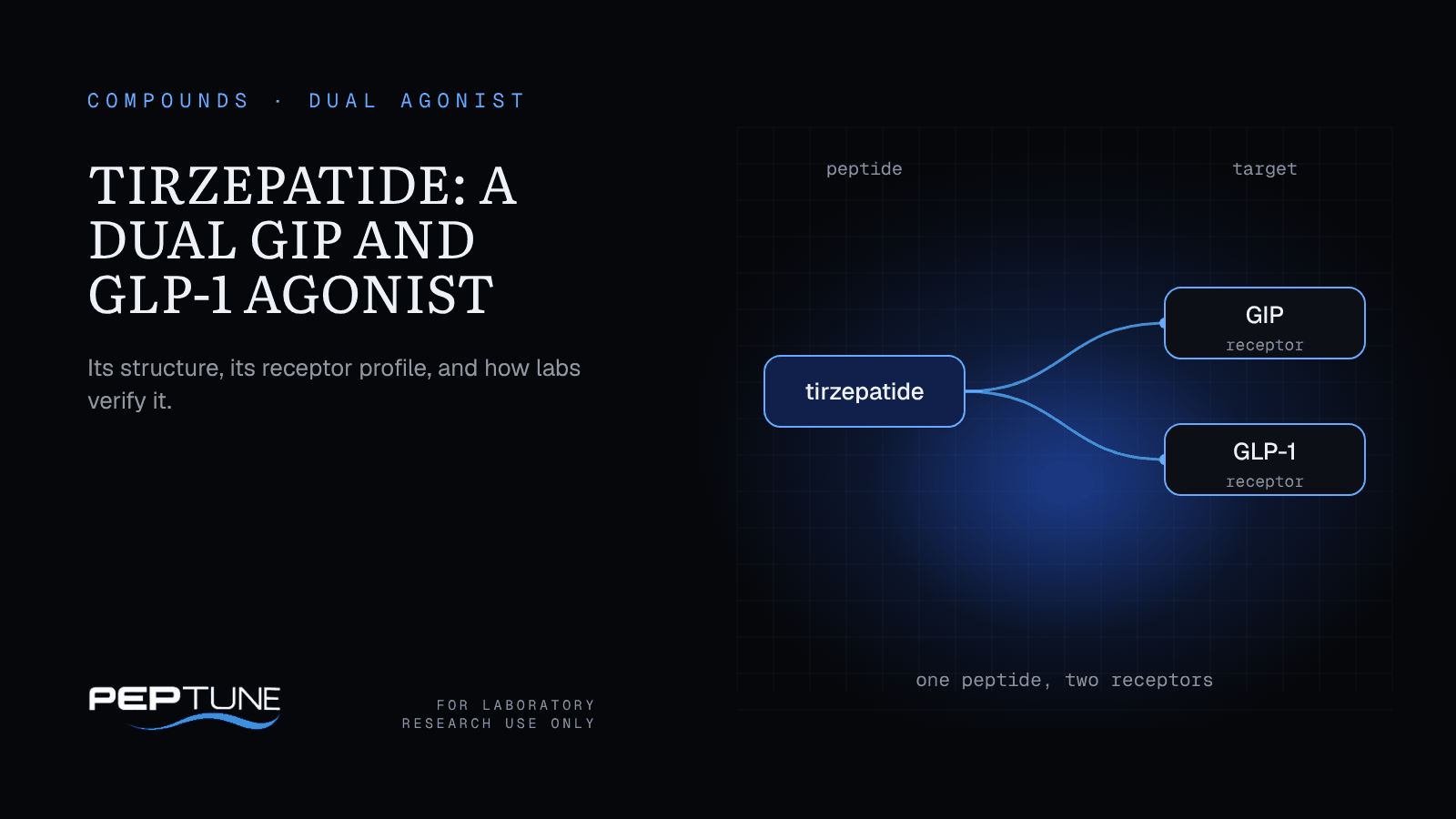
Tirzepatide is a 39-amino-acid synthetic peptide that activates two incretin receptors: the GIP receptor and the GLP-1 receptor. So what is tirzepatide from a laboratory point of view? It is the best-characterised dual incretin agonist, and a standard reference compound for studying how these two receptors behave together.
This guide covers its structure, its receptor profile, where it sits among related peptides, how to handle it at the bench and how to check a batch before it goes into an experiment.
What is tirzepatide made of?
Tirzepatide was developed under the code LY3298176. Its backbone is based on the sequence of glucose-dependent insulinotropic polypeptide (GIP), with substitutions that confer GLP-1 receptor activity and resistance to dipeptidyl peptidase-4 (DPP-4), the enzyme that rapidly cleaves the native hormones.
The main structural features are:
- 39 amino acids, with an amidated C-terminus;
- two alpha-aminoisobutyric acid (Aib) residues, at positions 2 and 13, which are non-natural amino acids that resist enzymatic cleavage;
- a C20 fatty diacid attached to a lysine side chain through a linker, which lets the molecule bind albumin and extends its half-life in experimental systems;
- a molecular weight of about 4.8 kDa.
The fatty diacid is what makes tirzepatide an acylated peptide. That single feature shapes much of how it behaves in solution, as the handling section below explains.
Receptor profile
The published pharmacology describes tirzepatide as an imbalanced agonist. It is roughly equipotent with native GIP at the GIP receptor and weaker than native GLP-1 at the GLP-1 receptor.
At the GLP-1 receptor it also shows a bias toward cAMP signalling over beta-arrestin recruitment. In cell studies this has been associated with less receptor internalisation than native GLP-1 produces. These details make tirzepatide a valuable reference compound for studying biased agonism at class B G-protein-coupled receptors.
Typical in-vitro questions include:
- potency and efficacy in cell lines engineered to express a single receptor;
- cAMP accumulation compared with beta-arrestin recruitment;
- receptor internalisation and recycling;
- structure-activity relationships across acylated incretin peptides.
Where tirzepatide fits
Tirzepatide sits between single GLP-1 receptor agonists and the triple agonist retatrutide, which adds the glucagon receptor. Studies comparing the three can isolate the contribution of each additional receptor.
GIP and GLP-1 are both incretin hormones, peptides released from the gut in response to nutrients. Their receptors are closely related, which is why one engineered sequence can be tuned to activate both. Tirzepatide shows how far a GIP-based backbone can be pushed toward GLP-1 receptor activity while keeping its GIP receptor potency.
If you are planning that kind of comparison, read what retatrutide is and our guide to retatrutide vs tirzepatide, which sets out a matched-pair experimental design.
Laboratory handling
As an acylated peptide, tirzepatide can adsorb to some plastics and aggregate at high concentration. A few habits keep results consistent:
- use low-binding tubes and pipette tips;
- define the solvent and concentration in the protocol rather than adjusting them run to run;
- let the vial reach room temperature before opening, so condensation does not form on the powder;
- record the batch number for each preparation.
Lyophilized material is far more stable than solutions. Our notes on lyophilized peptide storage and stability after reconstitution cover temperature, light and freeze-thaw cycles in more detail.
Verifying a tirzepatide batch
Before a batch goes into an experiment, two questions matter: is it the right molecule, and how much of the vial is that molecule?
- Identity is confirmed by mass spectrometry. The observed mass should match the expected mass for the acylated sequence. See mass spectrometry for peptide identity.
- Purity is measured by HPLC, reported as the share of the main peak. See HPLC peptide purity.
- The certificate should carry a batch number that matches the vial. Our guide on how to read a certificate explains each field.
Published certificates for Peptune products are collected on the COA studies page.
Ordering tirzepatide in Canada
Peptune supplies tirzepatide for laboratory research and ships across Canada by tracked mail. Shipping is $20 or $25 depending on the province, free on orders of $150 or more, with Canada Post Priority available at checkout. Payment is by Interac e-Transfer or crypto.
Certificates of analysis are published on each product page as they arrive, so you can read the batch data alongside the product before you order.
Researchers comparing incretin receptors often order tirzepatide and retatrutide together, so both compounds come from documented batches.
For laboratory research use only. Nothing in this article is medical advice or a suggestion to use any compound on people or animals.
For laboratory research use only. Not for human or veterinary use. Nothing here is medical advice.