
Compounds · 3 min read
IGF-1 LR3: an engineered IGF-1 analogue
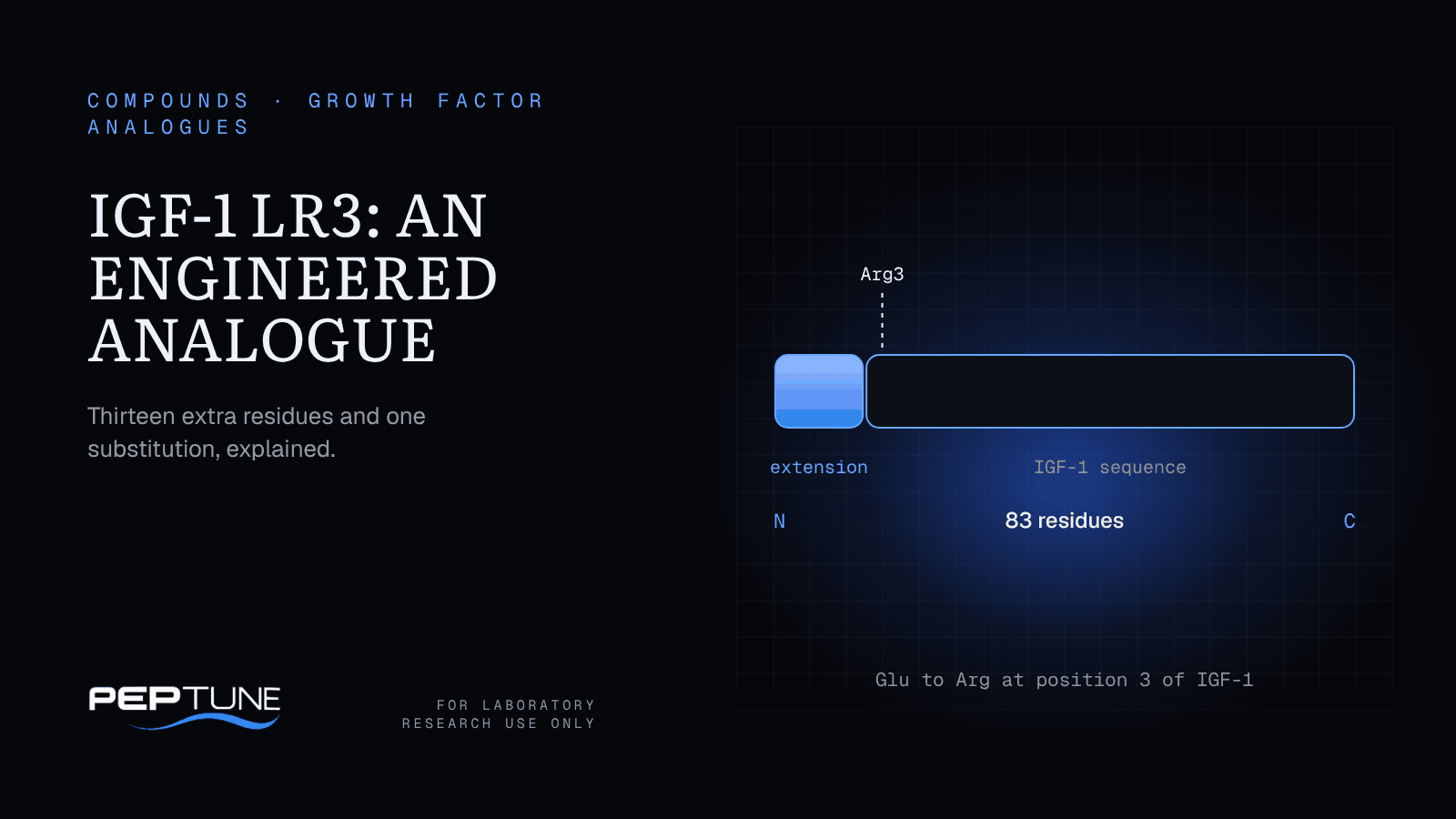
IGF-1 LR3 is a recombinant analogue of insulin-like growth factor 1 (IGF-1), engineered for laboratory use. Two small changes to the native sequence make it far less likely to be captured by binding proteins, and that single property explains why it became a standard reagent in cell culture and receptor-signalling research.
Native IGF-1 and its binding proteins
Native IGF-1 is a single-chain protein of 70 amino acids held in shape by three disulfide bonds. It is structurally related to proinsulin, and it acts mainly through the IGF-1 receptor, a receptor tyrosine kinase found on many cell types.
Most IGF-1 in biological fluids is not free. It is held by a family of six IGF-binding proteins (IGFBPs), which bind it tightly and keep it in an inactive state. The binding proteins control how much IGF-1 is available to the receptor at any moment. Proteases that cut the binding proteins add another layer, releasing IGF-1 where and when they act. For a researcher who wants a defined, predictable growth-factor signal, that extra layer of control is a complication.
The changes in IGF-1 LR3
- An N-terminal extension of thirteen amino acids.
- Arginine in place of glutamic acid at position 3. This is the "R3" in the name. The "L" refers to the long N-terminal extension.
The result is a protein of 83 amino acids. Together these changes sharply reduce binding to the IGFBPs that normally hold native IGF-1 in an inactive state, while leaving the parts of the molecule that bind the IGF-1 receptor intact. More of the analogue stays free to bind the IGF-1 receptor.
Why IGF-1 LR3 is used in cell culture
In cell culture, IGFBPs secreted by the cells themselves can mop up native IGF-1. IGF-1 LR3 avoids much of that, so it is widely used as a defined growth factor in serum-free or reduced-serum media. Replacing serum with defined components makes media more consistent from batch to batch, and IGF-1 LR3 is one of the components often used for that purpose, including in media for Chinese hamster ovary (CHO) cell lines.
It is also a common tool in studies of IGF-1 receptor signalling. When the receptor is activated, it phosphorylates itself and adaptor proteins such as insulin receptor substrate 1 (IRS-1). Two main pathways follow:
- the PI3K-Akt pathway, studied in relation to cell survival and metabolism;
- the Ras-MAPK pathway, studied in relation to cell proliferation.
Because IGF-1 LR3 is less affected by binding proteins, researchers can compare receptor responses with those to native IGF-1 and separate the role of the binding proteins from that of the receptor itself.
Handling
IGF-1 LR3 is a protein of about 9 kDa and is more delicate than short peptides. Its folded structure depends on its disulfide bonds, and it can lose activity through aggregation, adsorption to surfaces or repeated freezing and thawing.
- Keep it lyophilized and cold until use.
- Let the vial reach room temperature before opening, so moisture does not condense on the powder.
- Reconstitute it in the solvent the protocol specifies, and avoid vigorous shaking; swirl gently instead.
- Freeze single-use aliquots instead of repeatedly thawing a stock.
- Very dilute solutions lose protein to plastic and glass surfaces, which is why many protocols add a carrier protein.
Our guides to lyophilized peptide storage and peptide stability after reconstitution cover these points in more detail.
Checking a batch
For a recombinant protein, identity and purity data matter as much as for a synthetic peptide. A mass measurement confirms the expected molecular mass, and HPLC shows how much of the material elutes as the main form. See peptide mass spectrometry and HPLC peptide purity for how those results are produced and read.
Buy IGF-1 LR3 for research in Canada
Peptune supplies IGF-1 LR3 as a lyophilized single vial, alongside other research compounds such as MOTS-c and NAD+. Certificates of analysis are published on each product page as they arrive, and in the certificate library. Peptune ships across Canada by tracked mail. Shipping is $20 or $25 depending on the province and free on orders of $150 or more, and payment is by Interac e-Transfer or crypto.
For laboratory research use only. Nothing in this article is medical advice or a suggestion to use any compound on people or animals.
For laboratory research use only. Not for human or veterinary use. Nothing here is medical advice.