
Research basics · 3 min read
How to evaluate a peptide study: a practical checklist
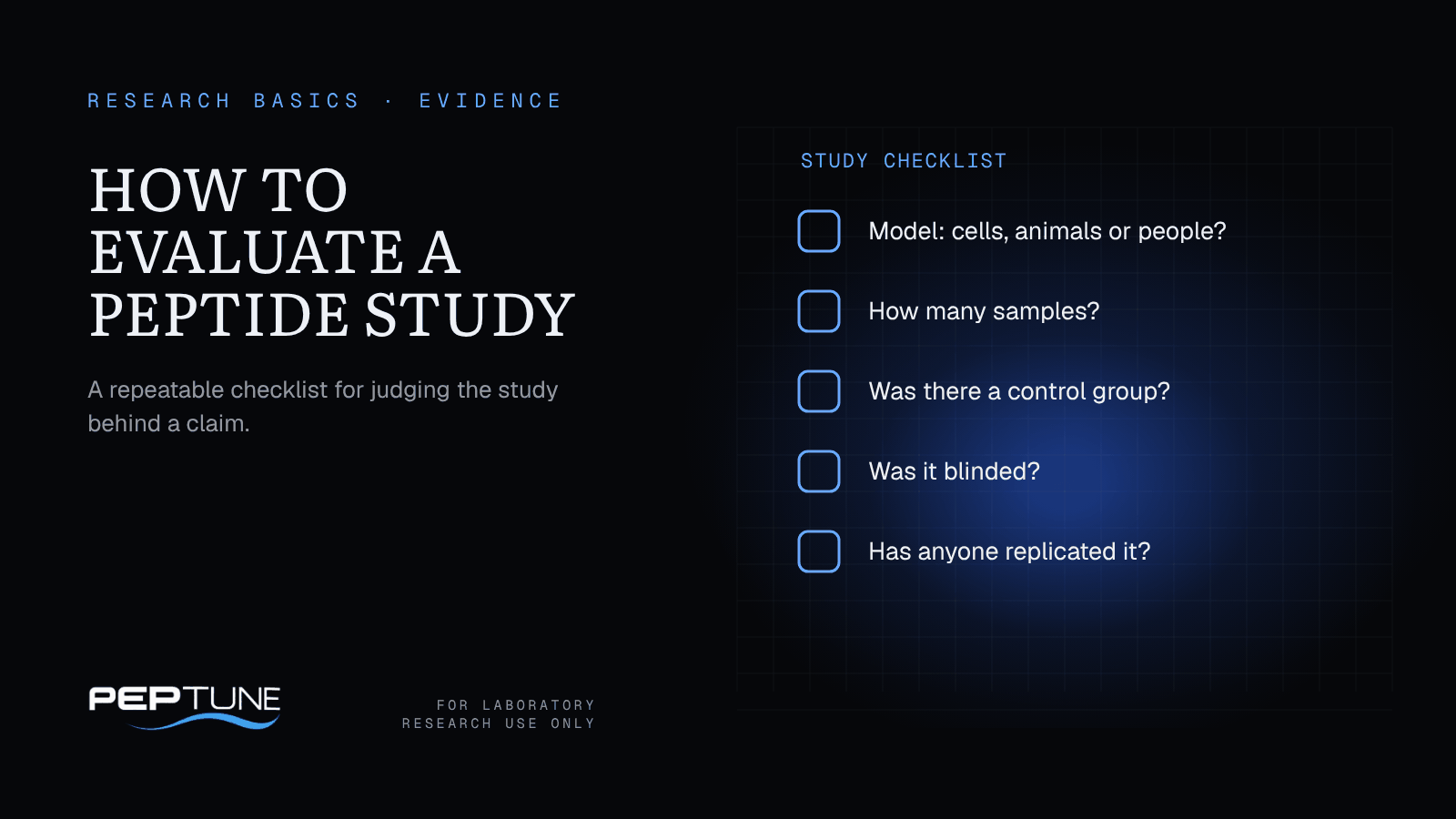
A claim about a peptide is only as good as the study behind it. Headlines, forum posts and product pages all summarise research, and summaries drift. This checklist helps you go back to the paper and judge what it actually shows. It works for any compound and any kind of study.
1. Find the original paper
Start by locating the study itself, not a summary of it. Check that it investigates the exact molecule being discussed. Similar names can hide different sequences, salts or modifications, and a paper on a related analogue is not evidence about the compound in your vial. Our guide to finding peptide research papers explains where to search.
2. Identify the study type
The first question is what kind of study it is:
- Biochemical: does the molecule bind or react with a target?
- Cell-based (in vitro): how do cultured cells respond?
- Animal (in vivo): what happens in a living organism of that species?
- Human (clinical): what happens in people, under these conditions?
Each answers a different question, and a result at one level does not carry over to the next. See in vitro, in vivo and clinical research.
3. Examine the methods
The methods section is where a study earns trust. Look for:
- A comparison or control group, treated the same way except for the variable being tested.
- A sample size that suits the question. Very small groups give unstable results.
- Outcomes defined before the study started, not chosen afterwards.
- Randomisation and blinding, where they apply.
- A clear description of the material used: its source, purity and how it was verified. A study on material of unknown identity is hard to interpret. See how to read a certificate.
4. Look at the size of the effect
A "statistically significant" result means the finding is unlikely to be due to chance alone, under the study's assumptions. It does not mean the effect is large or important. Look at how big the difference was, how uncertain the estimate is (confidence intervals help here), and whether any unwanted effects were reported.
5. Check funding, conflicts and corrections
Read the funding and conflict-of-interest statements. Industry funding does not make a study wrong, but it is context worth knowing. Check whether the paper has been corrected or retracted since it was published; journal pages and PubMed usually flag this.
6. Ask whether it has been repeated
One small study is a starting point. Findings that have been repeated by independent groups, with different methods or populations, deserve much more confidence. Review articles can help you see the wider picture, but check whether a review is systematic (with a defined search and selection method) or a narrative overview, and whether its conclusions match the studies it cites.
7. Compare the claim with the result
Finally, put the claim next to what the paper found. "Was studied for", "showed a signal in an animal model" and "improved an outcome in a controlled human trial" are not interchangeable. A fair summary names the model, the outcome and the main limitation. If a claim goes further than the paper, the claim is wrong, however confident it sounds.
A short version to keep
- Right molecule?
- Which kind of study?
- Controls, size and pre-defined outcomes?
- How big is the effect, and how certain?
- Who funded it, and has it been corrected?
- Has anyone repeated it?
- Does the claim match the result?
Common questions
Does peer review prove a claim is true?
No. Peer review is one quality check. The methods, the size of the effect and whether others have repeated the result still matter.
Can animal research establish an effect in people?
No. Animal findings can guide further research, but they do not show what happens in people.
Sources
- PubMed, the US National Library of Medicine's index of biomedical literature
- ClinicalTrials.gov, a public registry of clinical studies
- Wang L. et al. Therapeutic peptides: current applications and future directions. Signal Transduction and Targeted Therapy, 2022
Start from documented material
Good research starts with material you can identify. Peptune publishes certificates of analysis on each product page as they arrive, and in the certificate library. Browse the full catalogue.
For laboratory research use only. Nothing in this article is medical advice or a suggestion to use any compound on people or animals.
For laboratory research use only. Not for human or veterinary use. Nothing here is medical advice.