
Research basics · 3 min read
How to find and read peptide research papers
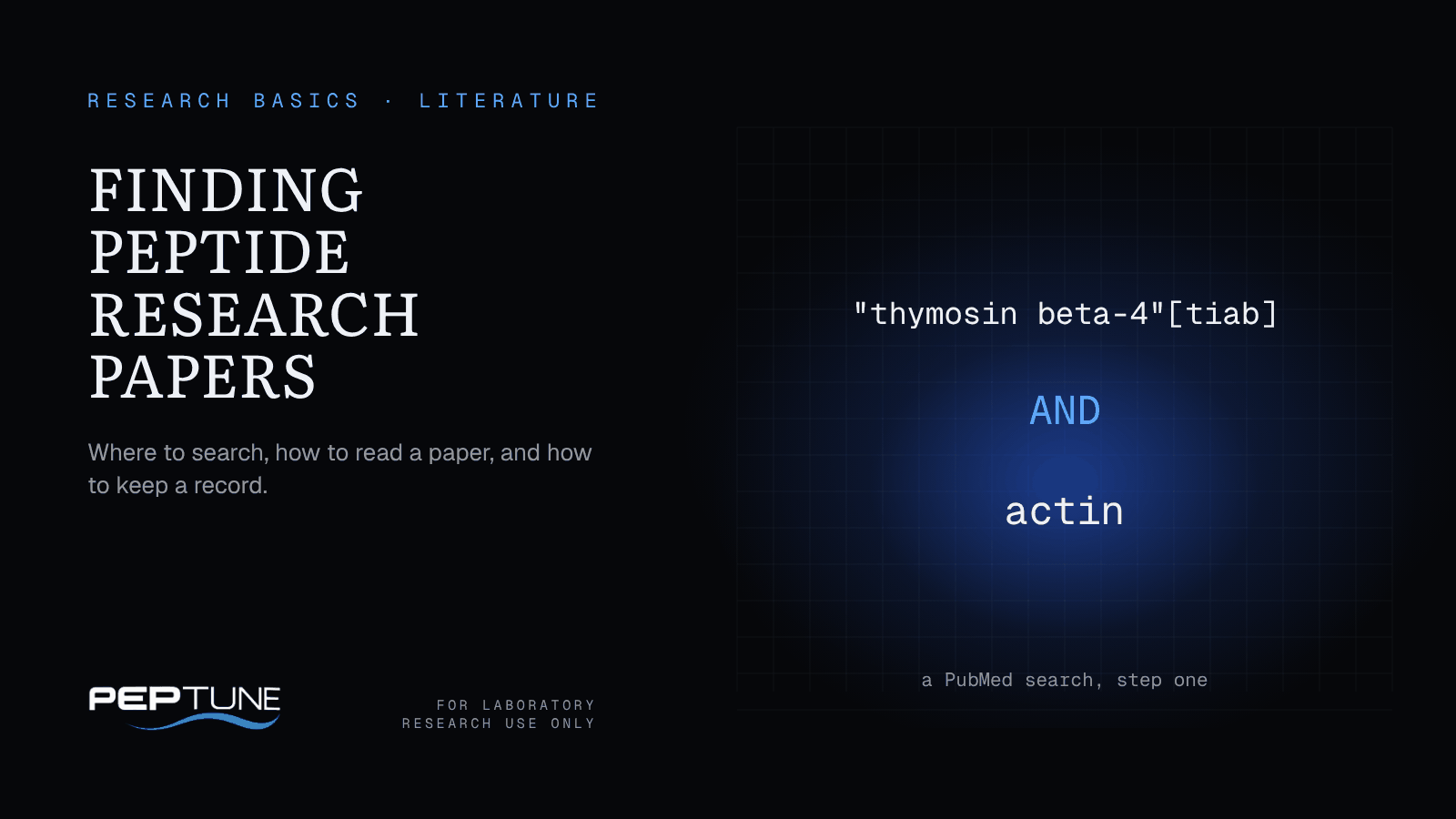
Good research starts with a clear question and the right place to look. This guide covers where to find peptide research, how to read a paper efficiently and how to keep a simple record of the sources behind your work.
Start with a precise question
Before searching, write down three things: the exact molecule, the outcome you care about, and the model or population. A broad search for a compound name returns unrelated products, shared abbreviations and studies of different formulations. A precise question filters most of that out.
Check the molecule's other names too. Many peptides are known by a code, a trade name and a chemical name, and some trade names refer to more than one molecule. Our article on TB-500 and thymosin beta-4 shows how much a name can hide.
Search PubMed
PubMed indexes most of the biomedical literature and is free to use. A few habits make it much more useful:
- Combine the molecule name with a focused term, such as mechanism, receptor, stability, mass spectrometry or randomised trial.
- Use quotation marks for exact phrases and the filters for article type and date.
- Check "similar articles" and the reference list of a good paper; they often lead to the key studies faster than new searches.
- Look for the free full text link. Many papers are available through PubMed Central.
Check clinical-trial registries
ClinicalTrials.gov lists clinical studies, often before they are published. A record shows a study's purpose, design, status and planned outcomes. A registered trial is not evidence that anything works: it records that a study was planned. Look for posted results or a published paper, and compare the published outcomes with the ones registered at the start. A study that quietly changed its main outcome deserves a closer look.
Read the paper in the right order
You do not need to read a paper from start to finish. A faster route:
- Abstract: what the authors say they found.
- Figures and tables: what the data actually show.
- Methods: how it was done, on what material, with what controls.
- Limitations and disclosures: what the authors themselves flag.
- Discussion, last: the authors' interpretation, which you can now judge.
Our checklist for evaluating peptide studies covers what to look for at each step.
Prefer primary sources
Reviews are good for orientation, but a specific factual claim should rest on the primary study that measured it. Check dates, because an older finding may have been updated or contradicted. Check whether a paper has been corrected or retracted before you rely on it. And never cite a paper on the strength of its title alone.
Keep an evidence trail
For each claim that matters to your work, keep a short record:
- The claim, in one sentence.
- The primary source, with a link.
- The study type: biochemical, cell, animal or human.
- The main limitation.
- The date you checked it.
This takes a minute per source and makes your notes easy to audit and update as new papers appear. It is the same habit as keeping batch numbers and certificates with your results: anyone should be able to trace a statement back to its evidence.
Common questions
Does a registered clinical trial mean a product works?
No. Registration records that a study was planned. It is not evidence of benefit or safety.
Should I rely only on review papers?
No. Reviews give context, but specific findings should be checked in the primary studies they cite.
Sources
Documented material for your experiments
Peptune publishes certificates of analysis on each product page as they arrive, and in the certificate library, so the material in your records can be traced to its data. Browse the full catalogue.
For laboratory research use only. Nothing in this article is medical advice or a suggestion to use any compound on people or animals.
For laboratory research use only. Not for human or veterinary use. Nothing here is medical advice.