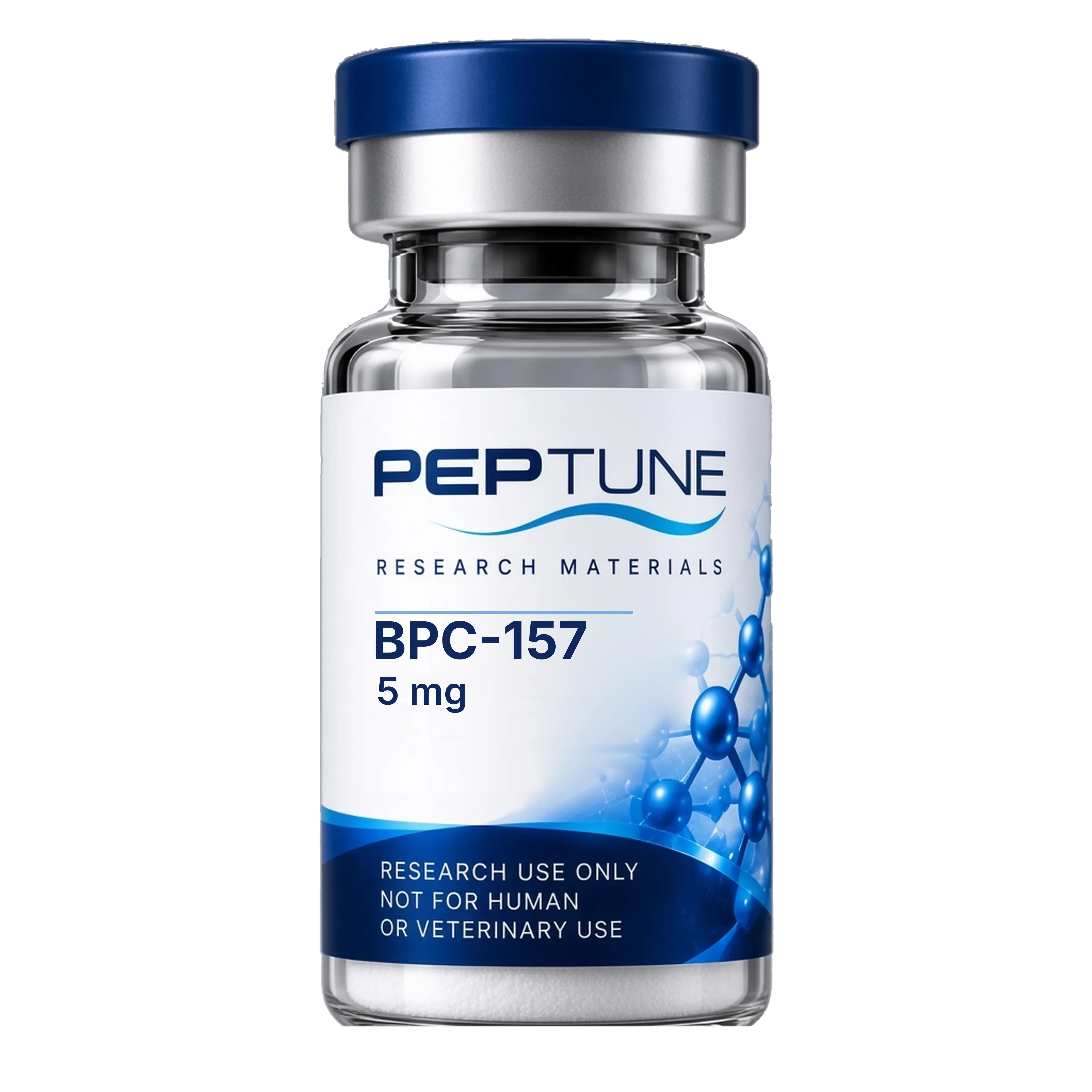
BPC-157 research peptide
The fifteen-residue research peptide on its own, in a lyophilized vial of 5 mg or 10 mg.
$49.00
Out of stock
- Class
- Synthetic pentadecapeptide
- Amount per vial
- 5 mg or 10 mg BPC-157, as labelled
- Form
- Lyophilized powder
- Length
- 15 residues
- CAS number
- 137525-51-0
- Molecular weight
- 1,419.5 g/mol
- Appearance
- White powder
For laboratory research use only · Certificate of analysis · Full specifications
Documentation
Certificate of analysis
No certificate is published for this product yet. Contact us to check the documentation for the current batch before you order; published certificates are listed in the documentation library.
Overview
About this product
BPC-157 is a synthetic pentadecapeptide: fifteen amino acids, Gly-Glu-Pro-Pro-Pro-Gly-Lys-Pro-Ala-Asp-Asp-Ala-Gly-Leu-Val. It was first described in the early 1990s as a fragment of a larger protein sequence isolated from gastric juice, and "BPC" stands for Body Protection Compound. It is also catalogued as PL 14736. With more than 230 papers indexed on PubMed, it is one of the most published small research peptides, and most of that literature comes from cell and animal models of tissue repair, blood-vessel growth and gut lining.
This vial holds BPC-157 on its own, so a laboratory can study it without a second peptide in the same preparation. It is the single-compound reference for anyone comparing it with our BPC-157 + TB-500 blend.
Supplied as a lyophilized white powder in a sealed vial, labelled with the compound and its amount.
What the research shows In a 2003 rat study of a cut Achilles tendon, tendons treated with BPC-157 bore a higher load before failing and showed smaller defects than saline controls. Later cell studies from the same field reported that BPC-157 increased the outgrowth, survival and migration of tendon fibroblasts (2011) and raised their expression of the growth hormone receptor (2014). A 2017 study reported faster recovery of blood flow in rats with ischaemic hind-limb muscle, and higher expression and activation of the VEGFR2 receptor in blood-vessel cells. A 2022 study in rats and dogs measured an elimination half-life under 30 minutes, with the peptide broken down into small fragments and amino acids. Two systematic reviews counted the evidence. Vasireddi and colleagues (2025) found 36 eligible studies, 35 preclinical and 1 clinical. Poolton and colleagues (2026) looked only at human studies and found three, with 30 participants in total; they rated every study of poor methodological quality and the overall certainty of evidence as very low. Sources: Staresinic et al., Journal of Orthopaedic Research, 2003, PMID 14554208. Chang et al., Journal of Applied Physiology, 2011, PMID 21030672. Chang et al., Molecules, 2014, PMID 25415472. Hsieh et al., Journal of Molecular Medicine, 2017, PMID 27847966. He et al., Frontiers in Pharmacology, 2022, PMID 36588717. Vasireddi et al., HSS Journal, 2025, PMID 40756949. Poolton et al., Acta Orthopaedica Belgica, 2026, PMID 42885452.
For laboratory research use only. Not for human or veterinary use. Purity and identity are stated on the batch certificate, published on this page once it is on file.
Research profile
BPC-157 in the literature
Research areas · 0–5
The molecule
About this compound
One vial holds a single synthetic peptide, BPC-157, at the amount on its label (5 mg or 10 mg). BPC-157 is a pentadecapeptide, fifteen residues, sequence Gly-Glu-Pro-Pro-Pro-Gly-Lys-Pro-Ala-Asp-Asp-Ala-Gly-Leu-Val, described in the early 1990s as a fragment of a larger protein sequence from gastric juice. It is also catalogued as PL 14736. Most of its literature is in cell and animal models; two systematic reviews (2025 and 2026) found very few human studies, rated of very low certainty.
- Class
- Synthetic pentadecapeptide
- Also known as
- Body Protection Compound-157, PL 14736
- CAS number
- 137525-51-0
- Sequence
- Gly-Glu-Pro-Pro-Pro-Gly-Lys-Pro-Ala-Asp-Asp-Ala-Gly-Leu-Val
- Length
- 15 residues
- Molecular formula
- C62H98N16O22
- Molecular weight
- 1,419.5 g/mol
- Target in the literature
- Fragment of a gastric protein sequence; no single receptor identified. Studies report VEGFR2 and growth hormone receptor involvement in cell models
- Half-life (published)
- Under 30 minutes in rats and dogs (PMID 36588717)
- Form
- Lyophilized powder
- Amount per vial
- 5 mg or 10 mg BPC-157, as labelled
- Appearance
- White powder
- Solubility
- Sterile water or bacteriostatic water
- Storage (unopened)
- −20 °C long term, 2 to 8 °C short term; sealed and away from light
- Storage (in solution)
- 2 to 8 °C, away from light; do not freeze
- Packaging
- Sealed vial
Published research
These are published papers about the molecule. A paper is not a dose, not medical advice, and not evidence that this vial is for human or veterinary use.
- Gastric pentadecapeptide BPC 157 accelerates healing of transected rat Achilles tendon and in vitro stimulates tendocytes growth.
Journal of Orthopaedic Research · 2003 · PMID 14554208
A rat tendon model and cultured tendon cells. The title states the model. It is not a protocol for this vial.
- Therapeutic potential of pro-angiogenic BPC157 is associated with VEGFR2 activation and up-regulation.
Journal of Molecular Medicine · 2017 · PMID 27847966
Blood-vessel growth in an egg membrane assay, cultured endothelial cells and a rat hind-limb model, and the VEGFR2 signalling behind it.
- Pharmacokinetics, distribution, metabolism, and excretion of body-protective compound 157, a potential drug for treating various wounds, in rats and dogs.
Frontiers in Pharmacology · 2022 · PMID 36588717
How the peptide is distributed, broken down and cleared in rats and dogs. Listed for its analytical methods.
- Human evidence for BPC-157 in orthopaedic and regenerative medicine: a systematic review of efficacy and safety.
Acta Orthopaedica Belgica · 2026 · PMID 42885452
A review of human studies only: three studies, 30 participants, certainty of evidence rated very low.
For laboratory research use only. Not for human or veterinary use. The amount on the label is the contents of the vial, not a dose.
Ordering in Canada
Buying Peptune BPC-157 in Canada
- Can I buy Peptune BPC-157 in Canada?
- Yes. Peptune sells Peptune BPC-157 online for laboratory research use only, with tracked delivery to every province and territory in Canada.
- How much is Peptune BPC-157?
- 5 mg: $49; 10 mg: $69, in Canadian dollars. Free shipping on orders of $150 or more.
- Is there a certificate of analysis for Peptune BPC-157?
- The certificate of analysis for the current batch of Peptune BPC-157 is published on this page and in the COA library as soon as it is on file.
- How is Peptune BPC-157 supplied?
- As a lyophilized powder in a sealed vial, labelled with the compound and the amount: 5 mg or 10 mg BPC-157, as labelled. The amount is the contents of the vial, not a dose. Keep it sealed, dry, cold and away from light.
- How do I pay?
- By Interac e-Transfer or crypto. The payment instructions arrive by email after you place the order, and nothing is charged before that step.
Verified buyers
Reviews
No reviews yet. Reviews come from verified buyers only, and each one is checked before it appears.
Bought this? Write a review
Loading…