
Comparisons · 2 min read · By Lola
Tesamorelin vs CJC-1295: two GHRH analogues compared
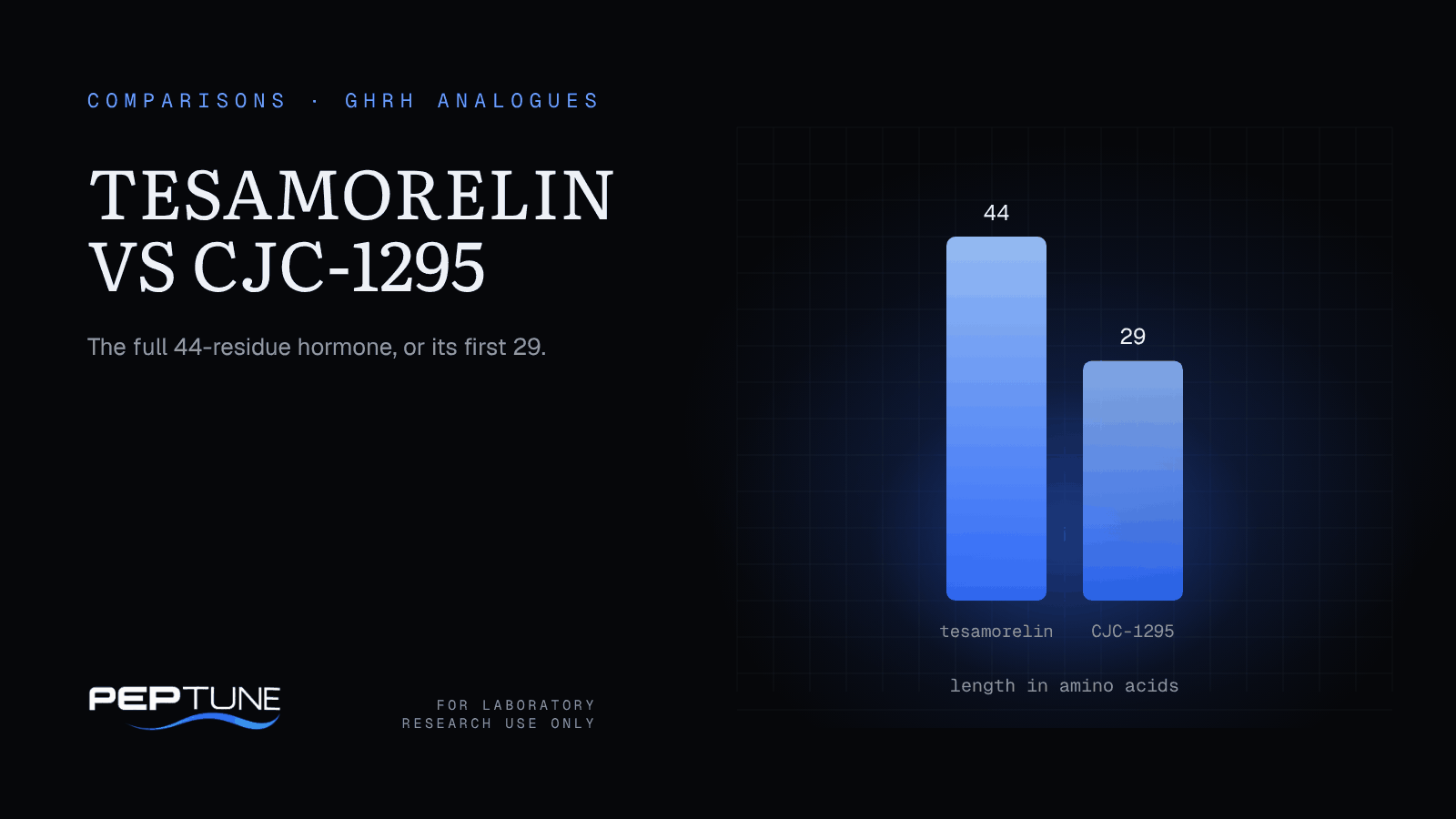
Tesamorelin and CJC-1295 both act on the same receptor, the receptor for growth hormone-releasing hormone (GHRH). They differ in length, in how they are protected from breakdown, and in how far their research has gone. This comparison sets out those differences.
Tesamorelin vs CJC-1295 at a glance
- Tesamorelin: all 44 amino acids of human GHRH, with a trans-3-hexenoyl group added at the start. About 5,136 daltons.
- CJC-1295: the first 29 amino acids of GHRH, with four amino acids swapped. About 3,368 daltons without DAC.
- Both act on the GHRH receptor in the pituitary. Neither acts on the ghrelin receptor.
Structure
Natural GHRH is broken down within minutes. Each analogue solves this in a different way.
Tesamorelin keeps the full natural sequence. The hexenoyl group at the start blocks the enzyme that would cut it. Its nonclinical profile was published in 2007 (Basic Clin Pharmacol Toxicol, 2007).
CJC-1295 is shorter. The first 29 amino acids carry all of GHRH's activity, and four substitutions make that fragment more stable. This version is often called modified GRF (1-29), or CJC-1295 without DAC.
The DAC question
The CJC-1295 used in the published human trials carried a "drug affinity complex" (DAC). DAC links the peptide to albumin in the blood. In healthy adults, it gave a half-life of 5.8 to 8.1 days. Single injections raised growth hormone levels 2- to 10-fold for six days or more (J Clin Endocrinol Metab, 2006). A second study found that growth hormone pulses kept their normal rhythm, while the lowest levels between pulses rose 7.5-fold (J Clin Endocrinol Metab, 2006).
The version without DAC has no albumin link, so it clears much faster. Results from the DAC trials don't carry over to it. Our post CJC-1295 vs ipamorelin covers the two forms.
What the trials measured
Tesamorelin has the larger clinical record. In a 26-week trial of 412 people with HIV and abdominal fat build-up, visceral fat fell by 15.2% with tesamorelin and rose by 5.0% with placebo. IGF-1 levels rose by 81% (N Engl J Med, 2007). A later 12-month trial in 61 people with HIV and fatty liver found a larger fall in liver fat with tesamorelin than with placebo (Lancet HIV, 201930338-8)). Our post on tesamorelin clinical research covers these studies.
CJC-1295's human data are the two short studies above, in healthy adults. Its development as a medicine did not go further.
These findings come from specific trial groups under medical supervision. They are not evidence of any effect outside those settings.
Questions people ask
Do tesamorelin and CJC-1295 act on the same receptor?
Yes. Both act on the GHRH receptor. Ipamorelin and other ghrelin-receptor peptides use a different receptor, as our post on GHRH and ghrelin receptor peptides explains.
Which one is longer?
Tesamorelin. It has all 44 amino acids of GHRH. CJC-1295 has the first 29.
Is the CJC-1295 that Peptune supplies the DAC form?
No. Peptune's CJC-1295 is the form without DAC, paired with ipamorelin.
Ordering in Canada
Peptune supplies tesamorelin as a single vial, and CJC-1295 with ipamorelin as a blend. Ipamorelin is also sold alone. Orders ship across Canada by tracked mail, free on orders of $150 or more.
For laboratory research use only. Nothing in this article is medical advice or a suggestion to use any compound on people or animals.
For laboratory research use only. Not for human or veterinary use. Nothing here is medical advice.