
Comparisons · 2 min read · By Lola
BPC-157 vs GHK-Cu: two peptides, two research histories
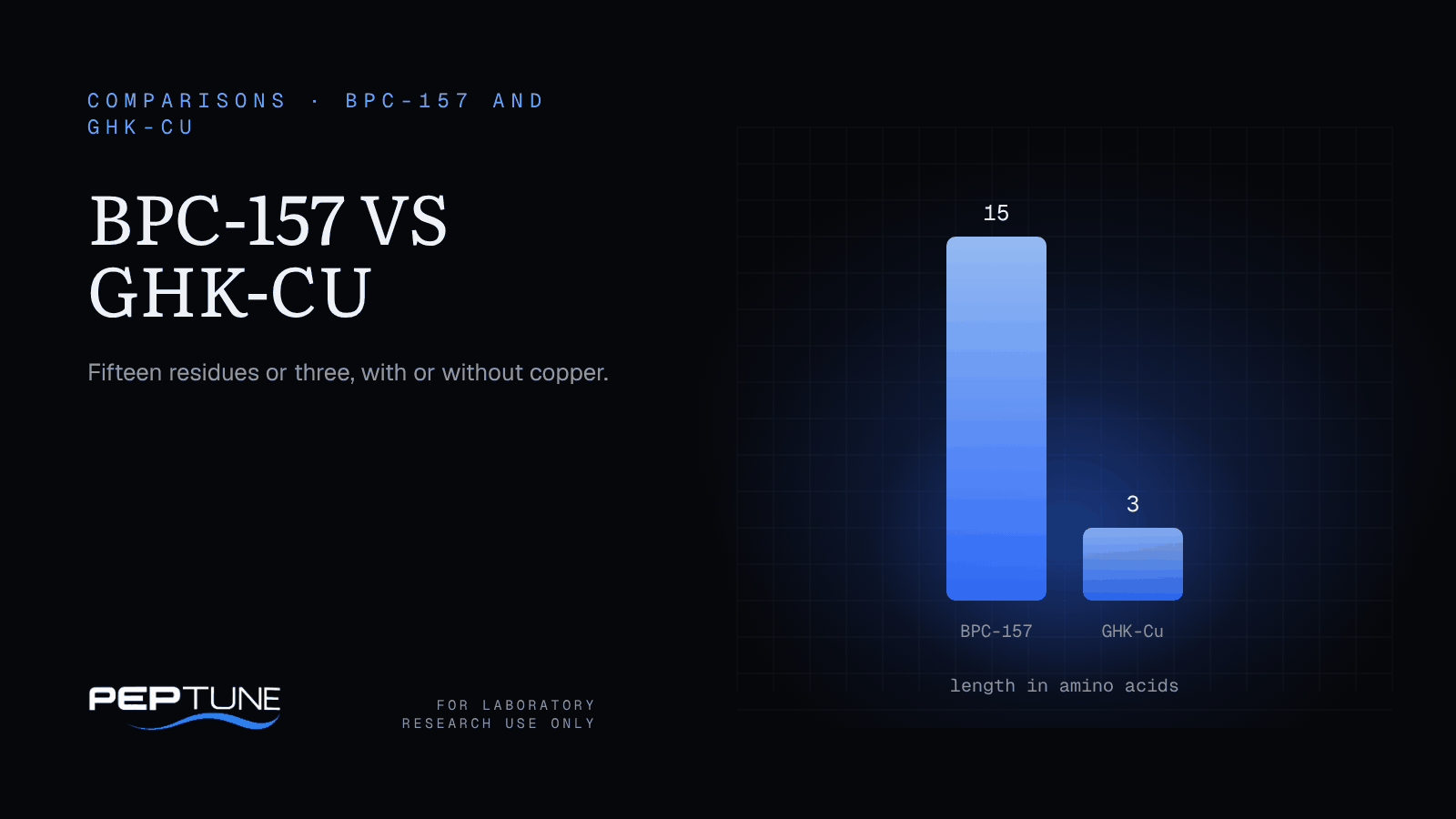
BPC-157 and GHK-Cu often appear in the same research blends. They have little else in common. This comparison sets out how the two differ in structure, origin, research models and handling.
BPC-157 vs GHK-Cu at a glance
- BPC-157: synthetic, 15 amino acids (GEPPPGKPADDAGLV), about 1,419 daltons, no metal.
- GHK-Cu: the tripeptide glycyl-L-histidyl-L-lysine bound to one copper(II) ion. GHK alone is about 340 daltons.
Origin
BPC-157 is a synthetic fragment described from a protein in gastric juice. Most of its literature comes from one research group in Zagreb.
GHK occurs naturally in human plasma. Loren Pickart first described it in 1973, as a plasma factor that kept liver cells alive longer in culture (Biochem Biophys Res Commun, 197391459-9)). It binds copper(II) tightly, and most research uses the copper complex, GHK-Cu.
Research models
- BPC-157 has been studied mostly in rats and in cell culture. In rat tendon fibroblasts, it increased outgrowth, cell survival and migration (J Appl Physiol, 2011). In endothelial cells and a rat model, it was linked to VEGFR2 activation (J Mol Med, 2017). Our post on BPC-157 human evidence covers how little human data exists.
- GHK-Cu has been studied in skin cell culture, wound models and gene-expression data sets. A 2018 review summarises which genes GHK changed in those data sets (Int J Mol Sci, 2018). Our post on GHK-Cu skin permeation covers the topical studies.
These are findings in particular models. They are not evidence of any effect in people.
Analytical identity
The two are easy to tell apart. BPC-157 gives a singly protonated ion near 1,420 m/z. GHK gives one near 341 m/z, and the copper complex adds the mass of copper. HPLC confirms purity for each. See mass spectrometry for peptide identity for how this works.
Handling and storage
GHK-Cu powder is blue because of its copper. It should be kept dry, cold and away from light. BPC-157 is a white powder, and it is unusually stable in acid for a peptide of its size. Both store best as sealed, freeze-dried powder. Our guide to lyophilized peptide storage covers the details.
Why they appear together
Both have been studied in tissue-repair models, by different groups and through different proposed mechanisms. That is why blends such as GLOW and KLOW combine them with TB-500. A study that uses a blend still needs single-compound arms to tell the effects apart.
Questions people ask
Is GHK-Cu a stronger version of BPC-157?
No. They are unrelated molecules. GHK-Cu is a copper-binding tripeptide, and BPC-157 is a 15-residue peptide with no metal.
Which has more published research?
GHK has been studied since 1973 by several groups. BPC-157 has a large literature too, but most of it comes from a single group.
Can they be in the same vial?
Yes. GLOW and KLOW both contain GHK-Cu and BPC-157, alongside TB-500. Mass spectrometry confirms each component separately.
Ordering in Canada
Peptune supplies BPC-157 and GHK-Cu as single vials. Both peptides are in GLOW and KLOW. Orders ship across Canada by tracked mail, free on orders of $150 or more.
For laboratory research use only. Nothing in this article is medical advice or a suggestion to use any compound on people or animals.
For laboratory research use only. Not for human or veterinary use. Nothing here is medical advice.