
Compounds · 5 min read · By Lola
GHK-Cu beyond skin: the gene-expression research
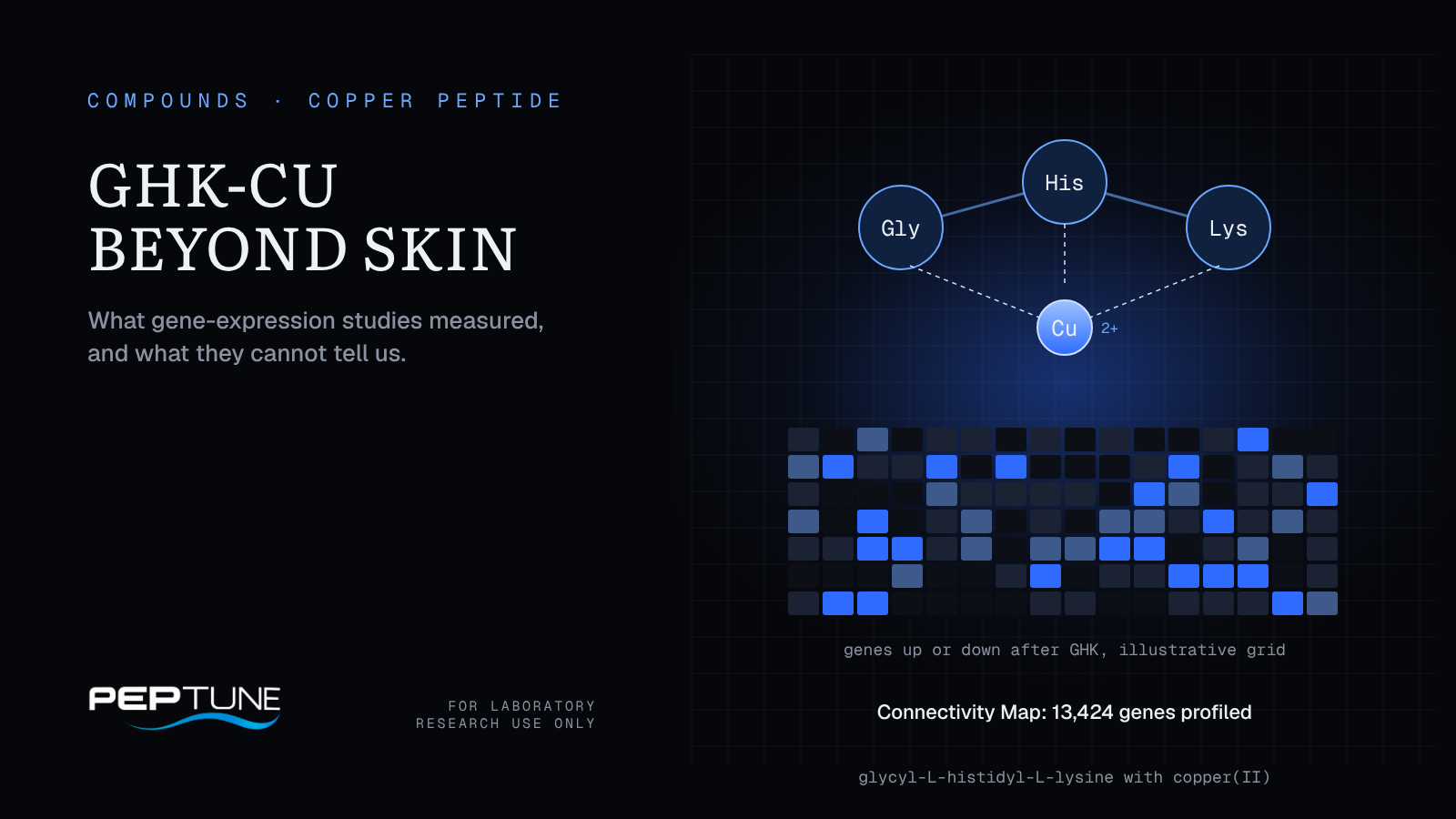
GHK-Cu is usually filed under skin research. Most of its early literature comes from fibroblast cultures, collagen synthesis and wound models, and that is still how it is usually described. Since the early 2010s, though, a different kind of study has drawn attention to the copper tripeptide: large-scale gene-expression analysis. These studies ask a broader question than "what does it do to a skin cell?" They ask which genes change, in which direction, and whether the pattern matches anything already catalogued.
This article summarises that research. It is not medical advice and not a suggestion to use any compound on people or animals.
A small peptide with a long history
GHK is the tripeptide glycyl-L-histidyl-L-lysine. In 1973, Loren Pickart and a co-author, Thaler, reported in Nature New Biology on a tripeptide factor from human plasma that affected the behaviour of liver cells in culture. Pickart identified it as GHK and proposed that it worked by binding metal ions, and its strong affinity for copper(II) became central to the research that followed. The copper complex, GHK-Cu, is the form most often studied. Our guide to what GHK-Cu is covers its structure and how the copper is bound.
For decades the research stayed close to tissue biology: collagen and glycosaminoglycan synthesis, metalloproteinase activity and cell migration. The gene-expression work came later, and it came largely from a public database.
What the Connectivity Map is
The Connectivity Map is a resource built at the Broad Institute. Researchers treated cultured human cell lines with a large library of small molecules and recorded how the expression of thousands of genes changed in response. Each compound leaves a "signature": a list of genes pushed up and genes pushed down.
The value of the resource is matching. A research group can take a gene signature from a disease tissue, search the database, and find compounds whose signatures point the opposite way. Those compounds become candidates for laboratory follow-up. It is a hypothesis generator, not a test of what a compound does in a living tissue. GHK happened to be one of the compounds in the library.
The emphysema study
The best-known GHK result came from a group studying chronic obstructive pulmonary disease. In 2012, Joshua Campbell, Avrum Spira and colleagues published a study in Genome Medicine that profiled gene expression in tissue taken from several regions of the same lungs, so that each region's degree of emphysema could be compared with its gene activity.
- The authors identified 127 genes whose expression was significantly associated with regional emphysema severity.
- Searching the Connectivity Map with that signature, they identified GHK as a compound whose signature ran in the opposite direction, consistent with activation of the TGF-beta pathway.
- They then tested GHK in cultured human lung fibroblasts. It affected the organisation of the actin cytoskeleton and the expression of integrin beta-1, and it restored collagen gel contraction by fibroblasts taken from lungs with COPD.
An accompanying commentary in the same journal by Silke Meiners and Oliver Eickelberg welcomed the approach and noted that animal experiments would be needed to see whether the effect holds in vivo. That is a fair summary of where the study stands: a computational match, confirmed in cultured cells, with the next steps still open.
The broader gene-count analysis
Pickart, with co-authors Vasquez-Soltero and Margolina, then went back to the Connectivity Map to look at GHK's signatures as a whole. Their 2014 paper in BioMed Research International, titled "GHK and DNA: resetting the human genome to health", is the source of a figure often repeated online.
What the paper actually reports is specific:
- The database held three GHK signatures, produced on two of its cell lines: two from the PC3 line and one from the MCF7 line, both cancer-derived lines.
- The 22,277 probe sets on the array represented 13,424 genes.
- The authors counted the genes whose expression changed by 50 per cent or more in either direction and reported this as 31.2 per cent of those genes. (The paper's introduction gives 32.1 per cent; the methods section gives 31.2.)
The authors grouped the changed genes by function, including DNA repair, antioxidant systems, the ubiquitin-proteasome system and TGF-beta signalling. Their own discussion adds a caution that is easy to miss: there is not yet enough information to translate gene-profiling data into biological effects.
Reading the gene-expression work carefully
These studies are interesting precisely because they are broad. That same breadth is why they need careful reading.
- The data are messenger RNA levels, not protein levels or functional outcomes. A gene that changes on an array may not change the cell's behaviour.
- The cell lines are cancer-derived lines chosen for the database, not the tissue a given study cares about. Results in PC3 and MCF7 cells do not automatically describe fibroblasts, neurons or lung tissue.
- A 50 per cent threshold is a choice. The paper does not report a statistical test for each gene, so the headline percentage describes magnitude, not significance.
- The analysis was carried out largely by one research group with a long association with the compound. Independent replication with fresh experiments, rather than reanalysis of the same database, is what would strengthen it.
None of this makes the work uninteresting. It does mean that a sentence such as "GHK-Cu resets a third of the genome" goes far beyond what was measured. Our checklist for evaluating a peptide study is a good companion when you read the primary papers, and our overview of in vitro, in vivo and clinical research explains why a cell-line result is a starting point.
What this means for laboratory design
For researchers following up the gene-expression literature, the practical lessons are familiar ones. Separate the peptide from the metal: run free GHK, a simple copper salt at the matching copper concentration, and the complex. Record pH, since copper binding depends on it. Choose cell types that match the question rather than defaulting to the lines in the database, and measure protein or function alongside RNA wherever possible.
GHK-Cu at Peptune
Peptune stocks GHK-Cu on its own and in two blends, for laboratory research use only. Certificates of analysis appear on each product page once they are on file, and in the certificate library.
- GHK-Cu, 50 mg: the copper complex itself, supplied as a blue lyophilised powder.
- GLOW, 70 mg: GHK-Cu with BPC-157 and TB-500, for multi-component designs.
- KLOW, 80 mg: the GLOW components plus the tripeptide KPV.
The differences between the two blends are laid out in KLOW vs GLOW. Every order ships within Canada in discreet packaging, free on orders of $150 or more.
Sources
- Campbell J.D. et al. A gene expression signature of emphysema-related lung destruction and its reversal by the tripeptide GHK. Genome Medicine, 2012
- Meiners S., Eickelberg O. Next-generation personalized drug discovery: the tripeptide GHK hits center stage in chronic obstructive pulmonary disease. Genome Medicine, 2012
- Pickart L., Vasquez-Soltero J.M., Margolina A. GHK and DNA: resetting the human genome to health. BioMed Research International, 2014
- Pickart and Thaler. Nature New Biology, 1973, volume 243, pages 85 to 87
- Broad Institute: the Connectivity Map
For laboratory research use only. Nothing in this article is medical advice or a suggestion to use any compound on people or animals.
For laboratory research use only. Not for human or veterinary use. Nothing here is medical advice.