
Research news · 6 min read
Peptide research roundup: 20 October 2026
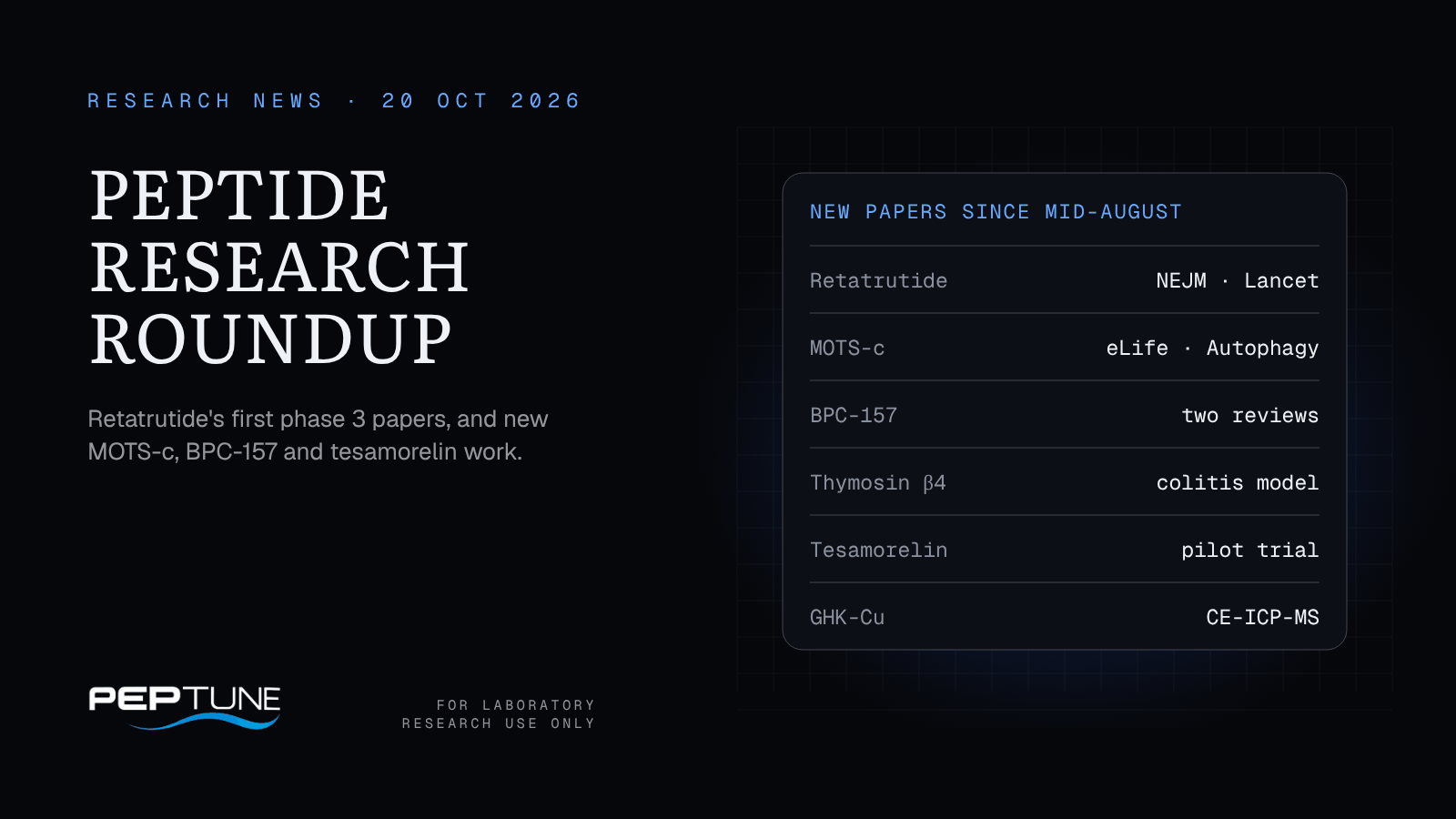
This is the first edition of a weekly roundup of new peptide research. Each week we search PubMed for papers published in the previous weeks on the compounds in our catalogue, pick the ones with new data, and summarise what each study measured, in what model, and where it stops. This first edition covers mid-August to 20 October 2026.
It is a summary of published research, not medical advice and not a suggestion to use any compound on people or animals.
Retatrutide: the first two phase 3 papers
The biggest news of the period is that the first full results of retatrutide's phase 3 programme, called TRIUMPH, are now peer-reviewed. Retatrutide is an investigational single peptide that activates three receptors at once: GIP, GLP-1 and glucagon. Both trials were funded by Eli Lilly, and retatrutide is not approved for any use.
TRIUMPH-1 (The New England Journal of Medicine, 29 September 2026). Jastreboff and colleagues randomised 2,339 adults with obesity and without diabetes to one of three retatrutide dose levels or placebo, once a week for 80 weeks.
- Mean change in body weight was −17.6%, −23.7% and −25.0% across the three dose groups, against −3.9% with placebo.
- Two subgroups had their own primary outcomes. In 574 participants with knee osteoarthritis, a pain score (WOMAC) fell more than with placebo. In 243 participants with obstructive sleep apnoea, breathing events per hour fell by about 23 to 34, against about 10 with placebo.
- The most common adverse events were gastrointestinal.
TRIUMPH-2 (The Lancet, 10 October 2026). Bellido and colleagues ran the same design in 1,152 adults with obesity and type 2 diabetes, at 92 centres in eight countries.
- Mean change in body weight at week 80 was −11.9%, −16.8% and −18.8%, against −5.1% with placebo.
- Diarrhoea (27 to 34% against 13%) and nausea (14 to 28% against 8%) were more common than with placebo, as were low blood pressure and dysesthesia, an abnormal skin sensation. Stopping treatment because of adverse events or death ranged from 4 to 12% across the retatrutide groups, against 5% with placebo.
Two details are worth noting when reading these numbers. Weight loss was smaller in the trial of people with type 2 diabetes, but the two trials enrolled different people, so their figures should not be compared directly. The figures above also use the "treatment-regimen" estimand, which counts everyone randomised, whether or not they kept taking the study drug. Some press coverage quotes higher figures from the on-treatment analysis. For the receptor background, see Retatrutide vs tirzepatide and What is retatrutide?.
MOTS-c: three new studies, one surprising
MOTS-c is a 16-residue peptide encoded inside the mitochondrial 12S rRNA gene. Three papers in this period add to what is known about it, all in cells or animals.
- An antimicrobial peptide from the mitochondria (eLife, 18 August 2026). Rice and colleagues report that MOTS-c has the chemistry of a host defence peptide, cationic and amphipathic, and directly attacked the membranes of E. coli and MRSA in the laboratory. In a mouse peritonitis model it neutralised MRSA, and it reprogrammed mouse monocytes into macrophages with stronger bacterial clearance. The authors propose that part of the immune system is encoded in the mitochondrial genome, a striking idea that will need independent replication.
- Ischaemic skin flaps in animals (Autophagy, October 2026). Shi and colleagues found that MOTS-c improved survival of ischaemic skin flaps in an animal model, and traced the effect to reduced lysosomal membrane leakage through the PLA2G4A enzyme and the MAPK–NF-κB pathway.
- Aged ovarian cells (Reproduction and Fertility, 19 October 2026). Tsui and colleagues report that MOTS-c raised energy production in aged human granulosa cells and was associated with better maturation of eggs from aged mice, though not to the level of young mice. The authors stress that the work did not test fertilisation, embryos or live births.
Background: What is MOTS-c?
BPC-157: two reviews map how thin the human evidence is
Two reviews published this period reach a similar conclusion from opposite ends.
- Human studies (Acta Orthopaedica Belgica, 8 October 2026). Poolton and colleagues searched four databases up to June 2026 for any study of BPC-157 in people. They found three, with 30 participants in total: two small retrospective studies and a two-person safety pilot. All were judged of poor methodological quality and the overall certainty of evidence was rated very low.
- Rodent ischaemia-reperfusion studies (International Journal of Molecular Sciences, 19 September 2026). Demirtaş reviewed the animal literature on BPC-157 in injury caused when blood flow returns to a tissue. The studies consistently report lower oxidative-stress, inflammatory and apoptosis markers, but they are heterogeneous, short and often single-dose, and the review calls BPC-157 a hypothesis-generating candidate that needs blinded replication and pharmacokinetic work.
For anyone designing a BPC-157 study, the second review's list of gaps (dose-response, therapeutic window, pharmacokinetics, toxicology) reads as a ready-made research agenda. Background: What is BPC-157?
Thymosin β4: a colitis model
TB-500 is a synthetic fragment based on thymosin β4, so research on the full protein is useful context. In Molecular Biomedicine (17 August 2026), Zhao and colleagues report that the gene for thymosin β4 is less active in colon tissue from people with inflammatory bowel disease, that mice lacking it were more vulnerable to chemically induced colitis, and that oral recombinant human thymosin β4 reduced inflammation and fibrosis markers in mice, partly by dampening mineralocorticoid receptor signalling. Background: What is TB-500?
Tesamorelin: a small cognition pilot
Tesamorelin is a GHRH analogue. In eNeurologicalSci (September 2026), Stewart and colleagues report a 10-week, double-blind, placebo-controlled pilot in 22 adults with cognition ranging from normal to mild impairment. The standard analysis found no significant changes in body composition, sleep, physical performance, glucose tolerance, cognition or brain imaging. A machine-learning analysis flagged possible differences in two brain regions, which the authors present as a reason to pair cognitive tests with imaging in future trials rather than as a finding. Background: GHRH and ghrelin-receptor peptides
GHK-Cu: measuring the complex inside a formulation
A methods paper rather than a biology paper. In the Journal of Chromatography A (10 October 2026), Ogórek and colleagues encapsulated GHK-Cu in liposomes, placed them in model emulsions and serums, and used capillary electrophoresis coupled to tandem ICP mass spectrometry to track copper (for the complex) and phosphorus (for the liposome) separately. The technique lets a laboratory check whether the copper–peptide complex stays intact and inside its carrier in a complex mixture, a question standard HPLC answers poorly. Background: What is GHK-Cu?
Nothing new this period
We found no new primary studies on Semax, Selank, ipamorelin, CJC-1295, IGF-1 LR3 or NAD+ supplementation in this window. They will appear here when new work is published.
Compounds in this roundup
Certificates of analysis for each batch are on each product page once they are on file, and in the certificate library.
- Retatrutide: the GIP, GLP-1 and glucagon receptor triple agonist.
- MOTS-c, 10 mg: the 16-residue peptide encoded in the 12S rRNA gene.
- BPC-157 + TB-500: BPC-157 and TB-500 in one vial.
- Tesamorelin, 10 mg: the stabilised GHRH analogue.
- GHK-Cu, 50 mg: the copper tripeptide complex.
Sources
- Jastreboff A.M. et al. Retatrutide, a Triple Hormone Receptor Agonist, for Treatment of Obesity. The New England Journal of Medicine, 2026
- Bellido V. et al. Retatrutide in adults with obesity and type 2 diabetes (TRIUMPH-2): a double-blind, parallel-group, randomised, placebo-controlled, phase 3 trial. The Lancet, 2026
- Rice M.C. et al. MOTS-c is a mitochondrial-encoded interferon-linked host defense peptide. eLife, 2026
- Shi J. et al. MOTS-c, a mitochondrial-derived peptide, ameliorates lysosomal membrane permeability and improves survival of soft tissue transplantation. Autophagy, 2026
- Tsui K.H. et al. The Mitochondrial-Derived Peptide MOTS-c Improves Bioenergetics in Aging-Associated Granulosa Cells and Oocytes. Reproduction and Fertility, 2026
- Poolton J.T. et al. Human evidence for BPC-157 in orthopaedic and regenerative medicine: a systematic review of efficacy and safety. Acta Orthopaedica Belgica, 2026
- Demirtaş H. BPC 157 in Rodent Ischemia-Reperfusion Injury: A Critical Review of Preclinical Evidence. International Journal of Molecular Sciences, 2026
- Zhao T.R. et al. Recombinant human Thymosin β4 ameliorates experimental colitis and intestinal fibrosis through suppression of mineralocorticoid receptor signaling. Molecular Biomedicine, 2026
- Stewart C.E. et al. The effect of growth hormone-releasing hormone on cognition and brain connectivity in adults with cognition ranging from normal to mild cognitive impairment. eNeurologicalSci, 2026
- Ogórek K. et al. Characterization of copper tripeptide-loaded lipid carriers and their stability in complex cosmetic matrices. Journal of Chromatography A, 2026
For laboratory research use only. Nothing in this article is medical advice or a suggestion to use any compound on people or animals.
For laboratory research use only. Not for human or veterinary use. Nothing here is medical advice.