
Research basics · 3 min read
What are research peptides?
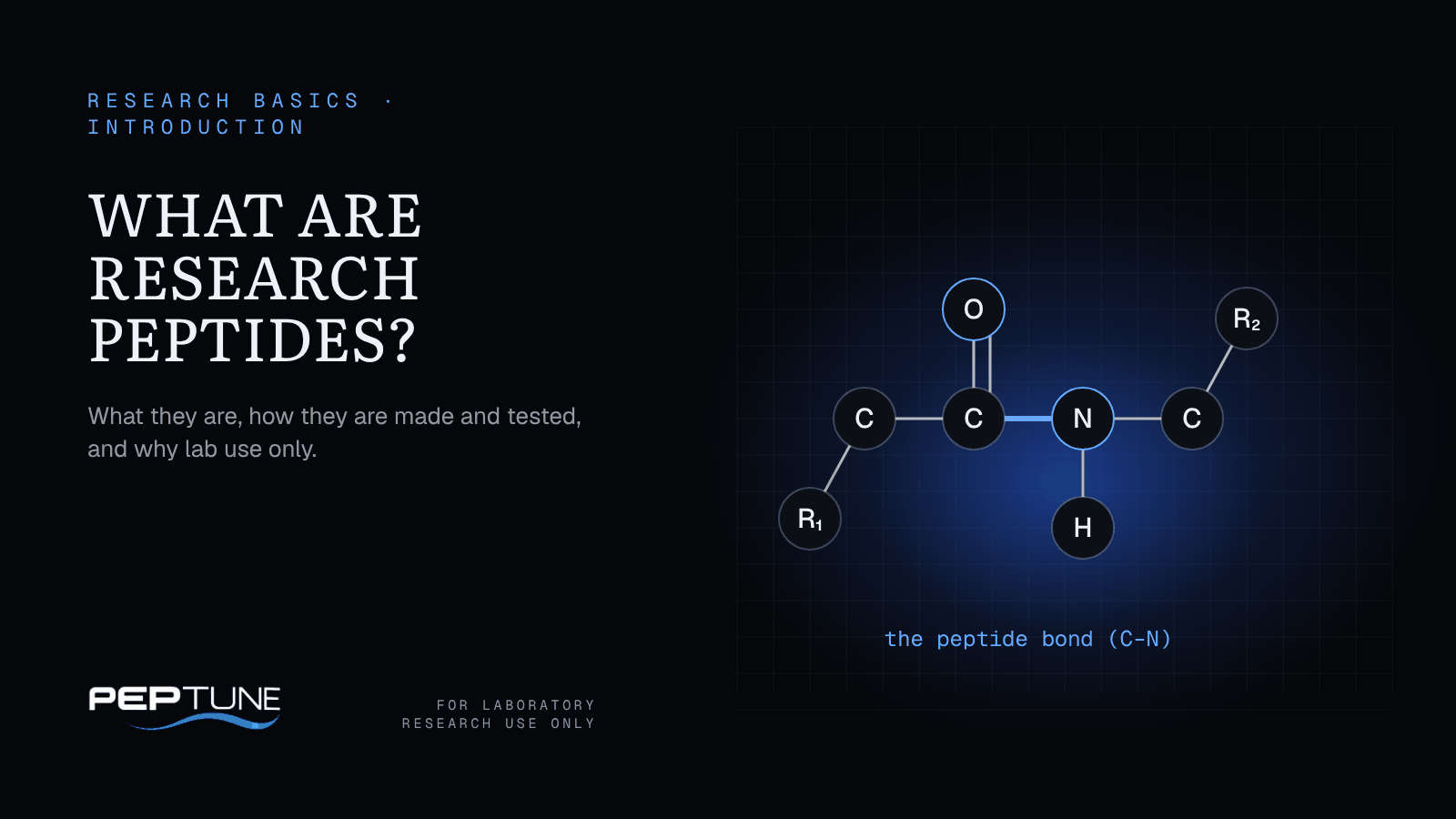
What are research peptides? In short, they are synthetic peptides made and sold as laboratory reagents. Peptides are short chains of amino acids joined by peptide bonds. The line between a peptide and a protein is loose, but peptides are usually under about fifty residues long. Many natural signalling molecules, such as hormones and neurotransmitters, are peptides, which is why synthetic versions and analogues are widely used in laboratory research.
What are research peptides, chemically?
Every peptide is defined by its sequence: the order of amino acids from one end of the chain (the N-terminus) to the other (the C-terminus). Twenty standard amino acids give an enormous number of possible sequences, and small changes in sequence can change how a peptide folds, how stable it is and how it behaves in an assay.
Research peptides fall into a few broad groups:
- Copies of natural sequences, or fragments of larger proteins.
- Analogues, where one or more residues are swapped or modified to change stability or behaviour in a model.
- Modified peptides, for example with an amidated C-terminus, an acetylated N-terminus or an attached chemical group.
- Complexes and related molecules, such as the copper peptide GHK-Cu; see what is GHK-Cu.
Some suppliers also offer blends, where two or more peptides are combined in one vial. See blends and, for an example, BPC-157 and TB-500 as a blend.
How they are made
Most research peptides are made by solid-phase peptide synthesis. The first amino acid is anchored to a resin bead, and the chain is built one residue at a time, with protecting groups added and removed at each step. When the chain is complete, it is cut from the resin, purified by HPLC and freeze-dried into a powder.
Because each coupling step is not perfectly efficient, the crude product contains shorter and modified chains alongside the target. Purification removes most of these, and the remaining share is what a purity figure reports.
Longer or more complex molecules, such as IGF-1 LR3, may instead be produced by recombinant methods in engineered cells. See what is IGF-1 LR3.
The finished peptide is usually supplied as a salt, often acetate or trifluoroacetate, because of the acids used in synthesis and purification. That is one reason the weight of powder in a vial is not the same as the weight of peptide.
How they are tested
Two analyses form the core of any certificate of analysis:
- Identity by mass spectrometry: the measured mass should match the expected mass of the sequence. See mass spectrometry for peptide identity.
- Purity by HPLC: the main peak as a share of all detected peaks. See HPLC and peptide purity.
Results apply to one batch, so each vial should carry a batch number that matches its certificate. See how to read a certificate.
Why "research use only"
Research peptides are supplied as laboratory reagents. They are not medicines, have not been approved for human or veterinary use, and are not made or labelled for that purpose. Their place is in cell culture, analytical chemistry, receptor studies and similar laboratory work.
Buyers are responsible for checking and following the rules that apply to their own work. See our research use only page.
How they are stored and handled
Research peptides are shipped as dry, lyophilized powder because they are far more stable without water. Dry vials are generally kept frozen, dry and dark; solutions are prepared only as needed and divided into aliquots. See storing lyophilized peptides and peptide handling best practices.
What makes a good supplier
- Batch certificates with real data: identity by mass spectrometry and purity by HPLC.
- Batch numbers on every vial.
- Clear, accurate labelling and honest descriptions that make no health claims.
- Plain information on storage, shipping and payment before you order.
Browse the catalogue
Peptune supplies research peptides as single vials and blends, with certificates of analysis published on each product page as they arrive. Browse the Peptune catalogue, or start with Semax and Selank. Orders ship across Canada by tracked mail; shipping is $20 or $25 depending on the province and free on orders of $150 or more, and payment is by Interac e-Transfer or crypto.
For laboratory research use only. Nothing in this article is medical advice or a suggestion to use any compound on people or animals.
For laboratory research use only. Not for human or veterinary use. Nothing here is medical advice.